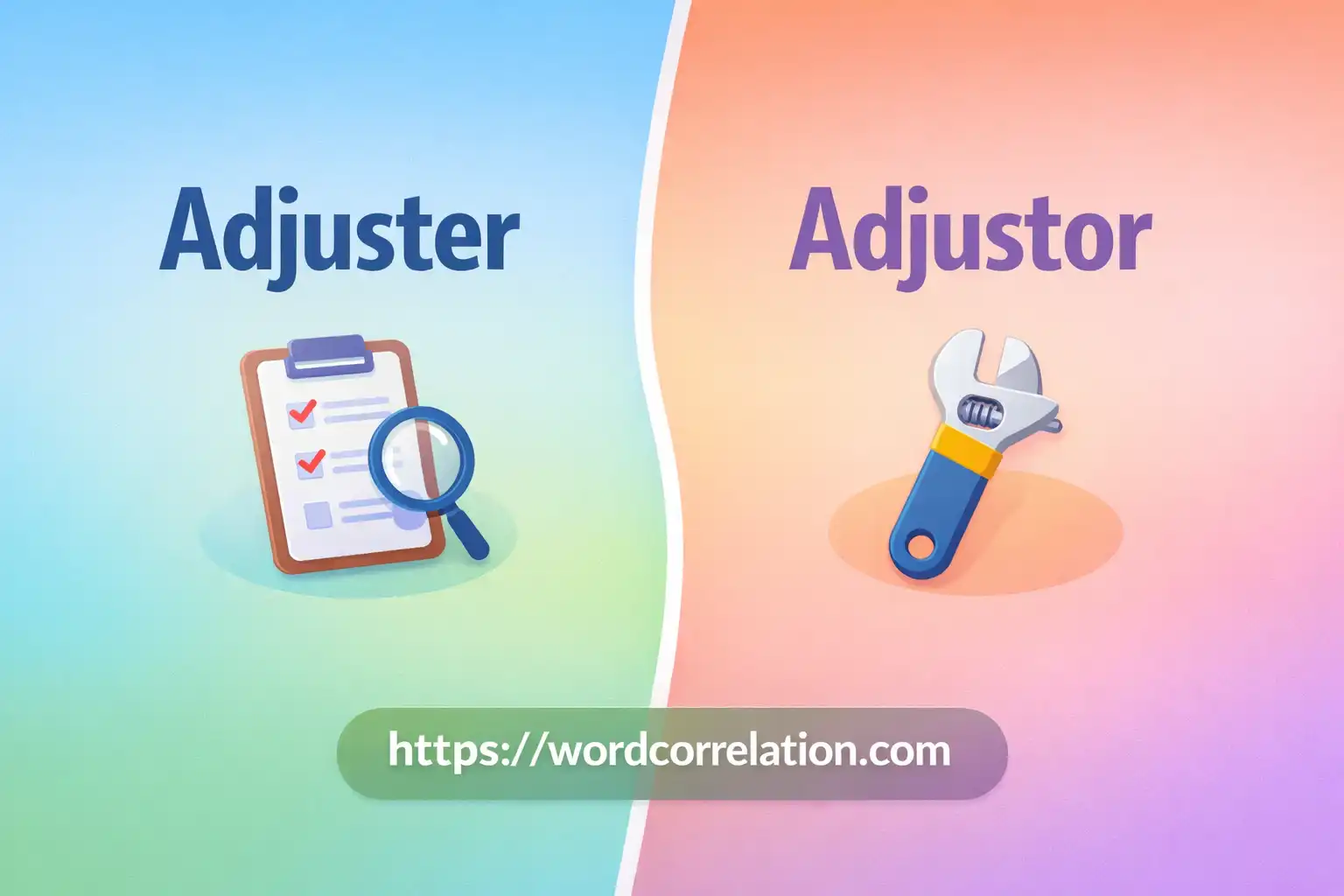
Many people stop and think when they see adjuster or adjustor. The words look almost the same. However, spelling one letter wrong can change trust. Therefore, students, writers, and professionals often search this topic. Moreover, job titles, legal papers, and insurance emails use this word daily. As a result, mistakes spread fast.
Confusion usually starts with spelling rules. English uses -er and -or endings in many nouns. Meanwhile, both endings sound the same. Because of that, writers guess. In contrast, guessing often leads to errors. Additionally, spellcheck tools sometimes allow both forms. That situation increases doubt.
This article solves that exact problem. It explains what adjuster and adjustor mean. It also shows which form people use today. Furthermore, it covers history, usage, and real examples. By the end, you will know which spelling fits your writing. Finally, you will learn one simple rule that removes confusion forever.
To compare accepted variants, visit the word comparison hub for examples.
Adjuster or Adjustor – Quick Answer
- Adjuster is the standard spelling today.
- Adjustor exists, but people rarely use it now.
Use adjuster in most cases.
For example: The insurance adjuster reviewed the claim.
The Origin of Adjuster or Adjustor
The word comes from the verb adjust. That verb entered English from French and Latin roots. Over time, English added noun endings to show a person who performs an action. Therefore, adjuster appeared with the -er ending.
However, English also borrowed the -or ending from Latin. Words like actor and editor followed that path. Because of this mix, adjustor also formed. For many years, both spellings lived side by side.
Confusion grew because both words meant the same thing. Moreover, pronunciation stayed identical. As a result, writers could not hear the difference. Over time, usage trends solved the issue. Modern English slowly chose adjuster as the preferred form.
This pair fits our word variants pillar where multiple forms are used.
British English vs American English Spelling
Spelling differences often confuse learners. However, this case stays simple.
American English strongly prefers adjuster. Insurance, law, and business writing use it daily.
British English also favors adjuster, especially in modern texts.
In contrast, adjustor appears rarely in both regions. Whereas older documents may show it, current style guides avoid it. Therefore, regional choice does not change the answer.
Small Comparison Table
| Aspect | Adjuster | Adjustor |
| Common today | Yes | No |
| US usage | Very high | Very low |
| UK usage | High | Very low |
| Meaning | Person who adjusts | Same meaning |
Which Spelling Should You Use?
The right choice depends on clarity and audience. Therefore, context matters.
For US audiences
Use adjuster every time. Legal and insurance writing expects it.
For UK or Commonwealth audiences
Choose adjuster as well. It matches modern usage.
For global or professional writing
Always select adjuster. It avoids confusion and looks correct worldwide.
Although adjustor is not wrong by rule, it feels outdated. As a result, readers may question credibility. Therefore, safe writing always uses adjuster.
Common Mistakes with Adjuster or Adjustor
Many errors follow clear patterns. However, awareness fixes them fast.
❌ The insurance adjustor called today.
✅ The insurance adjuster called today.
❌ She works as a claim adjustor.
✅ She works as a claim adjuster.
❌ The loss adjustor reviewed damages.
✅ The loss adjuster reviewed damages.
These mistakes happen because writers rely on sound, not usage. Therefore, visual memory matters. Another variant-style comparison is uncollectable or uncollectible.
Adjuster or Adjustor in Everyday Examples
Emails
The adjuster will contact you tomorrow.
Please wait for the adjuster’s report.
News
An insurance adjuster inspected the site.
The adjuster confirmed the loss amount.
Social Media
The adjuster finally responded today.
Waiting on the adjuster feels endless.
Formal or Professional Writing
The adjuster evaluated the claim carefully.
Certified adjusters follow strict rules.
Real examples show clear dominance. Therefore, practice reinforces the habit.
Adjuster or Adjustor – Google Trends & Usage Data
Search data shows strong interest in adjuster or adjustor. Students search it for assignments. ESL learners check it often. Professionals also confirm spelling before publishing.
By country, searches peak in the United States, Canada, the UK, and Australia. Moreover, insurance workers search it more than other groups. Writers and editors follow closely.
Trend data shows adjuster rising steadily. Meanwhile, adjustor stays flat or declines. Correct usage clearly wins. As a result, modern English favors one form strongly.
Comparison Table: Adjuster vs Adjustor
| Feature | Adjuster | Adjustor |
| Meaning | Person who adjusts claims or items | Same meaning |
| Part of speech | Noun | Noun |
| Context of use | Insurance, business, mechanics | Rare or outdated |
| Formal vs informal | Formal and standard | Feels old |
| Common mistakes | Misspelled as adjustor | Used instead of adjuster |
| Correct example | The adjuster approved payment. | Rarely recommended |
This table removes confusion instantly. Therefore, keep it in mind.
Semantic FAQs (People Also Ask)
Is adjuster the same as adjustor?
Yes in meaning. However, usage differs.
Which one is correct in formal writing?
Adjuster is correct today.
Can they be used interchangeably?
Technically yes. Practically no.
Why do people confuse them?
They sound identical.
Can grammar tools catch this mistake?
Most tools suggest adjuster.
Is there a British vs American difference?
No difference here.
Conclusion
Overall, adjuster or adjustor seems tricky at first. However, modern usage makes the choice easy. One spelling clearly dominates. Therefore, writers no longer need to guess. For a simpler variant example, see kabob or kebab.
In short, adjuster fits every common context. Insurance, law, business, and media all use it. Meanwhile, adjustor feels outdated and uncommon. Using it may raise doubts about accuracy.
Finally, remember one easy rule: If you mean a person who adjusts, write adjuster. This rule works every time. As a result, your writing stays clear, correct, and professional.

Charles Dickens is presented by our editorial team as a research-focused writer whose work centers on language clarity, meaning, and precise word usage. Drawing on a deep engagement with English semantics, Dickens approaches writing with close attention to how words function in context, how similar terms diverge in meaning, and how linguistic choices shape understanding.
His background reflects extensive experience in analytical reading, comparative language study, and careful textual interpretation. This perspective supports a methodical approach to word comparison, helping readers distinguish nuance rather than rely on oversimplified definitions. Accuracy, source awareness, and historical usage are core considerations in his work.
Through structured explanations and clear examples, Dickens contributes content that supports readers seeking reliable distinctions between words, phrases, and expressions. The emphasis remains on usefulness, transparency, and linguistic precision, ensuring that readers can apply what they learn with confidence. His writing is developed to inform rather than persuade, aligning with editorial standards that prioritize trust, factual consistency, and reader comprehension.