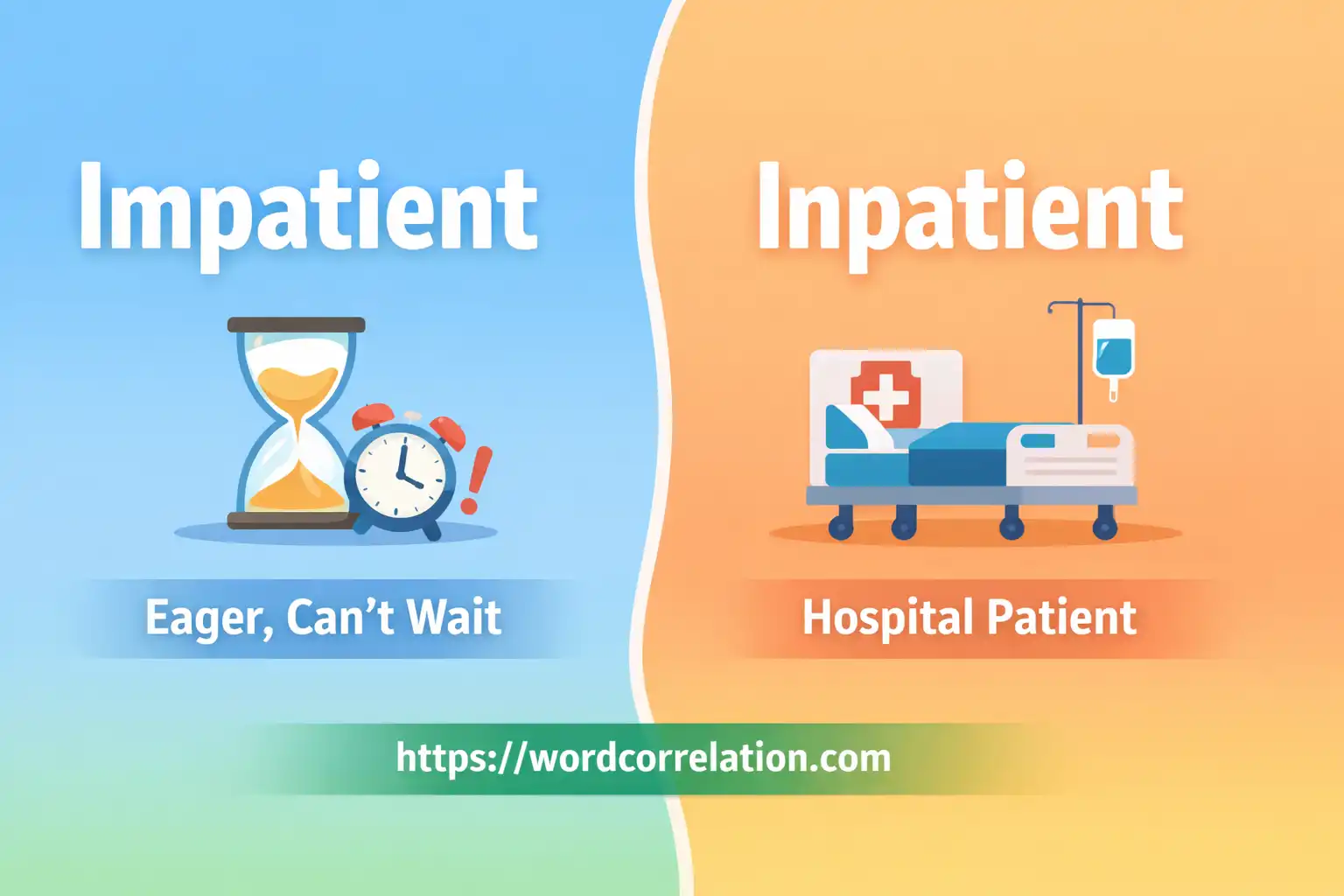
Many people search for impatient or inpatient because these two words look almost the same. However, their meanings are very different. As a result, writers often feel confused. Moreover, students, ESL learners, and even professionals make mistakes with them. One small letter changes everything. Therefore, the risk of error stays high.
In daily writing, this confusion appears in emails, hospital notes, essays, and social posts. For example, someone may write “an impatient was admitted to hospital,” which sounds wrong. Meanwhile, another person may say “I feel inpatient today,” which also fails. Consequently, the message becomes unclear.
In this guide, you will learn the clear difference between impatient and inpatient. Additionally, you will see real examples, common mistakes, and simple rules. Furthermore, you will understand where each word fits best. Overall, this article removes confusion and builds confidence. Finally, you will leave with one easy rule that always works.
Meaning differences are clarified in the word comparison hub.
Impatient or Inpatient – Quick Answer
- Impatient describes a feeling.
Example: “She feels impatient while waiting.” - Inpatient describes a hospital status.
Example: “He is an inpatient at the hospital.”
If it shows emotion, use impatient.
If it relates to hospital care, use inpatient.
The Origin of Impatient or Inpatient
Both words come from Latin. However, their paths split early. Impatient comes from impatiens, meaning “not able to endure.” Therefore, it connects to feelings. In contrast, inpatient combines in and patient. As a result, it refers to someone staying inside a hospital.
The confusion happens because both words share “patient.” Moreover, spelling looks similar. Additionally, pronunciation sounds close. Therefore, writers mix them up easily. However, their meanings never overlap. One talks about emotion. The other talks about medical care.
This pair fits under our meaning usage pillar.
British English vs American English Spelling
There is no spelling difference between British and American English for these words. However, usage context matters.
| Aspect | Impatient | Inpatient |
| Type | Adjective | Noun |
| Meaning | Feeling restless | Hospital patient |
| UK vs US | Same spelling | Same spelling |
In contrast to many word pairs, this confusion is not regional. Therefore, the rule stays the same worldwide.
Which Spelling Should You Use?
The choice depends on context.
For US writing, use inpatient only for hospital stays. Meanwhile, use impatient for emotions.
For UK or Commonwealth writing, the same rule applies. However, formal tone matters more in healthcare writing.
For global or professional writing, clarity matters most. Therefore, always ask one question first. Is this about a feeling or medical care? As a result, the correct word becomes obvious.
Common Mistakes with Impatient or Inpatient
Many mistakes follow the same pattern.
❌ The impatient was admitted overnight.
✅ The inpatient was admitted overnight.
Explanation: Hospital stay needs inpatient.
❌ I feel inpatient waiting for the bus.
✅ I feel impatient waiting for the bus.
Explanation: Feelings need impatient.
❌ She works with impatients in the ward.
✅ She works with inpatients in the ward.
Explanation: Patients in hospitals are inpatients.
These errors happen because writers focus on spelling, not meaning. Therefore, meaning should always come first.
Impatient or Inpatient in Everyday Examples
In emails, confusion appears often.
Example: “Sorry for being impatient.” This works.
However, “Sorry for being inpatient” sounds wrong.
In news writing, accuracy matters more.
Correct: “The hospital treated five inpatients today.”
On social media, casual tone increases mistakes.
Correct: “I get impatient in traffic.”
In formal or professional writing, errors reduce trust. Therefore, editors check these words carefully. As a result, correct usage improves credibility.
Impatient or Inpatient – Google Trends & Usage Data
Search interest shows clear patterns. Impatient appears more in daily searches. Meanwhile, inpatient appears more in medical contexts. By country, English-speaking nations show similar confusion. However, ESL learners search this pair more often.
By user type, students and writers lead searches. Additionally, healthcare professionals search inpatient more often. As a result, context shapes usage strongly. Correct usage appears less often than mistakes online. Therefore, clear guides like this solve real problems.
A related meaning mix-up is indecisive or undecisive.
Comparison Table: Impatient vs Inpatient
| Feature | Impatient | Inpatient |
| Meaning | Feeling restless | Hospital patient |
| Part of speech | Adjective | Noun |
| Context of use | Emotions, behavior | Medical care |
| Formal vs informal | Both | Mostly formal |
| Common mistakes | Used for hospitals | Used for emotions |
| Correct example | “He feels impatient.” | “She is an inpatient.” |
This table removes confusion instantly.
Semantic FAQs (People Also Ask)
Is impatient the same as inpatient?
No. One shows emotion. The other shows hospital status.
Which one is correct in formal writing?
Both work, depending on meaning.
Can they be used interchangeably?
Never. Their meanings differ completely.
Why do people confuse them?
Spelling and pronunciation look similar.
Can grammar tools catch this mistake?
Sometimes. However, meaning-based errors still slip through.
Is there a British vs American difference?
No. Both use the same spelling and meaning.
Conclusion
Overall, impatient or inpatient confusion comes from spelling, not meaning. However, meaning always decides the correct word. Impatient describes how someone feels. In contrast, inpatient describes where a patient stays. Therefore, context matters more than letters. A related meaning mix-up is indecisive or undecisive.
In short, never link impatient to hospitals. Meanwhile, never use inpatient for emotions. As a result, your writing stays clear. Moreover, your credibility improves.
Finally, remember this easy rule: Feelings = impatient. Hospitals = inpatient.
If you follow this rule, mistakes disappear.

Jonathan Swift is a writer whose work reflects sustained attention to language precision, meaning, and the practical effects of word choice. Trained in classical studies and theology, he develops a disciplined approach to writing that combines close textual analysis with a strong concern for clarity and accuracy. His essays, pamphlets, and satirical works show a consistent method: examining how words are used, misused, and reshaped to influence public understanding.
Swift’s writing demonstrates an early form of semantic analysis. He compares terms, exposes false equivalence, and highlights how subtle differences in wording alter meaning, intent, and interpretation. This analytical focus allows readers to see language not as decoration, but as a tool that shapes thought, policy, and belief.
By breaking down complex expressions into their functional parts, Swift helps readers distinguish between surface language and underlying meaning. His work remains valuable to audiences interested in word comparison, rhetoric, and the responsible use of language. Across genres, his reputation rests on careful reasoning, linguistic discipline, and a consistent commitment to helping readers read more critically and precisely.