Many people pause when they write junky or junkie. The words look close. The meanings feel close. However, the use is not the same. As a result, writers often guess. Meanwhile, readers feel confused. This problem shows up in emails, posts, essays, and news. Therefore, clarity matters.
This article fixes that problem. First, it explains why the words confuse people. Next, it shows how each word works in real life. Moreover, it explains tone, context, and risk. In contrast, it also shows what not to do. Additionally, you will learn which word fits formal writing. Finally, you will get one simple rule to remember.
By the end, you will know when to use junky and when to use junkie. As a result, your writing will sound clear, kind, and correct. Overall, this guide saves time and avoids mistakes.
Variant word forms are explained in the word comparison hub.
Junky or Junkie – Quick Answer
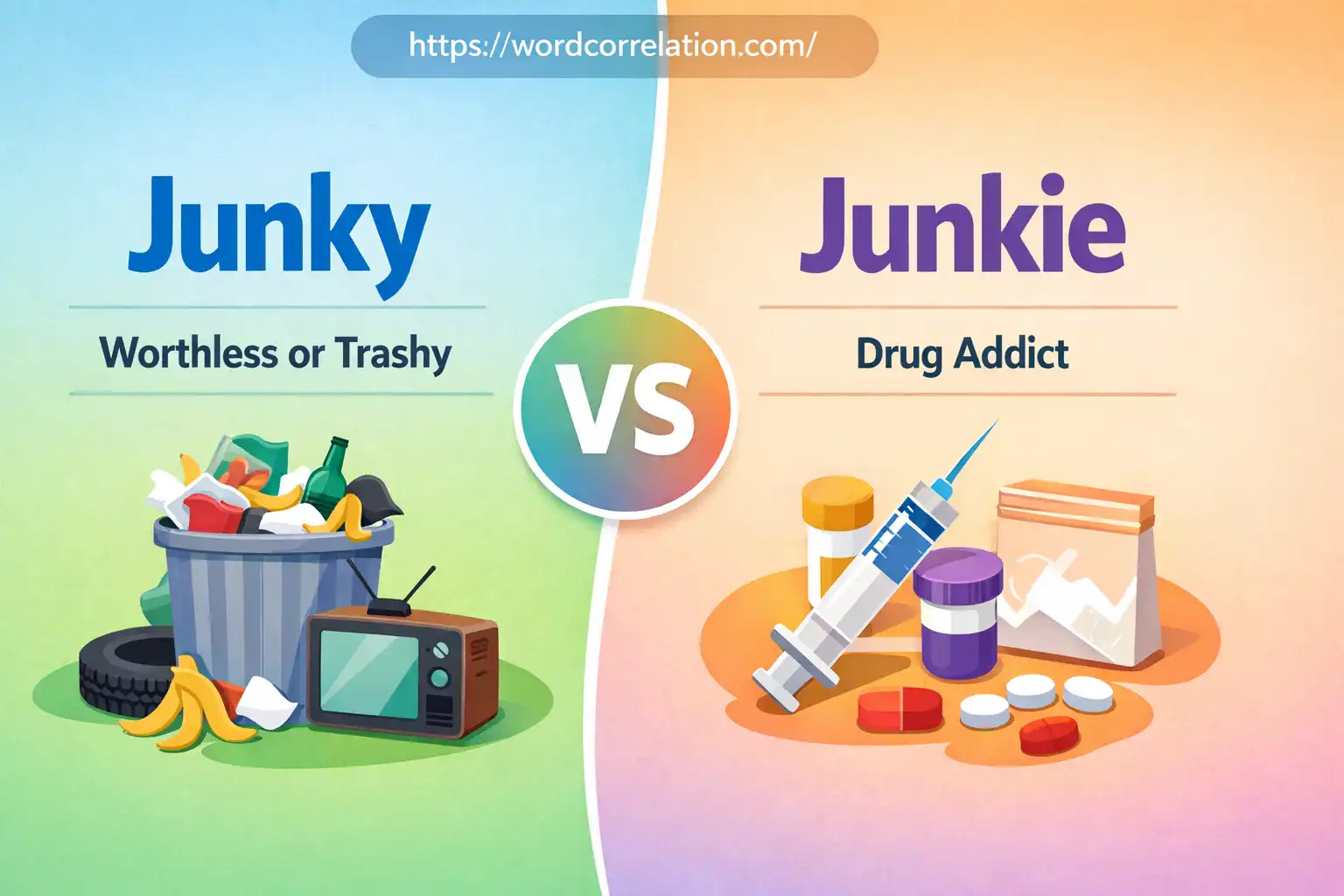
- Junky is an adjective. It describes poor quality or trash-like things.
Example: junky website. - Junkie is a noun. It names a person with an addiction or obsession.
Example: news junkie.
Use junky for things. Use junkie for people or habits.
The Origin of Junky or Junkie
Both words come from junk, which means trash or useless items. Over time, English added endings to change meaning. Therefore, junky grew to describe things that feel cheap or broken. Meanwhile, junkie grew to name people tied to drugs, then habits.
The confusion started because both words share the same root. Moreover, people hear them more than they see them written. As a result, spelling slips happen. In contrast, careful writing separates them by role and tone.
This fits our word variants pillar for informal usage.
British English vs American English Spelling
There is no spelling change between regions. However, usage and sensitivity can differ.
| Point | Junky | Junkie |
| Spelling | Same in US/UK | Same in US/UK |
| Role | Adjective | Noun |
| Tone | Casual, critical | Sensitive, personal |
| Risk | Low | Higher |
In contrast, British and American writers agree on form. However, context matters everywhere.
Which Spelling Should You Use?
Choose based on audience and purpose.
- US audiences: Use junky for objects. Use junkie carefully for people.
- UK / Commonwealth: Same rule applies. However, tone matters more in formal texts.
- Global or professional writing: Prefer neutral phrases. For example, use addicted to instead of junkie.
Therefore, think about respect first. Then choose the word.
Common Mistakes with Junky or Junkie
Writers make the same errors again and again. Avoid these:
- ❌ This app is junkie. → ✅ This app is junky.
Reason: the app is a thing. - ❌ He is junky for news. → ✅ He is a news junkie.
Reason: the person is the subject. - ❌ Formal report uses junkie. → ✅ Formal report avoids labels.
Reason: tone matters.
Overall, role decides the word.
Junky or Junkie in Everyday Examples
Emails
- The file looks junky. Please resend.
- She is a data junkie. She loves charts.
News
- The site faced complaints about junky ads.
- The host calls himself a politics junkie.
Social media
- Stop sharing junky links.
- I am a fitness junkie.
Formal or professional writing
- Avoid “junkie.” Use neutral language.
- Use “low quality” instead of “junky.”
Therefore, setting changes the choice.
Junky or Junkie – Google Trends & Usage Data
Search interest shows clear patterns. Students and ESL learners search both words together. Meanwhile, writers search for tone and safety. Professionals search for alternatives.
- By country: High interest in the US, UK, India, and Pakistan.
- By user type: Students seek rules. Writers seek tone. Professionals seek safe wording.
- Correct usage: Clear split by role.
- Common mistakes: Mixing roles and ignoring tone.
As a result, guidance helps many users. Another informal variant is mamma or momma.
Comparison Table: Junky vs Junkie
| Feature | Junky | Junkie |
| Meaning | Low quality | Person with addiction or obsession |
| Part of speech | Adjective | Noun |
| Context of use | Objects, content | People, habits |
| Formal vs informal | Informal | Informal, sensitive |
| Common mistakes | Used for people | Used for objects |
| Correct example | junky design | news junkie |
This table removes confusion fast.
Semantic FAQs (People Also Ask)
Is junky the same as junkie?
No. Junky describes things. Junkie names people.
Which one is correct in formal writing?
Neither fits well. Use neutral terms instead.
Can they be used interchangeably?
No. Roles differ, so meaning breaks.
Why do people confuse them?
They share the same root and sound similar.
Can grammar tools catch this mistake?
Sometimes. However, context checks work better.
Is there a British vs American difference?
No spelling difference. Tone rules stay the same.
Is junkie offensive?
It can be. Use with care or avoid it.
Conclusion
Overall, junky or junkie confusion comes from sound, not sense. However, the fix is simple. First, check the role. If you describe a thing, use junky. If you name a person or habit, use junkie. Meanwhile, think about tone. In formal writing, choose neutral words. Therefore, you avoid harm and sound professional.
In short, do not guess. Match the word to the job. Finally, remember this one rule: things are junky; people are junkies. Follow it, and your writing stays clear every time.
A similar spelling variant is lovey or lovie.

- S. Lewis was a scholar, literary critic, and researcher whose work was grounded in precise language use and careful semantic distinction. Trained as a classicist and medieval literature academic, he spent decades studying how words shape thought, belief, and interpretation across historical and cultural contexts. His academic career required rigorous attention to definitions, etymology, and the shifting meanings of terms over time.
Lewis’s writing demonstrates a consistent concern for clarity, accuracy, and the responsible use of language. He frequently examined how closely related words can carry different intellectual or moral implications, and he was known for unpacking subtle distinctions that readers often overlook. This approach makes his work especially valuable for audiences seeking a deeper understanding of meaning rather than surface-level explanations.
By combining scholarly discipline with accessible prose, Lewis helps readers navigate complex ideas through careful word choice and semantic precision. His work reflects a commitment to intellectual honesty, reader trust, and research-based explanation.