Many people search for wore or worn because these two words look similar and sound related. However, they do not work the same way. Because of this, learners often feel confused. They write sentences that feel wrong, yet they cannot see why. As a result, mistakes appear in exams, emails, and even professional writing.
English verb forms cause this problem often. In contrast, some languages use only one past form. Therefore, learners mix wore and worn without knowing the rule. Moreover, grammar tools sometimes miss the context. Because of that, writers lose confidence.
This article solves that problem clearly. First, you will learn the simple rule. Then, you will see real examples. Additionally, you will understand why the confusion exists. Finally, you will know exactly which word to use every time. The goal stays simple. You will stop guessing. You will start writing with confidence. Meaning differences like this are clarified in the word comparison hub.
Wore or Worn – Quick Answer
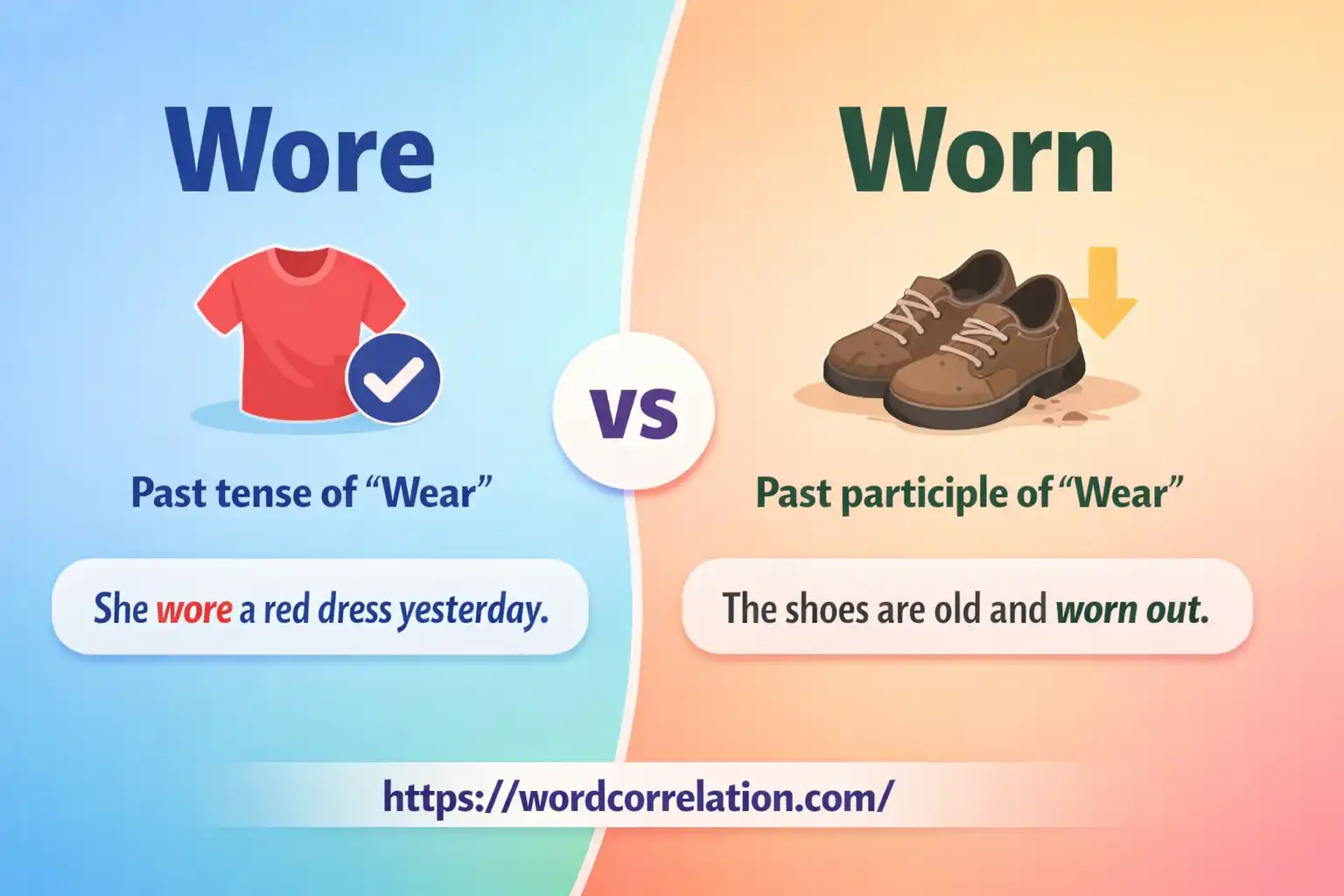
Wore is the simple past tense.
Worn is the past participle.
- Use wore alone with a subject.
I wore a jacket yesterday. - Use worn with has, have, or had.
I have worn this jacket before.
The Origin of Wore or Worn
The verb wear comes from Old English werian. It meant “to carry” or “to clothe.” Over time, English created different verb forms. Therefore, wore became the past tense. Meanwhile, worn became the past participle.
This history explains the confusion. Both words relate to the past. However, they serve different grammar roles. In contrast, modern English no longer explains this clearly to learners. As a result, mistakes continue.
British English vs American English Spelling
British English and American English follow the same rule for wore or worn. There is no spelling difference. However, usage frequency changes slightly.
| Aspect | British English | American English |
| Rule | Same | Same |
| Formal use | Common | Common |
| Spoken use | Very common | Very common |
In contrast to words like colour or favorite, wore and worn stay identical everywhere.
Which Spelling Should You Use?
The answer depends on sentence structure, not location.
For US writing, use wore for a finished past action. Use worn with helping verbs.
For UK or Commonwealth writing, the rule stays the same. Grammar does not change.
For global or professional writing, follow standard verb tense rules. Editors expect accuracy. Therefore, choose based on grammar, not style. This is a common example in our word confusion pillar.
Common Mistakes with Wore or Worn
Many learners repeat the same errors. However, each mistake has a clear fix.
❌ I have wore this shirt before.
✅ I have worn this shirt before.
Explanation: “Have” needs a past participle.
❌ She worn a red dress yesterday.
✅ She wore a red dress yesterday.
Explanation: Yesterday signals simple past.
❌ He was wore out shoes.
✅ He was wearing worn-out shoes.
Explanation: Wrong verb form and structure.
These errors happen because learners skip the helper verb rule. Therefore, memory alone does not help. Structure matters more.
Wore or Worn in Everyday Examples
In daily life, both words appear often. Context decides everything.
In emails, writers say:
I wore the company uniform last week.
However, they also write:
I have worn this uniform many times.
In news writing, reporters say:
The actor wore a black suit.
Meanwhile, features add:
The suit had been worn before.
On social media, casual posts appear.
I wore this outfit yesterday.
Yet influencers write:
This is my most worn jacket.
In professional writing, accuracy matters more. Therefore, editors always check helper verbs.
Wore or Worn – Google Trends & Usage Data
Search data shows steady interest in wore or worn. Students search most. ESL learners follow closely. Writers also check usage before publishing.
Countries with high searches include:
- United States
- United Kingdom
- India
- Pakistan
Students often confuse tense rules. Writers worry about tone. Professionals want accuracy. As a result, this keyword keeps strong demand. Another tense-based confusion is text or texted.
Wore or Worn Comparison Table
Here is a clear table to remove confusion instantly:
| Feature | Wore | Worn |
| Meaning | Past action | Past state |
| Part of speech | Simple past verb | Past participle |
| Context of use | Action finished | Action linked to present |
| Formal vs informal | Both | Both |
| Common mistakes | Used with “have” | Used alone |
| Correct example | I wore it yesterday. | I have worn it before. |
Semantic FAQs
Is wore the same as worn?
No. One is past tense. The other is a participle.
Which one is correct in formal writing?
Both are correct when used properly.
Can they be used interchangeably?
No. Grammar structure decides usage.
Why do people confuse them?
Both relate to past time. Structure feels hidden.
Can grammar tools catch this mistake?
Sometimes. However, manual checks work better.
Is there a British vs American difference?
No. The rule stays the same.
Conclusion
Overall, wore or worn becomes easy once you follow one rule. Wore works alone in the past. Worn needs a helper verb. Because of this, sentence structure matters more than memory.
Many learners guess. However, guessing causes mistakes. Instead, check for has, have, or had. If one appears, choose worn. If none appears, choose wore. That simple check solves most problems. A sound-based mix-up also occurs in hale or hail.
In short, do not focus on time words alone. Focus on verb helpers. Finally, remember this rule: no helper, use wore; helper present, use worn. That one habit will improve your English fast.

Charles Dickens is presented by our editorial team as a research-focused writer whose work centers on language clarity, meaning, and precise word usage. Drawing on a deep engagement with English semantics, Dickens approaches writing with close attention to how words function in context, how similar terms diverge in meaning, and how linguistic choices shape understanding.
His background reflects extensive experience in analytical reading, comparative language study, and careful textual interpretation. This perspective supports a methodical approach to word comparison, helping readers distinguish nuance rather than rely on oversimplified definitions. Accuracy, source awareness, and historical usage are core considerations in his work.
Through structured explanations and clear examples, Dickens contributes content that supports readers seeking reliable distinctions between words, phrases, and expressions. The emphasis remains on usefulness, transparency, and linguistic precision, ensuring that readers can apply what they learn with confidence. His writing is developed to inform rather than persuade, aligning with editorial standards that prioritize trust, factual consistency, and reader comprehension.