Many people pause when they write meters or metres. The words look almost the same. However, the spelling changes by country. As a result, students, writers, and ESL learners feel unsure. Moreover, mistakes appear in emails, exams, and blog posts.
Therefore, confusion grows fast. This article solves that problem clearly. First, it explains why the spelling feels confusing. Next, it shows the exact difference between the two forms. Additionally, it guides you on which spelling to choose for your audience.
Meanwhile, you will see real examples you can copy. Finally, you will learn one easy rule that always works.
Measurement spellings are compared in the word comparison hub.
Meters or Metres – Quick Answer
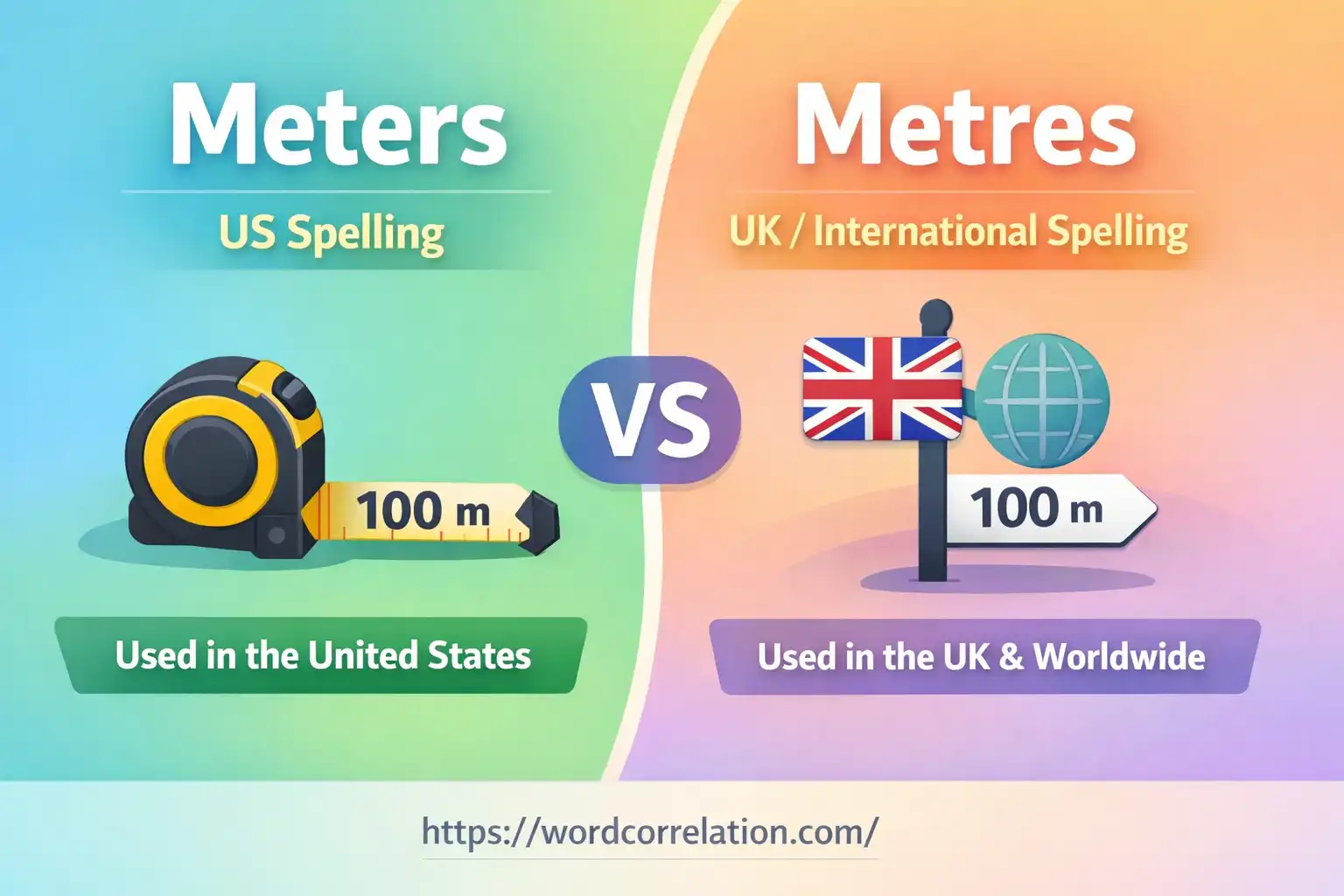
- Meters = American English spelling
- Metres = British English spelling
- Both mean the same unit of length
For example:
- The road is 100 meters long. (US)
- The road is 100 metres long. (UK)
The Origin of Meters or Metres
The word comes from the Greek word metron. It means “measure.” Later, French used mètre. After that, English adopted the term.
However, English split into styles over time. American English simplified many spellings. British English kept older forms. Therefore, two spellings survived. As a result, learners now see both and feel unsure.
This pair clearly shows a UK vs US difference.
British English vs American English Spelling
The difference depends on location, not meaning. Both spellings describe the same length unit in the metric system.
Key contrast
- American English prefers meters
- British English prefers metres
Examples
- The room is five meters wide. (US)
- The room is five metres wide. (UK)
Quick comparison
| Aspect | Meters | Metres |
| English type | American | British |
| Meaning | Unit of length | Unit of length |
| Used in | USA | UK, Commonwealth |
However, the meaning never changes. In contrast, only spelling changes.
Which Spelling Should You Use?
The right choice depends on your audience.
For US readers
Use meters. Schools, exams, and news follow this form.
For UK or Commonwealth readers
Use metres. This includes the UK, Australia, and Pakistan.
For global or professional writing
Check the style guide. Meanwhile, stay consistent throughout the text. As a result, your writing looks professional.
Common Mistakes with Meters or Metres
People often mix the spellings in one document. That creates confusion.
❌ The pool is 25 metres long in the US.
✅ The pool is 25 meters long in the US.
❌ The UK race track is 400 meters.
✅ The UK race track is 400 metres.
Additionally, some writers think one spelling is “more correct.” However, both are correct in the right context. Measurement terminology also differs in celsius or centigrade.
Meters or Metres in Everyday Examples
Emails
- Please walk 200 meters to the gate.
- Please walk 200 metres to the gate.
News
- The storm flooded roads within 50 meters.
- The storm flooded roads within 50 metres.
Social media
- I ran 5,000 meters today!
- I ran 5,000 metres today!
Professional writing
- Maintain a distance of two meters.
- Maintain a distance of two metres.
Therefore, context always guides the choice.
Meters or Metres – Google Trends & Usage Data
Search behavior shows clear patterns.
- Meters dominates searches in the United States.
- Metres leads in the UK and Commonwealth countries.
Students search this term often. Writers and ESL learners also search it frequently. Moreover, professionals check it for accuracy. Correct usage rises when audience awareness improves. Meanwhile, mistakes happen when people mix styles.
Meters or Metres Comparison Table
| Feature | Meters | Metres |
| Meaning | Unit of length | Unit of length |
| Part of speech | Noun | Noun |
| Context of use | American English | British English |
| Formal or informal | Both | Both |
| Common mistake | Used in UK text | Used in US text |
| Correct example | 10 meters tall | 10 metres tall |
This table removes confusion instantly.
Semantic FAQs
Is meters the same as metres?
Yes. Both mean the same unit of length.
Which one is correct in formal writing?
Both are correct. Choose by audience.
Can they be used interchangeably?
Not in the same document. Stay consistent.
Why do people confuse them?
The meaning is the same, but spelling changes.
Can grammar tools catch this mistake?
Sometimes. However, tools follow language settings.
Is there a British vs American difference?
Yes. That difference explains everything.
Conclusion
Meters or metres confuse many people at first. However, the solution stays simple. The meaning never changes. Only the spelling changes by region. Therefore, always think about your audience before you write. Use meters for American readers.
Use metres for British or Commonwealth readers. Moreover, stay consistent in one document. As a result, your writing looks clear and professional. Overall, remember one easy rule. American audience equals meters. British audience equals metres. Finally, follow that rule and avoid mixing styles.
Another regional spelling difference is faeces or feces.

Charles Dickens is presented by our editorial team as a research-focused writer whose work centers on language clarity, meaning, and precise word usage. Drawing on a deep engagement with English semantics, Dickens approaches writing with close attention to how words function in context, how similar terms diverge in meaning, and how linguistic choices shape understanding.
His background reflects extensive experience in analytical reading, comparative language study, and careful textual interpretation. This perspective supports a methodical approach to word comparison, helping readers distinguish nuance rather than rely on oversimplified definitions. Accuracy, source awareness, and historical usage are core considerations in his work.
Through structured explanations and clear examples, Dickens contributes content that supports readers seeking reliable distinctions between words, phrases, and expressions. The emphasis remains on usefulness, transparency, and linguistic precision, ensuring that readers can apply what they learn with confidence. His writing is developed to inform rather than persuade, aligning with editorial standards that prioritize trust, factual consistency, and reader comprehension.