People often pause when they write about moving from one place to another. They ask a simple but confusing question: should I write immigrated or migrated? The confusion happens because both words talk about movement. However, they do not mean the same thing. As a result, many students, writers, and ESL learners mix them up. This mistake appears in emails, essays, news posts, and even official documents.
However, the difference matters. One word focuses on entering a country. The other word focuses on moving in general. Therefore, choosing the wrong word can change the meaning of a sentence. Moreover, it can make your writing look unclear or unprofessional.
In this guide, you will learn the clear difference between immigrated or migrated. You will also see real examples, common mistakes, and an easy rule to remember. Overall, this article solves one problem: helping you pick the right word every time with confidence.
To understand subtle meaning shifts, use the word comparison hub.
Immigrated or Migrated – Quick Answer
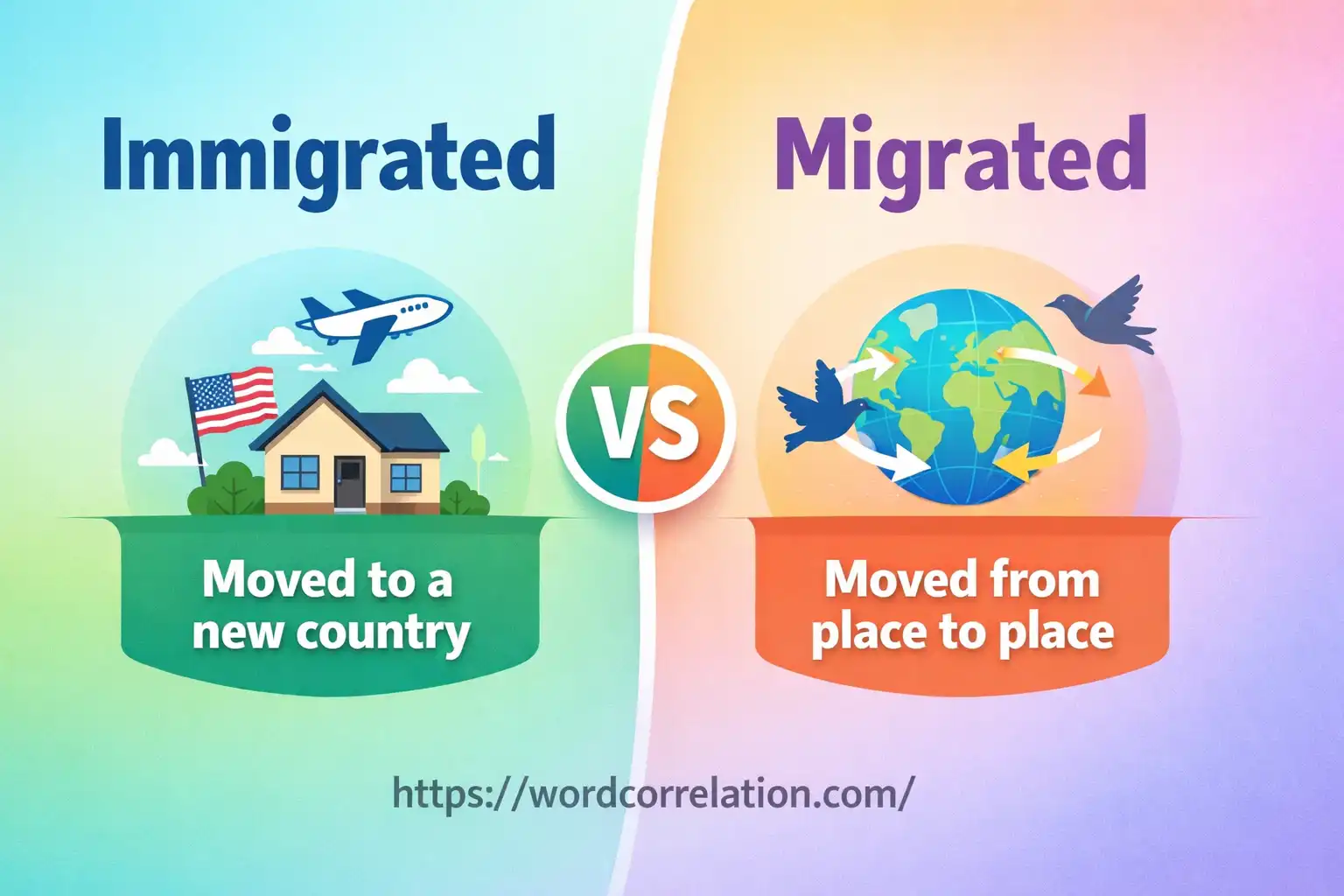
- Immigrated means moving into a new country to live there.
- Migrated means moving from one place to another, often for work, climate, or survival.
Example:
- She immigrated to Canada.
- Birds migrated south for winter.
The Origin of Immigrated or Migrated
Both words come from Latin. However, they grew in different directions over time. Immigrate comes from immigrare, which means “to move into.” Therefore, the word always points inside a country. Meanwhile, migrate comes from migrare, which means “to move.” As a result, it focuses on movement without borders.
The confusion happens because both words describe travel. Moreover, both appear in news stories about people moving. However, their purpose is not the same. One is legal and national. The other is general and broad. Therefore, understanding the origin makes the meaning clear.
This belongs under our word confusion pillar.
British English vs American English Spelling
There is no spelling difference between British and American English for immigrated or migrated. Both regions use the same spelling and meaning.
However, usage style can differ slightly.
| Aspect | British English | American English |
| Spelling | immigrated / migrated | immigrated / migrated |
| Meaning | Same | Same |
| Usage tone | Slightly formal | Neutral |
In contrast to many other English words, spelling rules stay consistent here. Therefore, you do not need to change spelling for location. You only need to choose the correct word.
Which Spelling Should You Use?
The choice depends on context, not country. Therefore, think about your audience and purpose.
- US writing: Use immigrated for legal or permanent moves. Use migrated for general movement.
- UK or Commonwealth: Follow the same rule. No change is needed.
- Global or professional writing: Be precise. Immigration relates to countries. Migration relates to movement.
Overall, clarity matters more than region. As a result, choosing the right word improves trust.
Common Mistakes with Immigrated or Migrated
Many errors repeat again and again. However, they are easy to fix.
- ❌ He migrated to the USA in 2015.
✅ He immigrated to the USA in 2015. - ❌ Birds immigrate during winter.
✅ Birds migrate during winter. - ❌ My family migrated from India and became citizens.
✅ My family immigrated from India and became citizens.
The main mistake happens when writers forget borders. Immigration always crosses a country line. Migration may not.
Immigrated or Migrated in Everyday Examples
You see these words daily. However, context changes meaning.
Emails:
- She immigrated last year for work.
News:
- Thousands of workers migrated to cities for jobs.
Social media:
- My grandparents immigrated decades ago.
Professional writing:
- The report studies how labor migrated between regions.
Therefore, noticing context helps you choose fast.
Immigrated or Migrated – Google Trends & Usage Data
Search trends show strong confusion between immigrated or migrated. Students and ESL learners search this topic the most. Meanwhile, writers and professionals search it for accuracy.
- High usage countries: USA, UK, Canada, Australia
- Top users: Students, bloggers, journalists
- Main issue: Using migrated instead of immigrated for countries
As a result, articles that explain the difference clearly perform well in search results. Meaning-based confusion also occurs in alterior or ulterior.
Immigrated or Migrated – Clear Comparison Table
| Feature | Immigrated | Migrated |
| Meaning | Move into a country | Move from place to place |
| Part of speech | Verb | Verb |
| Context of use | Legal, national | General, natural |
| Formal vs informal | More formal | Neutral |
| Common mistakes | Used for animals | Used for countries |
| Correct example | She immigrated to Canada | Birds migrated south |
This table removes confusion at a glance.
Semantic FAQs (People Also Ask)
Is immigrated the same as migrated?
No. Immigration is about entering a country. Migration is about movement.
Which one is correct in formal writing?
Use immigrated for legal or national topics.
Can they be used interchangeably?
No. Each word has a fixed meaning.
Why do people confuse them?
Both involve movement, which causes overlap.
Can grammar tools catch this mistake?
Sometimes. However, context matters more.
Is there a British vs American difference?
No. Both use the same spelling and meaning.
Conclusion
Overall, the difference between immigrated or migrated is simple once you focus on direction. Immigration always means moving into a country. Migration means moving from one place to another. However, many writers forget this rule and choose the wrong word. As a result, their message becomes unclear. Another commonly misused pair is despite or inspite.
In short, think about borders. If a country border is crossed to live there, use immigrated. If movement happens for work, weather, or survival, use migrated. Finally, remember one easy rule: countries equal immigration; movement equals migration. This rule will keep your writing clear every time.

H.G. Wells was a trained scholar and professional writer whose work reflects a rigorous approach to language, meaning, and precision. Educated in science and deeply engaged with journalism, essays, and social commentary, Wells developed a disciplined research habit that shaped both his nonfiction and analytical writing. His background in factual inquiry informed a careful use of words, where definitions, nuance, and context mattered as much as ideas themselves.
Across essays, criticism, and explanatory prose, Wells demonstrated a sustained interest in how language frames understanding. He often clarified subtle differences between related terms, helping readers grasp distinctions that affect interpretation and argument. This attention to semantics and accuracy supports readers who value clear meaning over rhetoric.
Wells’s writing serves audiences seeking reliable explanations and thoughtful comparisons rather than opinionated language. His work reflects an editorial standard built on evidence, clarity, and reader trust, offering lasting value to those who want to understand how precise word choices shape knowledge and communication.