Many people search for renumeration or remuneration because the words look almost the same. However, the meaning is not the same. As a result, writers, students, and professionals often feel confused. Moreover, spellcheck tools sometimes fail to explain the real issue. Therefore, the mistake keeps repeating in emails, reports, and contracts.
In daily writing, people usually want to talk about salary, pay, or compensation. However, they often choose the wrong spelling. In contrast, the correct word appears less familiar to new learners. Meanwhile, the incorrect form looks logical, so the brain accepts it quickly. As a result, this error spreads across blogs, CVs, and even official documents.
This article solves that problem clearly. First, it explains what each word means. Next, it shows why the confusion happens. Then, it gives simple rules you can remember easily. Finally, it shows real examples you can copy. Overall, you will learn how to use the correct word with confidence, even in formal writing.
Usage differences like this are explained in the word comparison hub.
Renumeration or Remuneration – Quick Answer
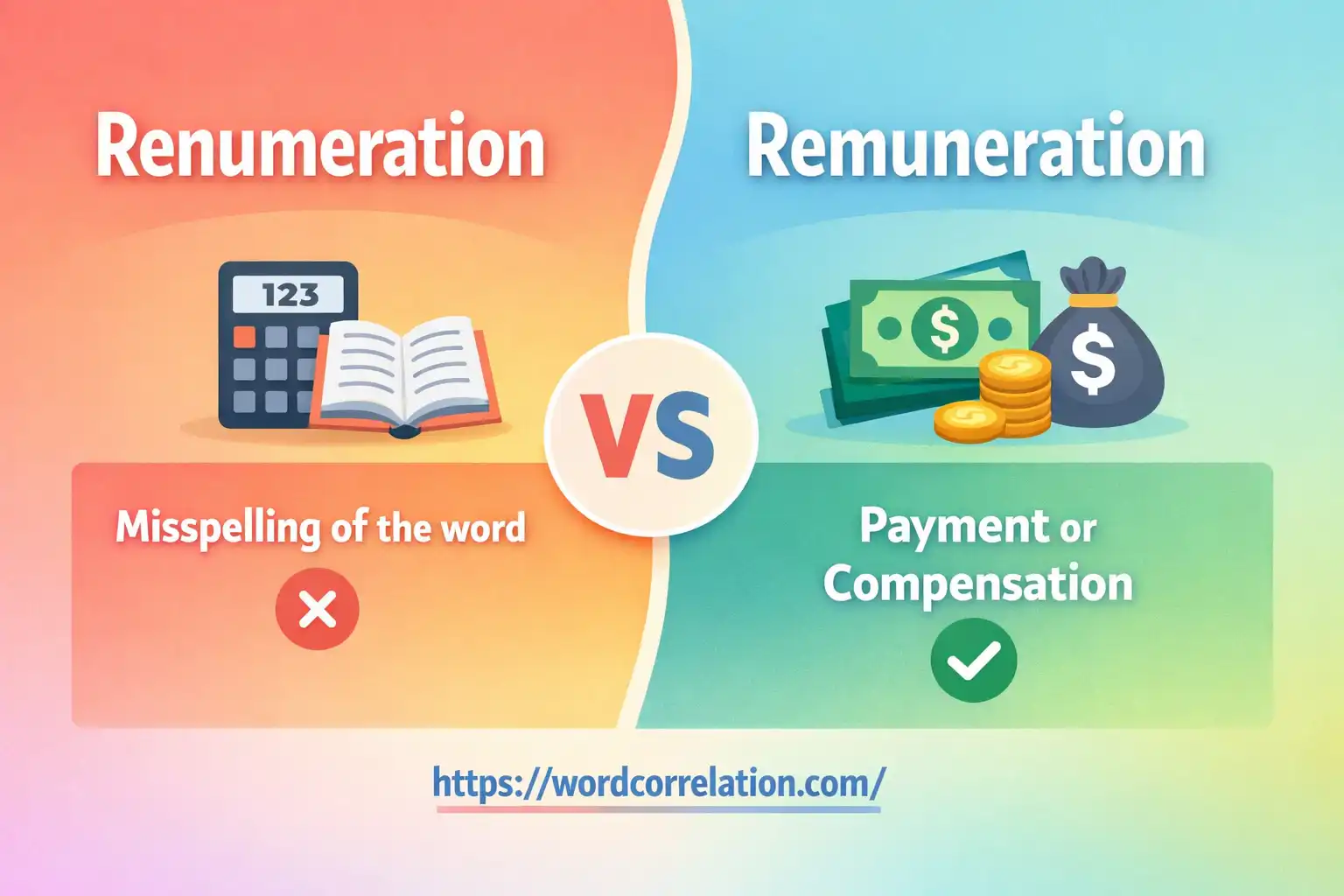
Remuneration is the correct word.
It means payment for work or services.
- ✅ Correct: She received fair remuneration for her job.
- ❌ Incorrect: She received fair renumeration for her job.
Renumeration is almost always a spelling mistake.
The Origin of Renumeration or Remuneration
The word remuneration comes from Latin. It comes from remunerari, which means to reward. Therefore, the meaning has always linked to payment or reward. Over time, English kept this meaning without change.
In contrast, renumeration comes from confusion. The prefix re- and the word number mislead people. As a result, many assume it means “pay again” or “count again.” However, English does not use renumeration for payment.
The confusion happens because both words look correct. Moreover, both follow English spelling patterns. Therefore, learners trust their eyes instead of checking meaning. As a result, the wrong form spreads quickly.
This pair belongs under our meaning usage pillar.
British English vs American English Spelling
Both British English and American English use remuneration. There is no spelling difference here. However, confusion still exists.
| Aspect | British English | American English |
| Correct spelling | Remuneration | Remuneration |
| Incorrect form | Renumeration | Renumeration |
| Usage | Formal and legal | Formal and legal |
In contrast to words like colour and color, this word stays the same. Therefore, region does not change the spelling.
Which Spelling Should You Use?
You should always use remuneration when you mean payment.
For US writers, this spelling appears in contracts, HR policies, and tax documents.
For UK and Commonwealth writers, the same rule applies in academic and legal writing.
For global or professional writing, remuneration remains the safest choice.
Meanwhile, you should avoid renumeration unless you truly mean counting again. However, that use is extremely rare. Therefore, most writers never need it.
Common Mistakes with Renumeration or Remuneration
People make the same mistakes again and again. However, each error is easy to fix.
- ❌ The company discussed employee renumeration.
✅ The company discussed employee remuneration. - ❌ His renumeration increased last year.
✅ His remuneration increased last year. - ❌ The contract explains renumeration terms.
✅ The contract explains remuneration terms.
The mistake happens because “numer” looks like number. However, payment has nothing to do with counting. Therefore, always choose remuneration.
Renumeration or Remuneration in Everyday Examples
You can see the correct word in many real situations.
Emails
We reviewed your role and adjusted your remuneration.
News
The board approved higher executive remuneration.
Social media
Fair remuneration matters for every worker.
Formal writing
The policy defines employee remuneration clearly.
In contrast, professional editors will flag renumeration as an error. Therefore, correct usage builds trust.
Renumeration or Remuneration – Google Trends & Usage Data
Search trends show strong interest in this topic. Moreover, confusion drives most searches.
- Countries: High searches appear in the UK, US, India, and Pakistan.
- User types: Students, ESL learners, HR staff, and content writers search most.
- Intent: Users want spelling confirmation and meaning clarity.
- Mistakes: Most searches come from incorrect use of renumeration.
As a result, learning this rule improves writing accuracy instantly. A related form-choice issue appears in proof or prove.
Comparison Table: Renumeration vs Remuneration
| Feature | Renumeration | Remuneration |
| Meaning | Recounting numbers | Payment for work |
| Part of speech | Noun (rare) | Noun |
| Context of use | Mathematical or theoretical | Salary, wages, compensation |
| Formal usage | Almost never | Very common |
| Common mistake | Used instead of remuneration | Rarely misused |
| Correct example | Renumeration of data | Fair remuneration policy |
This table removes confusion at a glance.
Semantic FAQs (People Also Ask)
Is renumeration the same as remuneration?
No. Remuneration means payment. Renumeration means recounting.
Which one is correct in formal writing?
Remuneration is always correct for salary or pay.
Can they be used interchangeably?
No. The meanings differ completely.
Why do people confuse them?
They look similar and sound alike.
Can grammar tools catch this mistake?
Some tools miss it. Manual checking helps.
Is there a British vs American difference?
No. Both use remuneration.
Conclusion
Overall, the confusion between renumeration or remuneration comes from spelling, not meaning. However, the solution stays simple. You should use remuneration whenever you talk about pay, salary, or compensation. In contrast, renumeration rarely applies in daily English. Another similar usage distinction is relieve or relief.
Moreover, professional writing demands accuracy. Therefore, using the correct word improves clarity and trust. Additionally, readers expect correct language in contracts, emails, and reports. As a result, one small spelling choice can affect credibility.
In short, remember one easy rule. If you mean money for work, always choose remuneration. Finally, ignore the extra “n” completely. That single habit will remove this mistake forever.

J.K. Rowling is a British author whose career centers on long-form narrative writing, editorial discipline, and sustained engagement with language at scale. Her professional background reflects years of structured research, drafting, and revision across fiction and nonfiction formats, with close attention to word choice, internal consistency, and reader interpretation.
Although best known for storytelling, Rowling’s published work shows a methodical approach to semantics—how individual words carry tone, implication, and contextual meaning. This sensitivity to language aligns naturally with research-based analysis of word differences, usage boundaries, and precision in expression. Her writing practice relies on clarity over ornament, favoring exact terms where meaning matters.
For readers interested in word comparison and meaning accuracy, her body of work offers a practical example of how careful language decisions shape understanding. The value lies not in authority claims, but in observable craft: disciplined editing, consistent terminology, and respect for reader comprehension. This emphasis supports trust, accuracy, and editorial responsibility—core expectations for informational content.