Temperature words often look simple. However, celsius or centigrade creates real confusion for many readers. Students hesitate in exams. Writers pause during editing. Teachers also face questions from learners. Therefore, this topic matters more than it seems.
Many people think both words mean different temperature systems. Others believe one word is wrong. Moreover, some users worry about British versus American English. As a result, small mistakes appear in homework, articles, and even news reports.
This article solves that exact problem. First, it explains why people search for celsius or centigrade. Next, it clears the confusion with simple logic. Additionally, it shows correct usage in daily life. Finally, it gives one clear rule you can always follow.
The language stays simple. The ideas stay clear. Therefore, beginners and non-native readers can learn with ease.
Measurement term differences are explained in the word comparison hub.
Celsius or Centigrade – Quick Answer
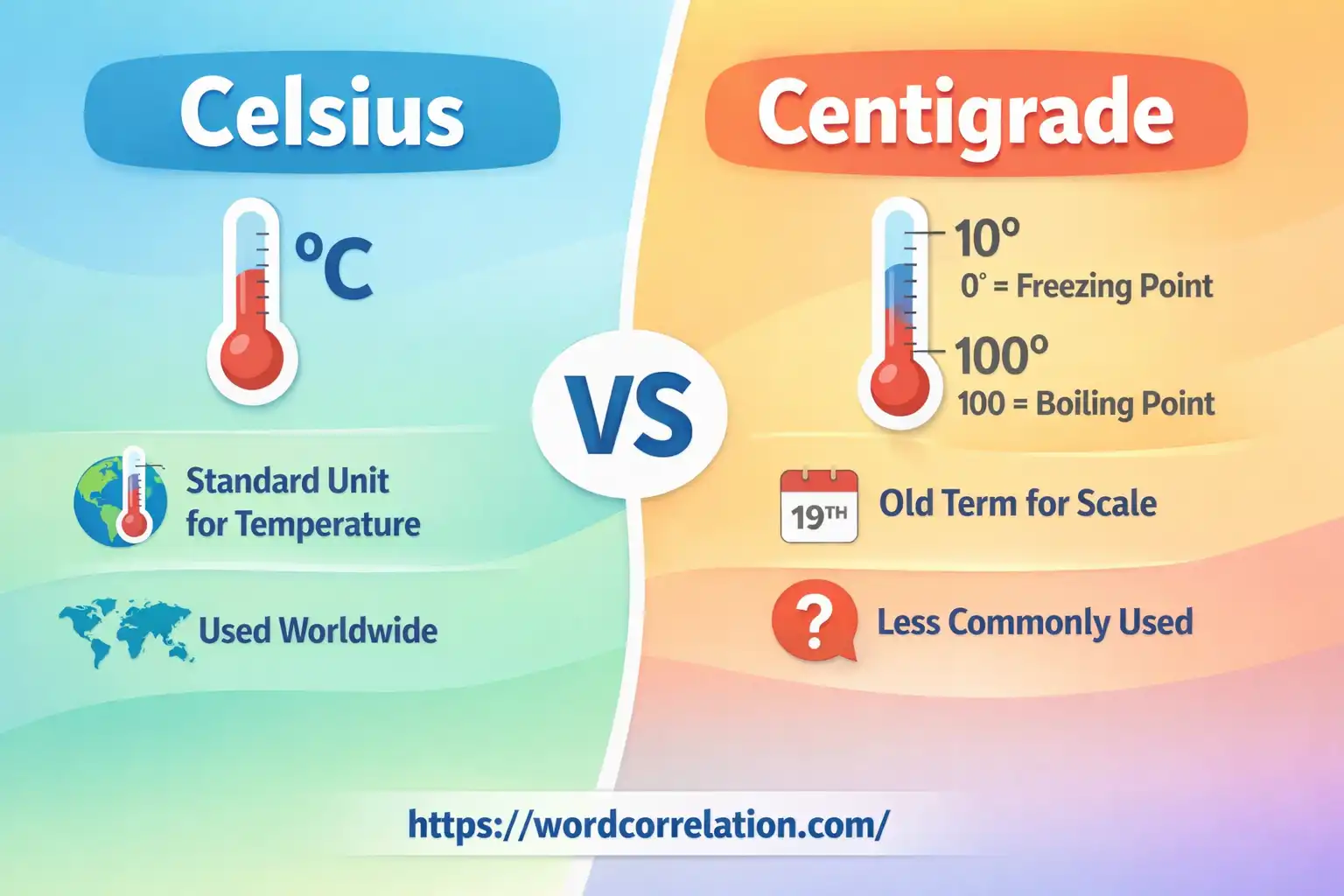
- Celsius and centigrade refer to the same temperature scale.
- However, Celsius is the correct and modern name.
- Centigrade is old and mostly avoided today.
For example:
- ✅ The water boils at 100 degrees Celsius.
- ❌ The water boils at 100 degrees centigrade.
The Origin of Celsius or Centigrade
The story starts in the 18th century. A Swedish scientist named Anders Celsius created a temperature scale. At first, people called it the centigrade scale. The word centi means one hundred. The scale had 100 steps between freezing and boiling water. Therefore, the name made sense.
However, confusion soon appeared. The word centigrade also meant angle measurement in math. As a result, scientists felt uneasy. To solve this, the scientific community changed the name.
In 1948, the scale officially became Celsius, named after its creator. Since then, schools, books, and labs follow this rule. Meanwhile, centigrade slowly faded away.
This pair belongs under our meaning usage pillar.
British English vs American English Spelling
Many learners suspect a spelling difference. However, that idea is incorrect. Both British and American English use Celsius. In contrast, neither prefers centigrade today.
Here is a simple comparison:
| Feature | Celsius | Centigrade |
| Modern use | Yes | No |
| Scientific writing | Yes | Avoided |
| UK usage | Common | Rare |
| US usage | Common | Rare |
Therefore, spelling does not change by region. Instead, correctness changes by time.
Which Spelling Should You Use?
Choosing the right word feels easier with guidance. Therefore, follow these clear rules.
For the United States:
Use Celsius in all cases. Schools, weather apps, and science books expect it.
For the UK and Commonwealth:
Again, choose Celsius. Teachers and editors prefer it strongly.
For global or professional writing:
Always use Celsius. Scientific standards demand consistency. Moreover, readers trust it more.
In short, one word works everywhere.
Common Mistakes with Celsius or Centigrade
Errors happen often. However, they are easy to fix.
- ❌ Today the temperature is 30 centigrade.
✅ Today the temperature is 30 degrees Celsius. - ❌ Centigrade is a new temperature system.
✅ Celsius is the modern name of the centigrade scale. - ❌ Use centigrade in British English.
✅ Use Celsius in both British and American English.
These mistakes happen due to old textbooks or spoken habits. Therefore, awareness matters.
Celsius or Centigrade in Everyday Examples
Usage becomes clear through daily life. Therefore, look at these examples.
Emails:
- The office temperature stays at 22 degrees Celsius.
News:
- Heatwaves pushed temperatures above 40°C today.
Social Media:
- It feels like 35 degrees Celsius outside today!
Formal or professional writing:
- The experiment ran at 25 degrees Celsius for accuracy.
In contrast, you rarely see centigrade in modern content.
Celsius or Centigrade – Google Trends & Usage Data
Search behavior reveals a pattern. People often type celsius or centigrade because they feel unsure. Therefore, comparison intent dominates.
By country:
- Global searches favor Celsius.
- Centigrade appears mainly in older regions or legacy content.
By user type:
- Students search during exams.
- Writers check for accuracy.
- ESL learners want clarity.
- Professionals confirm formal usage.
Correct usage vs mistakes:
Correct usage grows each year. Meanwhile, centigrade declines steadily. Another measurement-related comparison is meters or metres.
Celsius or Centigrade Comparison Table
This table removes confusion instantly:
| Aspect | Celsius | Centigrade |
| Meaning | Temperature scale | Old name of same scale |
| Part of speech | Noun | Noun |
| Context of use | Science, daily life | Historical references |
| Formal vs informal | Formal and standard | Informal and outdated |
| Common mistakes | None when used | Using it today |
| Correct example | 20°C today | Historical texts only |
Semantic FAQs (People Also Ask)
Is Celsius the same as centigrade?
Yes. Both refer to the same scale. However, Celsius is the correct name now.
Which one is correct in formal writing?
Celsius is always correct.
Can they be used interchangeably?
No. Centigrade is outdated and discouraged.
Why do people confuse them?
Old books and spoken habits cause confusion.
Can grammar tools catch this mistake?
Yes. Most tools flag centigrade as outdated.
Is there a British vs American difference?
No. Both regions use Celsius.
Conclusion
Overall, celsius or centigrade confusion comes from history, not grammar. Both words once meant the same scale. However, language evolved. Science demanded clarity. Therefore, Celsius became the global standard. Classification usage also appears in metal or nonmetal.
Students should remember this for exams. Writers should apply it for credibility. Teachers should explain it with context. Moreover, professionals must follow modern usage to avoid errors.
In short, always choose Celsius in modern English. Avoid centigrade unless you discuss history. That one rule solves the problem every time. Finally, confidence comes from clarity. Use the correct word, and your writing stays accurate.

Virginia Woolf is a British writer and essayist whose work centers on close reading, linguistic precision, and the careful examination of meaning. Her professional background spans fiction, literary criticism, and long-form essays, where attention to word choice and semantic nuance is central rather than decorative. Woolf approaches language as a system of relationships, treating individual words not as interchangeable units but as carriers of tone, context, and psychological weight.
Her research-based writing reflects sustained engagement with how meaning shifts across usage, rhythm, and narrative position. Through essays and critical studies, she demonstrates how subtle differences in wording shape interpretation, emotional response, and intellectual clarity. This focus aligns naturally with word comparison and semantic analysis, where accuracy matters more than flourish.
Woolf helps readers understand meaning differences by slowing language down, isolating terms, and examining how sense emerges through contrast. Her work builds trust by prioritizing clarity, textual evidence, and respect for the reader’s interpretive intelligence.