Many people stop and think when they see the words unselect and deselect.
Both look correct.
Both feel logical.
However, only one works well in real English.
This confusion happens often, especially in software, forms, and settings. Students, writers, and non-native speakers search this keyword because they want to avoid mistakes. Moreover, grammar tools sometimes fail to explain the difference clearly.
Therefore, this article solves one clear problem. It explains which word is correct, why confusion exists, and how to use the right word every time. Additionally, you will see real examples, common errors, and a simple rule to remember. By the end, you will never hesitate again when choosing between unselect or deselect.
For action-based word choices, the word comparison hub is helpful.
Unselect or Deselect – Quick Answer
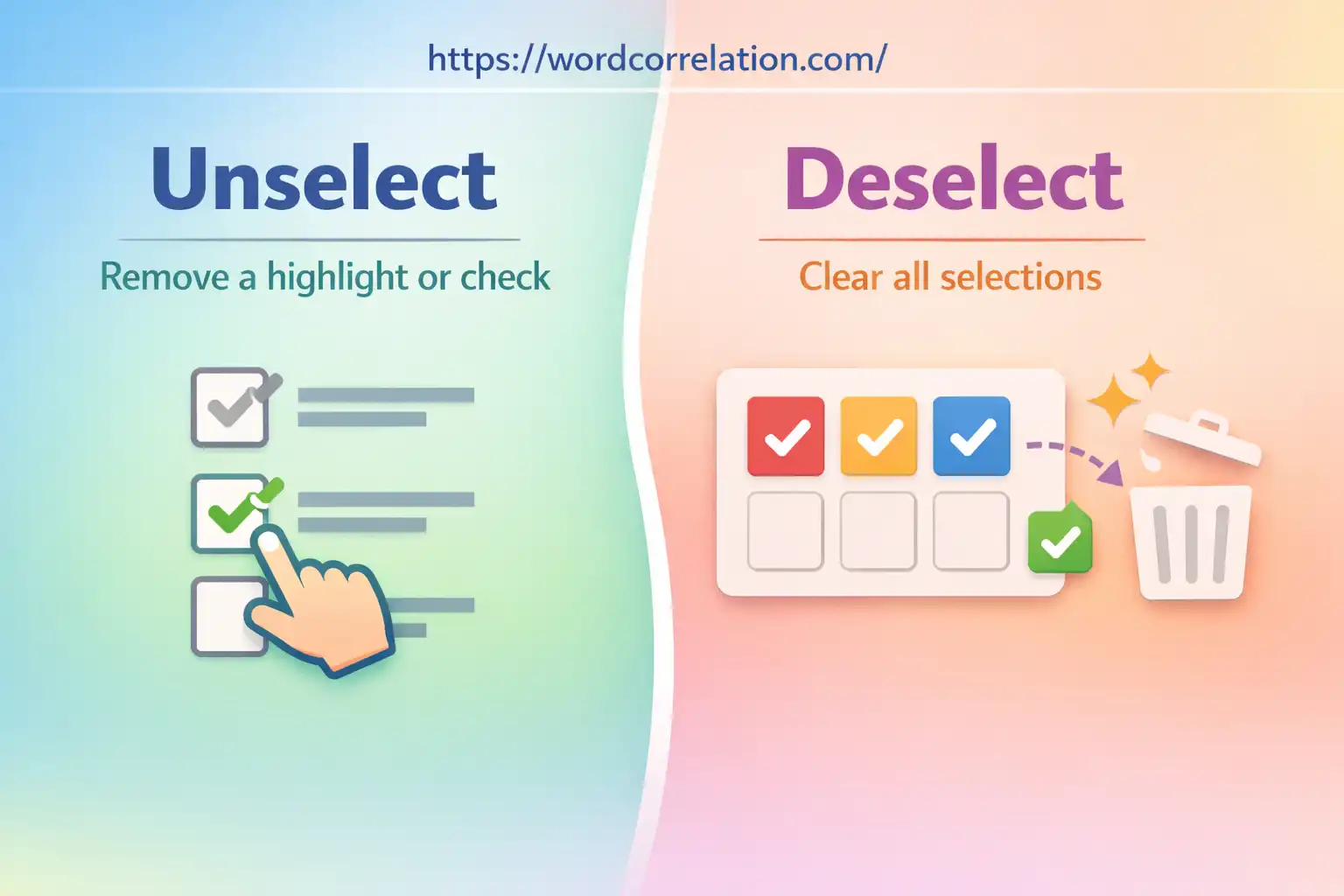
Deselect is the correct and widely accepted word.
Unselect exists but sounds unnatural in modern English.
- Use deselect when removing a selection
- Avoid unselect in professional writing
Example:
✅ Click to deselect the option
❌ Click to unselect the option
The Origin of Unselect or Deselect
The confusion starts with word formation.
English allows prefixes like un- and de-.
However, not all prefixes work the same way.
Deselect comes from:
- de- meaning “reverse”
- select meaning “choose”
Therefore, deselect literally means “reverse a selection.”
Unselect, in contrast, was formed later.
It follows a logical pattern.
However, English usage never fully accepted it.
As a result, deselect became standard, especially in computing and UI language.
Meanwhile, unselect stayed rare and informal.
This pair fits under our meaning usage pillar.
British English vs American English Spelling
Some people think this is a US vs UK issue.
However, that assumption is incorrect.
Both American English and British English prefer deselect.
Clear Rule
- Deselect → accepted everywhere
- Unselect → rare and discouraged
Examples
- US software manuals use deselect
- UK technical guides also use deselect
Quick Comparison
| Aspect | Deselect | Unselect |
| US English | ✅ Correct | ❌ Rare |
| UK English | ✅ Correct | ❌ Rare |
| Professional writing | ✅ Yes | ❌ No |
In contrast, unselect appears mostly in casual speech.
Which Spelling Should You Use?
The answer depends on your audience.
However, one option works in all cases.
For US Audiences
Use deselect in apps, emails, and instructions.
For UK or Commonwealth Audiences
Use deselect in formal and informal content.
For Global or Professional Writing
Always choose deselect.
It avoids confusion and sounds natural.
Therefore, deselect is the safest and smartest choice.
Common Mistakes with Unselect or Deselect
Many mistakes happen due to logic, not ignorance.
People assume un- works everywhere.
However, English does not always follow logic.
Frequent Errors
❌ Please unselect the checkbox
✅ Please deselect the checkbox
❌ Unselect your choice to continue
✅ Deselect your choice to continue
Short explanation:
Deselect matches standard usage.
Unselect sounds forced.
Unselect or Deselect in Everyday Examples
Understanding improves with real use.
Therefore, look at how deselect appears in daily language.
Emails
- Please deselect any options you do not need.
News or Tech Articles
- Users can deselect tracking in settings.
Social Media
- Tap again to deselect the filter.
Professional Writing
- The system allows users to deselect multiple items.
In contrast, unselect rarely appears in edited content. Another form-based confusion is possess or posses.
Unselect or Deselect – Google Trends & Usage Data
Search data shows a clear pattern.
Popularity by Country
- USA → Deselect dominates
- UK → Deselect dominates
- Global searches → Deselect leads strongly
User Type
- Students → search both, use deselect
- ESL learners → confusion common
- Writers → prefer deselect
- Professionals → only deselect
Usage Pattern
Correct usage grows each year.
Meanwhile, unselect stays flat.
As a result, search engines favor deselect in content.
Comparison Table: Unselect vs Deselect
| Feature | Unselect | Deselect |
| Meaning | Remove a choice | Remove a choice |
| Part of speech | Verb | Verb |
| Context of use | Rare, informal | Standard, technical |
| Formal usage | ❌ No | ✅ Yes |
| Common mistakes | Overused by learners | Rare |
| Correct example | ❌ Unselect the option | ✅ Deselect the option |
This table removes confusion instantly.
Semantic FAQs (People Also Ask)
Is unselect the same as deselect?
No.
They mean the same thing, but only deselect is standard.
Which one is correct in formal writing?
Deselect is always correct.
Can they be used interchangeably?
In theory yes.
In practice no.
Why do people confuse them?
Because un- feels logical.
English usage decides otherwise.
Can grammar tools catch this mistake?
Some do.
Many still miss it.
Is there a British vs American difference?
No.
Both prefer deselect.
Conclusion
Overall, the confusion between unselect or deselect is common but easy to fix. Both words seem logical. However, English depends on usage, not logic alone. A similar choice appears in procede or proceed.
Deselect is the accepted word in:
- Software
- Writing
- Education
- Professional communication
Meanwhile, unselect sounds awkward and outdated. Therefore, avoiding it improves clarity instantly. In short, remember one simple rule:
👉 If you remove a selection, always use “deselect.”
Finally, this single habit will make your English sound natural, confident, and correct every time.

Agatha Christie was a British writer whose work demonstrates an exceptional command of language, precision of meaning, and narrative clarity. Best known for her crime fiction, her professional background reflects decades of disciplined research, careful word choice, and structural accuracy—qualities central to research-based writing. Christie’s novels and short stories are noted not only for plot construction but for their economical use of language, where subtle differences in wording often carry decisive meaning.
Her writing shows a consistent sensitivity to semantics, ambiguity, and context, particularly in dialogue and descriptive passages, where small shifts in phrasing alter interpretation and intent. This attention to linguistic nuance helps readers distinguish between similar terms, implied meanings, and factual statements versus assumptions.
For readers seeking clarity in meaning and careful use of language, Christie’s body of work provides a reliable model of accuracy and restraint. Her enduring relevance rests on trust, consistency, and a demonstrable respect for the reader’s understanding—principles that align closely with research-driven word comparison and semantic analysis.