Many people search for stories or story’s because this small apostrophe causes big confusion. However, the problem looks simple at first. One tiny mark changes the meaning. Therefore, writers, students, and even professionals make this mistake often. In contrast, grammar rules here are actually very clear.
Most errors happen when people want to show plural meaning. Additionally, autocorrect tools sometimes add apostrophes without reason. As a result, users lose confidence in writing. Meanwhile, readers may see the text as unprofessional. Overall, this confusion slows learning and clear communication.
This article solves that problem step by step. First, you will learn what each form means. Next, you will see where people go wrong. Moreover, real examples will make the rule easy to remember. Finally, you will learn one simple rule that works every time. Therefore, by the end, you will never confuse stories and story’s again.
Grammar form differences are explained in the word comparison hub.
Stories or Story’s – Quick Answer
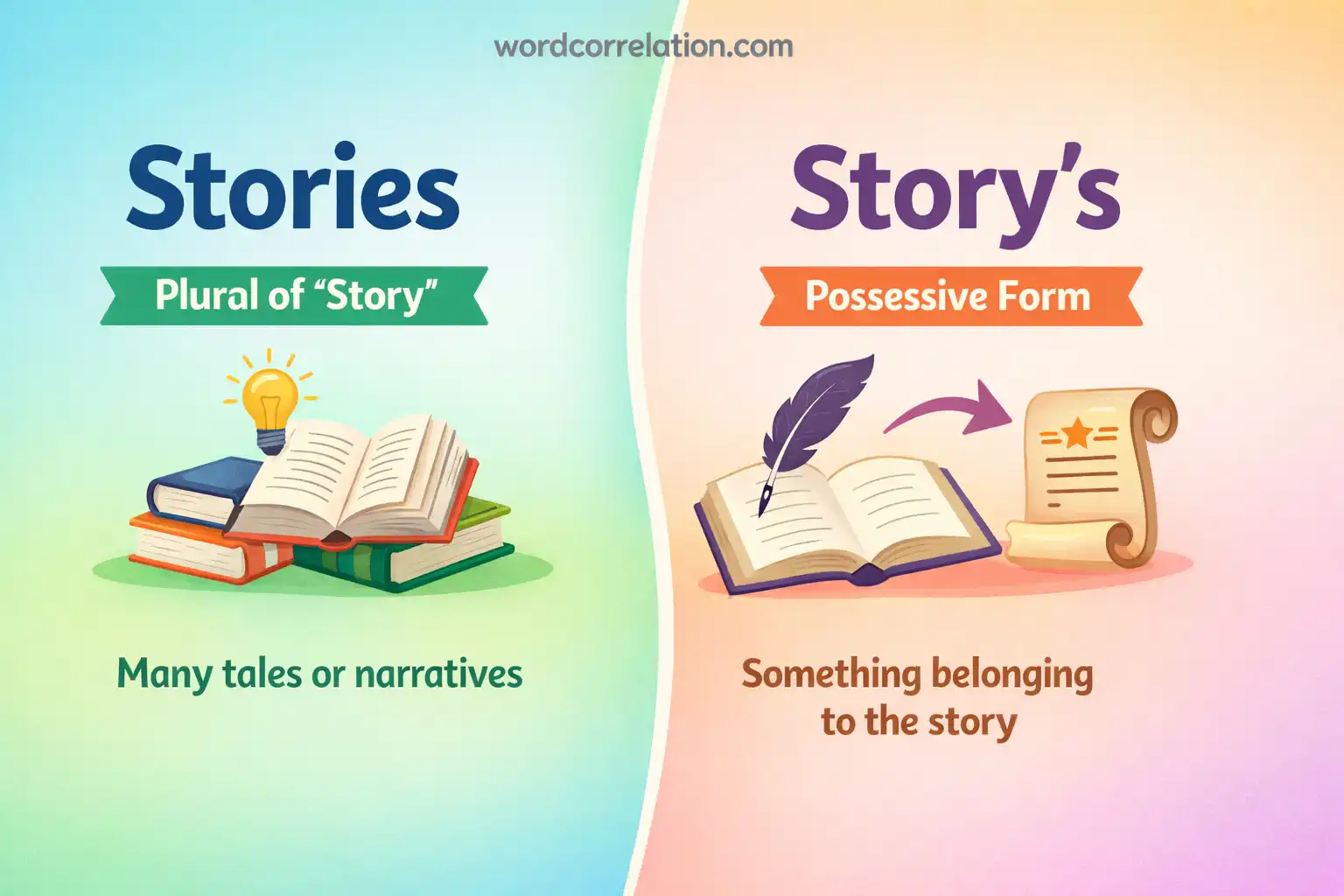
Stories is the plural form of story.
Story’s shows ownership or a contraction.
- Correct: She told many stories.
- Correct: This story’s ending is sad.
Use stories for more than one story.
Use story’s only to show ownership or “story is.”
The Origin of Stories or Story’s
The word story comes from Latin historia. It meant a tale or account. Over time, English added rules for plurals and possession. Therefore, stories became the plural form by changing y to ies. However, story’s followed a different path.
The apostrophe shows ownership or a shortened form. For example, the story’s lesson means the lesson of the story. Meanwhile, story’s can also mean story is. Because both forms look similar, confusion started. Additionally, typing habits and fast writing made the mistake common.
British English vs American English Spelling
Both British and American English follow the same rule here. However, users still expect a difference.
| Aspect | British English | American English |
| Plural form | stories | stories |
| Possessive | story’s | story’s |
| Apostrophe rule | Same | Same |
In contrast to spelling differences like colour and color, this rule stays identical. Therefore, location does not change usage.
Which Spelling Should You Use?
The correct choice depends on meaning, not audience.
- US writers: Use stories for plural meaning. Use story’s only for possession.
- UK / Commonwealth: Follow the same rule without change.
- Global or professional writing: Always avoid apostrophes for plurals.
Therefore, meaning decides the spelling. Audience does not change the rule.
Common Mistakes with Stories or Story’s
Many writers add apostrophes by habit. However, apostrophes never make words plural.
❌ I read many story’s.
✅ I read many stories.
❌ These story’s are popular.
✅ These stories are popular.
❌ The stories moral is clear.
✅ The story’s moral is clear.
Each correction fixes meaning. Therefore, remove the apostrophe unless ownership or contraction appears.
Stories or Story’s in Everyday Examples
Understanding improves with real use. Therefore, see these clear examples.
Emails:
- Please send the stories by Friday.
- The story’s deadline is tomorrow.
News:
- Several stories broke overnight.
- The story’s impact was huge.
Social media:
- I love sharing stories.
- This story’s message matters.
Formal writing:
- The stories support the theory.
- The story’s structure is strong.
Each sentence shows purpose clearly. Moreover, meaning stays clear.
Stories or Story’s – Google Trends & Usage Data
Search data shows high confusion. Students search this term most often. Additionally, ESL learners struggle with apostrophes. Professionals also make mistakes under time pressure. However, correct usage appears more in edited content.
Countries with high English learners show higher error rates. Meanwhile, grammar tools catch some errors. Still, tools miss context. Therefore, learning the rule matters more than relying on software.
This pair belongs to our grammar rules pillar.
Comparison Table: Stories vs Story’s
| Feature | Stories | Story’s |
| Meaning | More than one story | Ownership or “story is” |
| Part of speech | Noun (plural) | Possessive noun / contraction |
| Context of use | Counting stories | Showing belonging |
| Formal vs informal | Both | Both |
| Common mistakes | Adding apostrophe | Using for plural |
| Correct example | Many stories inspire us. | The story’s ending surprised me. |
This table removes confusion instantly. The core rule is covered in plural or possessive.
Semantic FAQs (People Also Ask)
Is stories the same as story’s?
No. Stories is plural. Story’s shows ownership or contraction.
Which one is correct in formal writing?
Both work when used correctly.
Can they be used interchangeably?
No. Meaning changes completely.
Why do people confuse them?
Apostrophes look misleading and tools add them.
Can grammar tools catch this mistake?
Sometimes. However, context errors still slip through.
Is there a British vs American difference?
No. Rules stay the same everywhere.
Conclusion
Overall, the confusion between stories or story’s comes from one small symbol. However, the rule stays simple. Use stories when you mean more than one story. Use story’s only for ownership or when shortening story is. Therefore, meaning always decides the spelling.
Many writers fear grammar mistakes. However, confidence grows with clear rules. Additionally, remembering this rule improves writing fast. In contrast, guessing causes repeated errors. Meanwhile, readers notice mistakes quickly.
In short, never use an apostrophe to make a word plural. Finally, follow this one easy rule: If you can replace it with “story is” or “of the story,” use story’s. Otherwise, use stories.
Another related example is boys or boy’s.

Jonathan Swift is a writer whose work reflects sustained attention to language precision, meaning, and the practical effects of word choice. Trained in classical studies and theology, he develops a disciplined approach to writing that combines close textual analysis with a strong concern for clarity and accuracy. His essays, pamphlets, and satirical works show a consistent method: examining how words are used, misused, and reshaped to influence public understanding.
Swift’s writing demonstrates an early form of semantic analysis. He compares terms, exposes false equivalence, and highlights how subtle differences in wording alter meaning, intent, and interpretation. This analytical focus allows readers to see language not as decoration, but as a tool that shapes thought, policy, and belief.
By breaking down complex expressions into their functional parts, Swift helps readers distinguish between surface language and underlying meaning. His work remains valuable to audiences interested in word comparison, rhetoric, and the responsible use of language. Across genres, his reputation rests on careful reasoning, linguistic discipline, and a consistent commitment to helping readers read more critically and precisely.