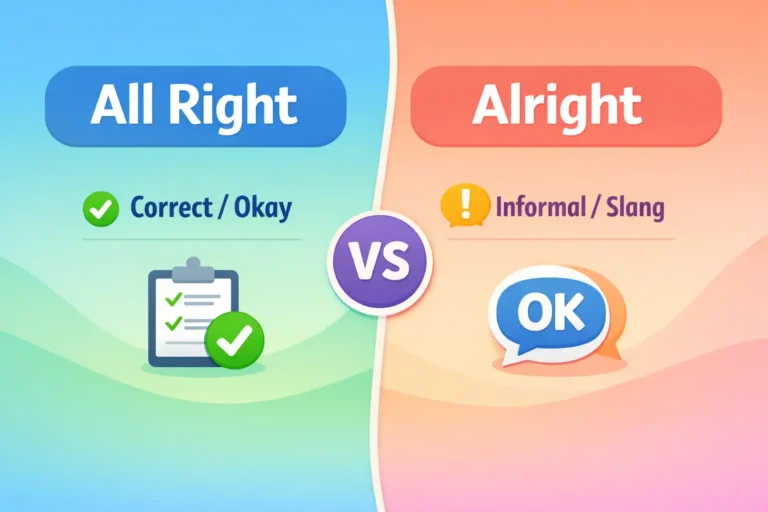
All Right vs. Alright: Why People Get Confused
Many English learners stop for a moment when they write all right vs. alright. Both forms appear online, in books, and even in messages. So people ask: Which one is correct? And more importantly, when should I use each one?
The confusion happens because both words sound the same. Also, many people use them in casual writing. But grammar guides, teachers, and style rules do not always agree. Some accept both forms, while others prefer only one.
You may also see questions like: “Are you alright or all right?” or “Is it I hope you are doing all right or alright?” These small choices matter in emails, school papers, and professional writing.
In this guide, you will learn the meaning of all right and alright, the grammar rules, and the real usage in American and British English. You will also see clear examples and common mistakes so you can choose the correct spelling fast.
All right vs. Alright – Quick Answer
Meaning of all right vs. alright
- All right = the traditional and widely accepted spelling
- Alright = informal spelling used in casual writing
Examples:
- Are you all right after the fall?
- It’s alright, don’t worry.
Easy rule:
Use all right in formal or professional writing. Use alright only in casual conversations or informal messages.
Origin and History of “All Right” and “Alright”
The phrase all right started many centuries ago. It comes from two simple words:
- all = completely
- right = correct or good
When people said “all right,” they meant everything is correct or acceptable.
Example in early English:
- Everything is all right now.
Over time, people began to shorten many phrases. Words like already, almost, and altogether became one word. Because of this pattern, writers slowly started using alright as a single word.
However, traditional grammar books still prefer all right. That is why many teachers and editors continue to recommend the two-word spelling.
Why “All Right” and “Alright” Are Confusing
The confusion continues for several reasons.
First, both forms sound exactly the same when spoken.
Second, casual writing is very common today. People write quickly in texts, social media, and chats. Because of that, shortened spellings like alright appear often.
Third, different style guides give different advice. Some modern dictionaries accept alright, but many grammar authorities still prefer all right.
Because of these mixed rules, learners often ask questions such as:
- Is it I’m alright or I’m all right?
- What is the correct spelling of alright?
The simple answer: all right is always safe, especially in formal writing.
British English vs American English Spelling
In many English words, the spelling changes between British and American English. But all right vs. alright does not follow that pattern.
Both British and American English generally prefer all right in formal writing.
However, informal writing in both regions may use alright.
Short Examples
American English:
- Are you all right?
- The plan is all right with me.
British English:
- Everything is all right now.
- It will be all right in the end.
Simple Comparison
| Usage | Preferred Form |
| Formal writing | all right |
| Academic writing | all right |
| Informal texting | alright (sometimes used) |
| Journalism (AP style) | all right |
In fact, all right vs alright AP style clearly prefers all right.
So even in the US or the UK, all right remains the safest spelling.
How to Choose the Right Word Fast
Choosing the correct form becomes easy when you consider the audience.
US
American writing guides strongly recommend all right. Newspapers, schools, and professional editors usually avoid alright.
Example:
- The report looks all right.
UK / Commonwealth
British English also prefers all right in formal contexts. Casual writing may use alright, especially in dialogue or messages.
Example:
- It’s alright, you can go now.
Global or Professional Writing
For global communication—emails, articles, academic writing, or reports—always use all right.
This keeps your writing clear and professional.
Common Mistakes with all right vs. alright
Many errors appear because writers mix informal and formal styles.
Frequent Errors
❌ Incorrect: Everything is alright in the report.
✅ Correct: Everything is all right in the report.
Explanation: Formal writing requires the two-word form.
❌ Incorrect: Is everything allright?
✅ Correct: Is everything all right?
Explanation: Allright is never correct.
❌ Incorrect: I hope you are doing alright. (formal email)
✅ Correct: I hope you are doing all right.
Explanation: Use all right in professional communication.
❌ Incorrect: She said are you allright.
✅ Correct: She asked, “Are you all right?”
Explanation: Correct spelling and punctuation improve clarity.
all right vs. alright in Everyday Examples
Understanding usage becomes easier with real situations.
Emails
- I hope you are doing all right today.
- Your document looks all right to me.
Professional emails usually avoid alright.
News
Journalists follow strict grammar rules.
Example:
- Officials confirmed that everything is all right after the inspection.
Social Media
Casual platforms sometimes use alright.
Example:
- It’s alright, mistakes happen.
But both forms appear frequently online.
Formal or Professional Writing
Academic writing always prefers all right.
Example:
- The results appear all right, but further review is needed.
all right vs. alright – Usage Patterns & Search Interest
Online searches show that many users want to know the correct spelling of alright.
Students and ESL learners often search this topic because both forms appear in daily writing.
Typical user groups include:
- English learners
- students
- professional writers
- editors and teachers
A common real-world problem happens in emails or job applications. If someone writes alright in a formal message, an editor may mark it as incorrect. That small mistake can make the writing look less professional.
So understanding all right vs alright grammar helps writers avoid confusion and improve clarity.
Comparison Table
| Feature | All Right | Alright |
| Meaning | Correct, acceptable, safe | Same meaning |
| Part of speech | Phrase | Informal variant |
| Context of use | Formal and informal | Mostly informal |
| Formal vs informal | Preferred in formal writing | Casual writing only |
| Common mistakes | Writing “allright” | Using in professional text |
| Correct example | Everything is all right | It’s alright with me |
This table shows that all right is the safest and most widely accepted spelling.
People Also Ask
Is it gonna be alright or all right?
Both appear in casual speech, but all right is the traditional and preferred spelling in writing.
Do Americans say “alright”?
Yes, many Americans say it in conversation. But in writing, most style guides still prefer all right.
Is it I hope you are doing all right or alright?
In professional writing, the correct form is I hope you are doing all right.
Is alright not correct?
Some modern dictionaries accept it, but many grammar experts still consider it informal.
Is it I’m alright or I’m all right?
Both are understood. However, I’m all right is the more standard and widely accepted form.
How to write it’s alright?
In casual writing you may see it’s alright, but formal writing should use it’s all right.
Can I say “Are you alright?”?
Yes, people say it often in conversation. In formal writing, Are you all right? is preferred.
Does alright mean yes?
Not exactly. It usually means acceptable, fine, or okay, depending on the sentence.
Is all right the same as alright?
Yes, they have the same meaning. The difference is formality and spelling preference.
Conclusion
The difference between all right vs. alright is mostly about formality and spelling tradition.
Both forms mean the same thing: something is acceptable, safe, or correct. But grammar guides and style manuals strongly prefer all right. This spelling works in almost every situation, including academic writing, professional emails, and news articles.
The single-word alright appears mainly in casual writing such as texts, dialogue, or social media posts. Many dictionaries now recognize it, but it still sounds informal.
The most common mistake is writing “allright.” This spelling is always incorrect and should never be used.
Overall, the safest rule is simple.
If you are unsure, choose all right.
Finally, remember this easy rule:
Use “all right” for formal writing, and avoid “allright” completely.

Daniel Morris writes about English word differences and spelling confusion. His focus is to provide clear, simple explanations with practical usage examples.