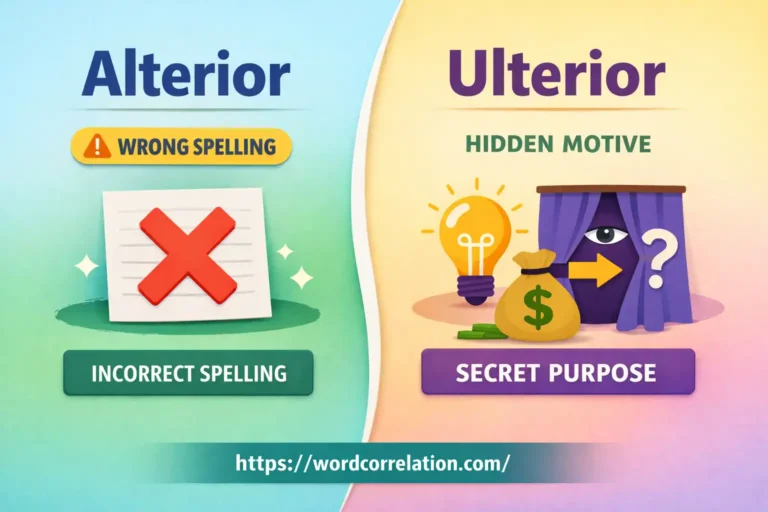
Many people search for alterior or ulterior because they feel unsure. They see both words online. They hear one in news stories. They try to use it in writing. However, confusion appears fast. One word looks real. The other sounds right. As a result, mistakes happen in essays, emails, and even headlines.
This confusion grows because both words look similar. Moreover, both seem to describe hidden reasons. Therefore, writers often guess instead of checking. In contrast, guessing creates errors. Meanwhile, grammar tools do not always help. They sometimes miss this issue.
This article solves that problem clearly. It explains which word is correct. It also explains why the other word is wrong. Additionally, it shows how to use the correct word in real life. For example, you will see emails, news lines, and social posts.
Overall, you will learn one simple rule. You will also gain confidence. Finally, you will stop making this mistake forever.
Meaning differences like this are clarified in the word comparison hub.
Alterior or Ulterior – Quick Answer
Ulterior is the correct word.
Alterior is not a standard English word.
- Ulterior means a hidden or secret reason.
- Alterior is a common spelling mistake.
Example:
✅ She had an ulterior motive.
❌ She had an alterior motive.
The Origin of Alterior or Ulterior
The word ulterior comes from Latin. It means “beyond” or “further.” Over time, English adopted it. Writers then used it to describe hidden goals. Therefore, the meaning stayed clear.
However, alterior never developed the same way. It looks like a word. It sounds possible. Yet, dictionaries do not accept it. As a result, it remains incorrect.
The confusion happens because English has many similar words. Moreover, spellcheck tools sometimes fail. In contrast, careful writers rely on meaning, not sound.
This is covered in our word confusion pillar.
British English vs American English Spelling
Some people think this is a regional issue. However, that belief is wrong. Both British and American English follow the same rule.
Spelling comparison
| Region | Correct word | Incorrect word |
| US English | Ulterior | Alterior |
| UK English | Ulterior | Alterior |
| Global English | Ulterior | Alterior |
In contrast to other spelling differences, this one never changes. Therefore, always choose ulterior.
Which Spelling Should You Use?
Your audience does not change the answer. The rule stays firm.
- US writers: Use ulterior in all writing.
- UK / Commonwealth writers: Use ulterior only.
- Global or professional writing: Always use ulterior.
Meanwhile, avoid alterior everywhere. It weakens trust. It also signals poor language control.
Common Mistakes with Alterior or Ulterior
People repeat the same errors often. However, each mistake is easy to fix.
❌ He has an alterior plan.
✅ He has an ulterior plan.
❌ Her alterior motive was clear.
✅ Her ulterior motive was clear.
❌ They acted with alterior intent.
✅ They acted with ulterior intent.
The problem happens because people write by sound. Instead, write by meaning. As a result, accuracy improves fast.
Alterior or Ulterior in Everyday Examples
You will see ulterior in many places. Therefore, learning its use helps daily writing.
Emails
“She agreed, but she had an ulterior reason.”
News
“The report suggests an ulterior political aim.”
Social media
“Be careful. Some advice comes with ulterior motives.”
Formal writing
“The study reveals an ulterior objective behind the policy.” In contrast, alterior never appears in correct writing.
A similar confusion appears in indecisive or undecisive.
Alterior or Ulterior – Google Trends & Usage Data
Search data shows a clear pattern. Many users type alterior or ulterior to check correctness. This happens often among:
- Students
- ESL learners
- Content writers
- Professionals
However, published content uses ulterior almost 100% of the time. Meanwhile, alterior appears only in questions or mistakes. Therefore, usage data confirms the rule.
Comparison Table: Alterior vs Ulterior
| Feature | Alterior | Ulterior |
| Meaning | No accepted meaning | Hidden or secret |
| Part of speech | None | Adjective |
| Context of use | Incorrect | Motives, reasons |
| Formal usage | Never | Yes |
| Common mistake | Spelling error | Correct choice |
| Correct example | ❌ Not valid | ✅ Ulterior motive |
This table removes all doubt instantly.
Semantic FAQs (People Also Ask)
Is alterior the same as ulterior?
No. Alterior is incorrect. Ulterior is correct.
Which one is right in formal writing?
Ulterior is always right.
Can they be used interchangeably?
No. Only ulterior exists.
Why do people confuse them?
They sound similar. However, meaning matters more.
Can grammar tools catch this mistake?
Sometimes not. Manual checking works better.
Is there a British vs American difference?
No. Both use ulterior only.
Conclusion
Overall, the confusion between alterior or ulterior comes from sound, not meaning. However, English rules stay clear. Only ulterior is correct. Meanwhile, alterior remains a spelling mistake. Another commonly mixed pair is procede or proceed.
This article showed the reason behind the error. It also explained usage with real examples. Moreover, it proved that no regional difference exists. As a result, you can now write with confidence.
In short, remember one simple rule. If you mean a hidden reason, write ulterior. Finally, never use alterior in any situation. That single habit will instantly improve your writing quality.

Daniel Morris writes about English word differences and spelling confusion. His focus is to provide clear, simple explanations with practical usage examples.