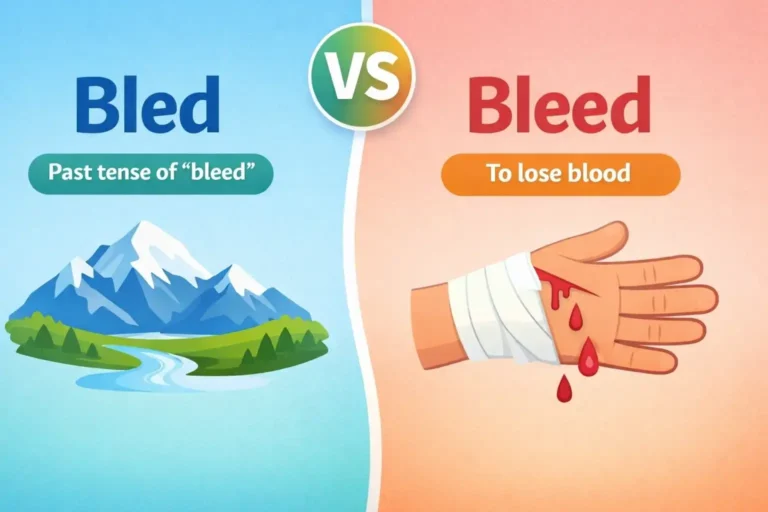
Many English learners search for “bled vs bleed” because both words look almost the same. They come from the same verb, but they are used in different situations. This small change in form often creates big grammar mistakes.
Students, ESL learners, and even writers sometimes mix them up. For example, someone may write “He bleed yesterday” instead of “He bled yesterday.” The sentence sounds small, but the tense becomes incorrect. Because of this, readers may feel confused about the time of the action.
This problem happens often because English verbs change form between present and past tense. However, the spelling does not always follow a clear rule. So many learners wonder when to use bleed and when to use bled.
In this guide, you will learn the clear difference between bled vs bleed, their meaning, correct grammar usage, and real examples. You will also see common mistakes writers make and a simple rule that helps you choose the right word instantly.
Bled vs Bleed – Quick Answer
Bleed is the base form (present tense) of the verb.
Bled is the past tense and past participle.
Meaning of Bleed
- Present action of losing blood
- Used for current or general situations
- Example: The cut may bleed.
Meaning of Bled
- Past action of losing blood
- Used when the event already happened
- Example: The wound bled yesterday.
Easy rule:
Use bleed for present, and bled for past.
The Origin of Bled vs Bleed
The words bleed and bled come from Old English. The early word was “blēdan,” which meant to lose blood or release blood. Over time, English simplified the spelling and created different verb forms.
The base verb became bleed, while the past form changed to bled. This pattern follows a group of irregular verbs in English.
For example:
- bleed → bled
- feed → fed
- lead → led
Because of this irregular pattern, learners cannot simply add -ed to make the past tense. Instead, the vowel sound changes.
Editors often notice confusion here because the spelling difference is small. However, the time of the action changes completely.
Today, the confusion mainly appears in writing where tense matters. Emails, reports, and social posts often show mistakes like “The wound bleed yesterday.”
Understanding the verb structure helps remove this confusion.
British vs American English Spelling
In this case, there is no spelling difference between British and American English. Both forms use the same words:
- Bleed (present)
- Bled (past)
However, usage examples may appear in different contexts.
Example in American English
The athlete began to bleed after the fall.
Example in British English
The patient bled during the operation.
Although spelling stays the same, the verb tense rules remain important in both versions of English.
Small comparison overview:
Form | American English | British English
Bleed | Present tense | Present tense
Bled | Past tense | Past tense
Because the spelling does not change, writers only need to focus on correct tense usage.
How to Choose the Right Word Fast
Choosing between bled vs bleed becomes easy when you focus on time.
Use bleed when the action happens now or generally.
Examples:
- The cut may bleed again.
- Small wounds sometimes bleed a lot.
Use bled when the action already happened.
Examples:
- The injury bled for several minutes.
- The patient bled during the accident.
Audience guidance:
US writing
Follow standard tense rules. Bleed = present, Bled = past.
UK and Commonwealth writing
The same grammar rule applies.
Global or professional writing
Always match the verb with the correct time in the sentence.
Simple memory trick:
Present → bleed
Past → bled
Common Mistakes with Bled vs Bleed
Writers often confuse these words because the difference is only one letter. However, the grammar error changes the meaning of the sentence.
Here are common mistakes.
❌ He bleed yesterday.
✅ He bled yesterday.
Explanation: The action happened in the past.
❌ The wound bled every time it opens.
✅ The wound bleeds every time it opens.
Explanation: This sentence describes a repeated present action.
❌ She has bleed a lot.
✅ She has bled a lot.
Explanation: Past participle form must be bled.
Another mistake appears when learners try to add -ed.
❌ bleeded
✅ bled
English irregular verbs do not follow the normal -ed rule.
Bled vs Bleed in Real Life Examples
Understanding grammar becomes easier with real situations. These examples show how the words appear in daily communication.
Emails
Present tense
The cut may bleed again if you move your hand.
Past tense
The wound bled after the fall.
News Writing
Present
Doctors warn that deep injuries can bleed heavily.
Past
The patient bled during emergency surgery.
Social Media
Present
Paper cuts always bleed more than expected.
Past
My finger bled when I opened the package.
Professional Writing
Present
Severe injuries may bleed internally.
Past
The athlete bled after the collision.
These examples show that the tense controls the word choice.
Bled vs Bleed – Word Usage Patterns and Search Trends
Search patterns show that many users look up bled vs bleed while learning English grammar. Students, ESL learners, and beginner writers often ask this question.
One reason is that irregular verbs break the normal spelling rule. Instead of adding -ed, the word changes form.
Language teachers often see this mistake in essays and homework. Writers know the meaning of the word, but they choose the wrong tense.
Another reason comes from speech. In fast conversation, bled and bleed may sound similar to learners. Because of this, they may write the wrong form.
A real scenario shows why correct usage matters.
Imagine a medical report:
Incorrect
The patient bleed during surgery.
Correct
The patient bled during surgery.
The incorrect version makes the grammar unclear and unprofessional. Therefore, tense accuracy is important in both everyday and formal writing.
Bled vs Bleed Comparison Table
Aspect | Bleed | Bled
Meaning | To lose blood | Lost blood
Part of Speech | Verb (base form) | Verb (past tense / past participle)
Time of Action | Present or general | Past action
Context of Use | Current events, habits | Completed events
Formal vs Informal | Used in both | Used in both
Common Mistake | Used instead of past tense | Sometimes replaced with “bleeded”
Correct Example | The cut may bleed again. | The wound bled yesterday.
This table shows the difference quickly. If the action already happened, bled is correct.
FAQs About Bled vs Bleed
Is bled the same as bleed?
No. Bleed is the present form of the verb. Bled is the past form.
Which one is correct in formal writing?
Both are correct. The choice depends on the tense of the sentence.
Can bleed and bled be used interchangeably?
No. Each word shows a different time of action.
Why do people confuse bled vs bleed?
The spelling difference is small, and English irregular verbs do not follow a clear pattern.
Can grammar tools detect this mistake?
Many grammar tools can detect incorrect tense. However, they sometimes miss context.
Is there a British vs American difference?
No. Both versions of English use bleed and bled the same way.
What is the past participle of bleed?
The past participle is bled. Example: He has bled before.
Conclusion
The difference between bled vs bleed is simple once you understand verb tense. Both words come from the same root verb, but they describe actions at different times.
Use bleed when the action happens now or describes a general situation. Use bled when the action already happened in the past. This small grammar rule helps keep your writing clear and correct.
Many learners make the mistake of writing bleed for past events or adding incorrect forms like bleeded. However, remembering the irregular pattern solves the problem quickly.
Overall, the key idea is easy to remember. English changes the vowel instead of adding -ed in this verb.
Final rule to remember:
Present action → bleed
Past action → bled
Once you follow this rule, the confusion between these two words disappears.

Daniel Morris writes about English word differences and spelling confusion. His focus is to provide clear, simple explanations with practical usage examples.