Many people search for camaraderie vs comradery because both words look correct. They sound the same. They also appear in blogs, social posts, and even emails. So confusion grows fast.
Writers often ask: “Which one should I use?” Some tools accept both. However, not all forms are standard. This creates doubt, especially for students and ESL learners. A small spelling mistake can affect clarity and credibility.
In this guide, you will learn the real difference. You will see which spelling is correct, why the confusion exists, and how to use the word in real life. You will also get simple rules and clear examples. So by the end, you will never mix them again.
camaraderie vs comradery – Quick Answer
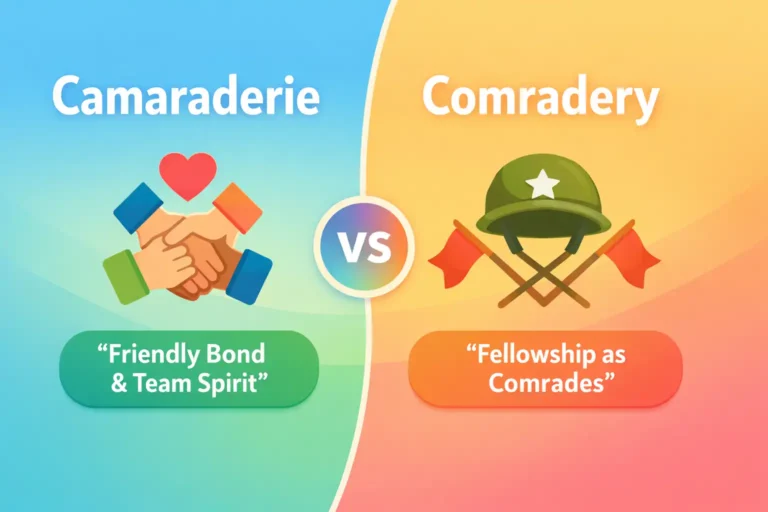
Camaraderie is the correct spelling.
Comradery is a common misspelling.
Meaning of camaraderie
- Friendly bond between people
- Often used in teams or groups
- Example: “The team had strong camaraderie.”
Meaning of comradery
- Not standard English
- Often seen as a spelling mistake
- Example: ❌ “We value comradery.”
Easy rule:
Use camaraderie in all cases. Avoid comradery.
The Origin of camaraderie vs comradery
The word camaraderie comes from French. It is linked to the word camarade, which means “companion” or “friend.” The term entered English in the 19th century. It kept its original French style spelling.
However, people started writing it as comradery later. Why? Because of the word “comrade.” That word is easier and more common. So writers assumed the longer form should match it. This led to the incorrect version.
Writers often confuse similar-looking words. Editors usually see this mistake in casual writing, blogs, and student essays. But standard dictionaries only accept camaraderie.
So the confusion today comes from:
- Similar sound
- Influence of “comrade”
- Simpler spelling pattern
British vs American English Spelling
There is no major difference between British and American English here. Both use camaraderie as the correct spelling.
However, people still try to simplify it in informal writing. That is where comradery appears.
Here is a simple comparison:
| Aspect | Camaraderie | Comradery |
| Correct spelling | Yes | No |
| Used in US English | Yes | No |
| Used in UK English | Yes | No |
| Formal writing | Accepted | Not accepted |
| Informal use | Common | Seen as mistake |
In contrast to many words, this one does not change across regions. So the rule stays simple worldwide.
How to Choose the Right Word Fast
Choosing the right word is easy if you follow a simple rule.
For US users
Use camaraderie in all writing. It is the only accepted form.
For UK / Commonwealth users
Use camaraderie as well. No variation exists.
For global or professional writing
Always choose camaraderie. It keeps your writing clear and correct.
There is no tone difference between the two. The issue is only spelling. So you do not need to think twice.
Common Mistakes with camaraderie vs comradery
Many writers make small but important mistakes. Here are the most common ones:
❌ “The team showed great comradery.”
✅ “The team showed great camaraderie.”
❌ “We built strong comradery at work.”
✅ “We built strong camaraderie at work.”
These errors often happen because:
- People trust spell check tools too much
- They follow phonetic spelling
- They copy incorrect sources
So always double-check your writing.
camaraderie vs comradery in Real Life Examples
Now let’s see how the correct word works in daily use.
Emails
- “Our team’s camaraderie improved after the project.”
News
- “Players showed great camaraderie during the match.”
Social Media
- “Loved the camaraderie at the event today!”
Professional Writing
- “Workplace camaraderie boosts team performance.”
In each case, the correct spelling builds trust. It also shows attention to detail.
camaraderie vs comradery – Word Usage Patterns and Search Trends
The word camaraderie is widely used in:
- Education
- Workplace writing
- Sports and teamwork content
Students and ESL learners often search for this keyword. They want clear spelling rules.
On the other hand, comradery appears in:
- Informal blogs
- Social media posts
- User-generated content
However, it is not accepted in formal English.
A real problem can happen in professional writing. For example, a job application with “comradery” may look careless. So correct spelling matters.
Comparison Table
Here is a simple table to remove all confusion:
| Feature | Camaraderie | Comradery |
| Meaning | Friendship and team spirit | Same intended meaning |
| Part of speech | Noun | Noun (incorrect form) |
| Context of use | Formal and informal | Informal only (error) |
| Formal usage | Correct | Incorrect |
| Common mistake | Misspelled as comradery | Used instead of camaraderie |
| Correct example | “Team camaraderie is strong.” | ❌ “Team comradery is strong.” |
FAQs
Is camaraderie the same as comradery?
No. Camaraderie is correct. Comradery is a misspelling.
Which one is correct in formal writing?
Use camaraderie. It is the standard form.
Can they be used interchangeably?
No. Only camaraderie is accepted.
Why do people confuse them?
Because of the word “comrade” and similar sound.
Can grammar tools catch this mistake?
Some tools catch it, but not all. Always review manually.
Is there a British vs American difference?
No. Both use camaraderie only.
Is comradery ever correct?
No. It is not recognized as standard English.
Conclusion
Now the confusion around camaraderie vs comradery should be clear. Only one spelling is correct, and that is camaraderie. The other form appears due to sound and word similarity, but it is not standard.
This mistake matters because it affects clarity and trust. Writers often use the wrong form in casual content. However, in professional or academic writing, it can create a poor impression.
In short, always choose camaraderie when you talk about friendship, team spirit, or group bonding. Avoid the common error of writing comradery.
Easy rule to remember:
If you mean teamwork and friendship, always write camaraderie—never comradery.

Daniel Morris writes about English word differences and spelling confusion. His focus is to provide clear, simple explanations with practical usage examples.