Many learners search for “compared vs comparing” because both words look almost the same. They come from the same verb, compare, so people often mix them in sentences. The confusion becomes stronger when writing essays, emails, or reports. One word may sound right, yet the grammar can still be wrong.
Writers often pause and ask: Should I write “compared to” or “comparing to”? Both appear in books, blogs, and news. However, they do not work in the same way. Each form fits a different grammar role. Because of this, choosing the wrong one can make a sentence sound awkward or incomplete.
Editors usually notice this mistake in student writing and online articles. The issue often comes from misunderstanding verb forms. Once you understand how these two forms work, the difference becomes very simple.
In this guide, you will learn the clear meaning of compared vs comparing, when to use each form, and how to avoid common mistakes. You will also see real examples from everyday writing so the rule stays easy to remember.
Compared vs Comparing – Quick Answer
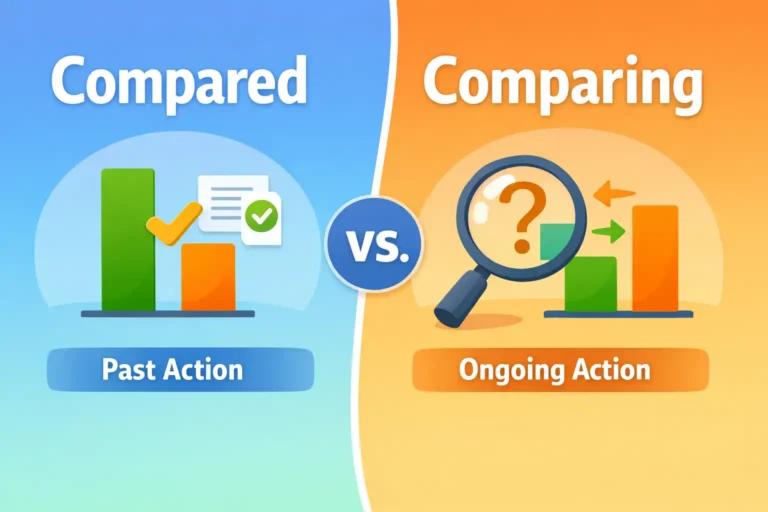
Compared and comparing both come from the verb compare, but they serve different grammar roles.
Meaning of Compared
- Past form or past participle of compare
- Shows that a comparison already happened
- Often used with to or with
Examples:
- The new phone is compared to last year’s model.
- This year’s sales compared with last year’s numbers.
Meaning of Comparing
- Present participle of compare
- Shows an action happening now or as part of a phrase
Examples:
- She is comparing two laptops.
- We are comparing prices online.
Easy rule:
Use compared for a finished comparison.
Use comparing when the action is happening now.
The Origin of Compared vs Comparing
Both compared and comparing come from the verb compare. This word entered English through French during the Middle Ages. The French word comparer came from the Latin comparare, which means to examine similarities or differences.
Early English writers used compare mainly in academic and literary writing. Scholars used it when discussing poetry, science, and philosophy. Over time, the word became common in daily speech.
The forms compared and comparing developed from normal English verb patterns.
- Compared formed as the past tense and past participle.
- Comparing formed as the present participle with -ing.
The confusion today comes from how both forms appear in similar sentences. For example:
- Compared to last year, profits increased.
- Comparing this year to last year shows growth.
Both sentences talk about comparison. However, the grammar structure is different. Because of this similarity, learners often switch the forms by mistake.
British vs American English Spelling
Good news: compared and comparing have no spelling difference between British and American English.
Both regions use the same spelling and grammar rules.
| Form | American English | British English |
| Compared | compared | compared |
| Comparing | comparing | comparing |
Since the spelling stays identical, writers only need to focus on grammar usage, not regional spelling.
Examples in both styles:
American usage
- The report compared two companies.
British usage
- The study compared two universities.
In both cases, the spelling remains the same.
How to Choose the Right Word Fast
Choosing between compared vs comparing becomes simple once you look at the sentence structure.
For US writers
American academic writing often uses compared with or compared to in reports and articles.
Example
- The new policy is compared with last year’s version.
For UK and Commonwealth writers
British writing also uses compared with more frequently in formal analysis.
Example
- The results were compared with earlier data.
For global or professional writing
Focus on grammar rather than region.
Use compared when the comparison acts like a completed action or adjective.
Example
- Compared to last year, revenue improved.
Use comparing when the subject actively performs the comparison.
Example
- The analyst is comparing quarterly results.
Quick tip:
If the sentence describes a finished comparison, choose compared.
If the sentence describes someone doing the comparison, choose comparing.
Common Mistakes with Compared vs Comparing
Many mistakes happen when writers mix verb forms or sentence structure.
Mistake 1
❌ Comparing to last year, sales increased.
✅ Compared to last year, sales increased.
Explanation: The sentence describes a condition, not an action happening now.
Mistake 2
❌ The report compared two phones and is comparing their features yesterday.
✅ The report compared two phones yesterday.
Explanation: Mixing time frames creates confusion.
Mistake 3
❌ She compared prices online right now.
✅ She is comparing prices online right now.
Explanation: The action is happening in the present.
Mistake 4
❌ Comparing with last month, profits improved.
✅ Compared with last month, profits improved.
Explanation: The phrase acts like an introductory clause.
Writers often confuse these forms because both relate to the same action. However, grammar determines the correct choice.
Compared vs Comparing in Real Life Examples
Understanding grammar becomes easier when you see real-world writing.
Emails
- I compared the two proposals before sending this message.
- I am comparing the updated files now.
News writing
- The study compared climate data from 20 cities.
- Researchers are comparing weather patterns across decades.
Social media
- Just comparing phone prices before buying.
- This model looks cheap compared to others.
Professional writing
- The report compared productivity across departments.
- Analysts are comparing market trends this week.
These examples show how both forms appear in daily communication.
Compared vs Comparing – Word Usage Patterns and Search Trends
Search engines show that many users type “compared vs comparing” when they struggle with grammar in essays or reports.
Students, ESL learners, and professional writers search for this phrase often. Many want to check whether their sentence sounds correct before submitting an assignment or publishing an article.
Grammar tools sometimes highlight the mistake, yet they do not always explain the difference clearly. Because of this, writers still feel unsure.
One real-world situation where misuse causes confusion happens in research writing.
Example:
Incorrect sentence
- Comparing last year’s data, the company improved.
This sentence sounds unfinished. Readers may wonder who is doing the comparison.
Correct sentence
- Compared to last year’s data, the company improved.
Small changes like this can improve clarity in reports and articles.
Compared vs Comparing – Quick Comparison Table
| Feature | Compared | Comparing |
| Meaning | A finished comparison | The act of making a comparison |
| Part of speech | Past tense / past participle | Present participle |
| Context of use | Describing results or conditions | Showing an ongoing action |
| Formal vs informal | Common in formal writing | Common in both casual and formal |
| Common mistake | Using it when action is ongoing | Using it in sentence openings incorrectly |
| Correct example | Sales increased compared to last year | She is comparing two plans |
This table helps writers quickly see how the forms differ.
Frequently Asked Questions
Is compared the same as comparing?
No. Compared shows a completed comparison, while comparing describes the act of making a comparison.
Which one is correct in formal writing?
Both can appear in formal writing. However, compared appears more often in reports and analysis.
Can compared and comparing be used interchangeably?
No. Their grammar roles differ. One describes a finished state, while the other shows an ongoing action.
Why do people confuse compared vs comparing?
Both words come from the same verb. Also, they often appear in similar sentences about comparisons.
Can grammar tools detect this mistake?
Many grammar tools highlight the issue. However, they sometimes miss the error when the sentence structure looks acceptable.
Is there a British vs American difference?
No. Both forms have identical spelling and usage in British and American English.
Which phrase is more common: compared to or compared with?
Both appear in English. Compared to often appears in general writing, while compared with appears in analytical contexts.
Conclusion
The difference between compared vs comparing becomes clear once you focus on the verb form. Both words come from the same base verb, compare, yet they serve different roles in a sentence.
Compared usually shows a completed comparison or describes a result. Writers often use it in phrases like compared to last year or compared with earlier data. Because of this, it appears often in reports, analysis, and summaries.
Comparing, on the other hand, shows an action happening right now. It appears when someone actively studies similarities or differences between things.
Many learners mix the two forms because the sentences look very similar. However, the grammar rule is simple once you understand the structure.
Overall, remember this easy guideline:
Use compared when the comparison is already done.
Use comparing when someone is actively making the comparison.
Keeping this rule in mind will help you write clearer sentences in emails, essays, reports, and everyday communication.

Daniel Morris writes about English word differences and spelling confusion. His focus is to provide clear, simple explanations with practical usage examples.