Many people search “compliancy vs compliance” because the two words look almost the same. They both relate to rules, laws, or standards. However, their real use is not identical. Writers, students, and professionals often feel unsure about which word sounds correct.
The confusion usually happens in business writing, legal documents, and workplace communication. Someone may write “system compliancy” in a report. Another person may say “regulatory compliance.” Both seem correct, but only one word is widely accepted in formal English.
Because of this, many learners ask a simple question: Is compliancy wrong, or is it just another form of compliance?
This article solves that confusion in clear and simple language. You will learn the exact meaning of each word, their origin, and how real writers use them today. You will also see examples from emails, news, and professional writing so you can choose the correct word with confidence.
Compliancy vs Compliance – Quick Answer
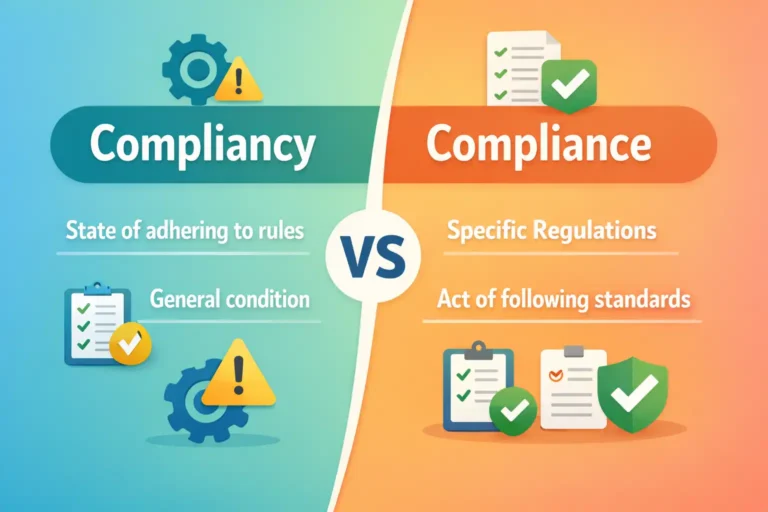
Compliance means following rules, laws, or standards. It is the correct and widely used word in formal English.
Compliancy is a rare variation. Some industries use it, but most writers avoid it.
Simple rule:
- Use compliance in almost all writing.
- Use compliancy only if a specific industry prefers it.
Examples:
- The company ensures data compliance with privacy laws.
- The software tool checks security compliancy settings.
Meaning of Compliancy
Compliancy refers to the state of being compliant or meeting certain rules.
It appears mostly in technical or software environments. Some industries adopted the word to describe system status.
Key points:
- Rare in everyday English
- Appears in technical documents
- Often replaced by compliance
Examples:
- The software checks system compliancy automatically.
- Engineers reviewed security compliancy before release.
Meaning of Compliance
Compliance means acting according to rules, laws, standards, or instructions.
This word is standard English. Businesses, governments, and media use it widely.
Key points:
- Common in formal writing
- Used in legal, business, and policy contexts
- Recognized globally
Examples:
- The company maintains regulatory compliance.
- Hospitals follow health compliance rules.
- Banks monitor financial compliance carefully.
The Origin of Compliancy vs Compliance
Both words come from the Latin word “complere,” which means to fulfill or complete. Later, Old French influenced the English word “comply,” meaning to act according to a request or rule.
The noun compliance appeared earlier in English. Writers used it to describe obedience or agreement with rules.
Compliancy developed later as an alternative noun form. However, it never gained the same acceptance in formal English.
Editors, legal writers, and journalists strongly prefer compliance. As a result, it became the dominant term in business, law, and public policy.
Today, compliancy survives mainly in technical contexts, especially in software development or IT documentation.
British vs American English Spelling
There is no spelling difference between British and American English for these words.
Both regions use the same forms:
| Word | US English | UK English | Usage |
|---|---|---|---|
| Compliance | Compliance | Compliance | Standard word |
| Compliancy | Compliancy | Compliancy | Rare usage |
However, style guides in both regions recommend compliance.
Examples:
- US: The company must meet data compliance standards.
- UK: Firms ensure financial compliance regulations.
Because of this consistency, the real difference is usage preference, not spelling.
How to Choose the Right Word Fast
Most writers only need one rule.
Use compliance in almost every situation.
However, context may influence the choice.
For US audiences
Business, legal, and academic writing almost always uses compliance.
For UK and Commonwealth audiences
The same rule applies. Compliance remains the standard form.
For global or professional writing
Use compliance to avoid confusion. It sounds natural to international readers.
If you see compliancy, it often appears in software or technical descriptions. Even then, many companies now prefer compliance.
Common Mistakes with Compliancy vs Compliance
Writers sometimes choose the wrong word because both sound similar.
Here are frequent mistakes.
❌ The company focuses on regulatory compliancy.
✅ The company focuses on regulatory compliance.
Explanation: Legal and business writing almost always uses compliance.
❌ Our policy ensures safety compliancy.
✅ Our policy ensures safety compliance.
Explanation: Safety standards use the formal term compliance.
❌ The bank monitors financial compliancy systems.
✅ The bank monitors financial compliance systems.
Explanation: Banking language strongly prefers compliance.
A simple rule helps avoid mistakes: When in doubt, choose compliance.
Compliancy vs Compliance in Real Life Examples
Seeing real examples helps clarify usage.
Email example
“We are reviewing our data compliance procedures before the new policy begins.”
News example
“The regulator fined the company for failing to meet environmental compliance standards.”
Social media example
“Businesses must take privacy compliance seriously.”
Professional writing example
“The audit confirmed full regulatory compliance across all departments.”
Technical software example
“The tool scans the server for security compliancy issues.”
Notice how compliance dominates most contexts, while compliancy appears mainly in technical environments.
Compliancy vs Compliance – Word Usage Patterns and Search Trends
Search interest for compliance is much higher than for compliancy. Businesses, legal teams, and policy experts use it daily.
Typical users include:
- business professionals
- legal teams
- students studying law or business
- ESL learners writing reports
Meanwhile, compliancy appears more often in IT documentation, especially when describing system compatibility with standards.
One real-world confusion happens in business reports. A manager may write “security compliancy review.” Editors usually change it to “security compliance review.”
Because of this pattern, many style guides advise writers to avoid compliancy unless industry terminology requires it.
Compliancy vs Compliance Comparison Table
| Feature | Compliancy | Compliance |
|---|---|---|
| Meaning | State of being compliant | Following rules, laws, or standards |
| Part of speech | Noun | Noun |
| Context of use | Mostly technical or IT | Legal, business, general English |
| Formal usage | Rare | Very common |
| Informal usage | Sometimes in software discussions | Used everywhere |
| Common mistake | Used instead of compliance | Rarely misused |
| Correct example | The system checks security compliancy. | The company maintains regulatory compliance. |
FAQs About Compliancy vs Compliance
Is compliancy the same as compliance?
Not exactly. Both relate to following rules, but compliance is the standard and widely accepted word.
Which word is correct in formal writing?
Compliance is correct in legal, academic, and professional writing.
Can compliancy and compliance be used interchangeably?
Sometimes in technical contexts, but most editors prefer compliance.
Why do people confuse these words?
They come from the same root word and have similar spelling and meaning.
Can grammar tools detect this mistake?
Some tools flag compliancy as uncommon or suggest compliance instead.
Is there a British vs American difference?
No. Both regions use compliance as the standard term.
Why does the word compliancy still appear online?
Certain industries, especially software and IT, still use it in technical documentation.
Conclusion
The confusion between compliancy vs compliance happens because both words come from the same root and carry similar meanings. However, real-world usage shows a clear pattern.
Compliance is the standard word. Businesses, governments, and universities use it in policies, reports, and regulations. It works in almost every professional context.
Compliancy, on the other hand, appears rarely. Some technical or software environments still use it, but many companies are moving toward compliance even in those fields.
Writers often make the mistake of choosing compliancy because it sounds correct. Yet editors usually replace it with compliance to maintain clarity and consistency.
Overall, remembering one simple rule solves the confusion.
Use “compliance” in nearly all writing.
Finally, if you see the word compliancy, check the context. If it comes from technical documentation, it may be acceptable. In most other situations, compliance is the safer and clearer choice.

Daniel Morris writes about English word differences and spelling confusion. His focus is to provide clear, simple explanations with practical usage examples.