Many learners pause when they see continually vs continuously in a sentence. The two words look almost the same. They also come from the same root word, continue. Because of this, many writers think they mean exactly the same thing. That small confusion leads to many mistakes in emails, essays, news writing, and even professional documents.
Students often ask which one is correct. Writers also wonder if the words can replace each other. Sometimes they can. Yet many times they cannot. The difference depends on how an action happens over time.
Editors often notice this mistake because the wrong word can change the meaning of a sentence. For example, rain that stops and starts is not the same as rain that never stops at all.
This article solves that confusion clearly. You will learn the real meaning of continually vs continuously, how they are used in everyday English, and how to choose the right word quickly. Simple examples will help you remember the difference forever.
Continually vs Continuously – Quick Answer
Continually and continuously both describe actions over time, but they are not identical.
Meaning of Continually
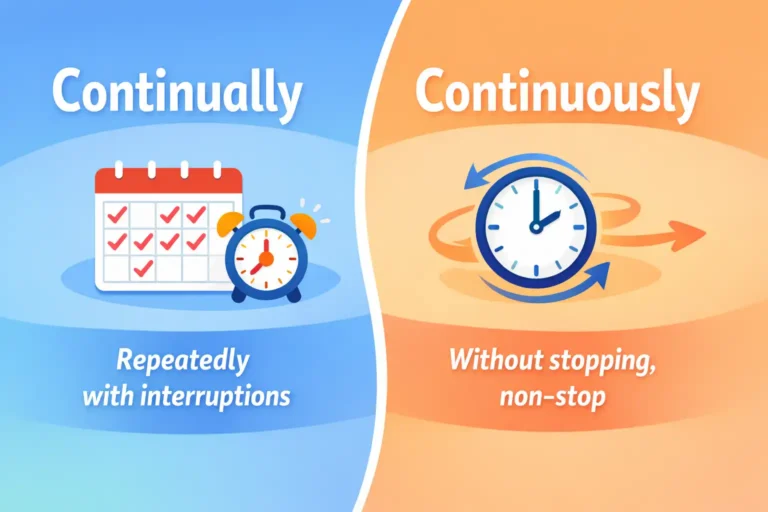
Continually means something happens again and again with small pauses.
Examples:
- The phone rang continually all morning.
- She continually checks her messages.
Meaning of Continuously
Continuously means something happens without any stop or break.
Examples:
- The machine runs continuously for 24 hours.
- Water flows continuously from the pipe.
Easy rule:
If something repeats with breaks → continually
If something never stops → continuously
The Origin of Continually vs Continuously
Both words come from the same Latin root continuus, which means unbroken or connected. The English verb continue developed from this root during the Middle Ages.
Later, English formed two adverbs:
- Continually
- Continuously
At first, the meanings overlapped. Writers often used them as synonyms. Over time, language experts started to separate their meanings to make communication clearer.
Now most modern style guides explain the difference:
- Continually → repeated actions with pauses
- Continuously → actions without interruption
However, everyday speech still mixes them. That is why confusion continues today.
Many dictionaries still mention that casual usage may overlap. Yet professional writing usually keeps the distinction.
British vs American English Spelling
Good news: there is no spelling difference between British and American English for these two words.
Both forms remain the same in all major English varieties.
| Word | American English | British English |
| Continually | Continually | Continually |
| Continuously | Continuously | Continuously |
So the difference is not spelling. Instead, the difference depends only on meaning and usage.
Examples:
American usage
The teacher continually reminds students to study.
British usage
The engine runs continuously during testing.
The spelling stays identical.
How to Choose the Right Word Fast
Choosing the correct word becomes simple when you think about time and pauses.
If the action repeats many times but stops between events, use continually.
Example
The manager continually calls meetings.
Meetings happen again and again. They do not run without stopping.
If the action never stops at all, use continuously.
Example
The alarm sounded continuously for five minutes.
The sound did not pause.
Quick audience guidance
US writers
Follow the pause vs no-pause rule.
UK and Commonwealth writers
Use the same rule. Style guides usually keep this difference.
Global or professional writing
Editors prefer the clearer distinction between the two words.
Fast decision tip
Ask one question:
“Does the action stop at any moment?”
Yes → continually
No → continuously
Common Mistakes with Continually vs Continuously
Many mistakes appear because the words look nearly identical.
Here are common errors.
❌ Incorrect: The machine breaks down continuously.
✅ Correct: The machine breaks down continually.
Explanation: Breakdowns happen many times, not nonstop.
❌ Incorrect: The river flows continually.
✅ Correct: The river flows continuously.
Explanation: The water never stops flowing.
❌ Incorrect: She complains continuously during meetings.
✅ Correct: She complains continually during meetings.
Explanation: Complaints happen repeatedly, not without pause.
❌ Incorrect: The signal plays continually for ten seconds.
✅ Correct: The signal plays continuously for ten seconds.
Explanation: The sound does not stop.
Editors often see these errors in student writing and blog articles.
Continually vs Continuously in Real Life Examples
Understanding real usage helps the difference become clear.
Emails
Continually example
“I continually receive customer requests about this issue.”
Continuously example
“Our system runs continuously during maintenance.”
News writing
Continually example
“The team continually improved its performance this season.”
Continuously example
“The camera recorded continuously for three hours.”
Social media
Continually example
“I continually forget my password.”
Continuously example
“The music played continuously all night.”
Professional writing
Continually example
“The company continually updates its safety policy.”
Continuously example
“The device monitors temperature continuously.”
In professional writing, this distinction keeps meaning precise.
Continually vs Continuously – Word Usage Patterns and Search Trends
Search interest for continually vs continuously remains steady. Many English learners search for it when writing essays or preparing for exams.
Three groups search for this topic most often:
- ESL learners
- Students writing academic papers
- Content writers and editors
The confusion happens because both words share the same root and structure.
Grammar tools sometimes fail to catch the mistake. A sentence may be grammatically correct even when the word choice changes the meaning.
Consider a real scenario.
A technical manual states:
“The system records data continually.”
Readers may think the system records data again and again, not without interruption. However, the device may actually record data nonstop.
In this case, the correct word is continuously. One small word changes the meaning of the entire instruction.
Continually vs Continuously Comparison Table
| Feature | Continually | Continuously |
| Meaning | Repeated again and again with pauses | Happening without any stop |
| Part of Speech | Adverb | Adverb |
| Context of Use | Repeated events | Nonstop actions |
| Formal vs Informal | Common in both | Common in both |
| Common Mistake | Used when action never stops | Used when action repeats |
| Correct Example | She continually checks her phone. | The machine runs continuously. |
This simple comparison removes most confusion quickly.
Frequently Asked Questions
Is continually the same as continuously?
No. Continually means repeated with pauses. Continuously means without interruption.
Which word is correct in formal writing?
Both are correct. However, writers should choose the one that matches the exact meaning of the action.
Can continually and continuously be interchangeable?
Sometimes in casual speech they overlap. In careful writing, they usually describe different types of actions.
Why do people confuse continually vs continuously?
Both words look similar and come from the same root word continue. Many people assume they mean the same thing.
Can grammar tools detect this mistake?
Some tools miss it because both words are grammatically correct. Human review often catches the difference better.
Is there a British vs American difference?
No. Both varieties use the same spelling and meanings.
Which word shows repetition?
Continually shows repetition with breaks.
Conclusion
The difference between continually vs continuously becomes simple once you focus on one idea: does the action stop or not.
Continually describes actions that happen again and again. Small pauses exist between each event. For example, someone may continually check messages or continually ask questions.
Continuously describes actions that never stop. The activity flows without interruption. Machines run continuously. Water flows continuously.
Many writers confuse these words because they share the same root word. They also look nearly identical. Yet their meanings differ in an important way.
Overall, remember one easy rule.
If something repeats with breaks, choose continually.
If something never stops, choose continuously.
This small difference makes writing clearer and more precise.

Daniel Morris writes about English word differences and spelling confusion. His focus is to provide clear, simple explanations with practical usage examples.