Many English learners mix up continuously vs constantly. The words look similar. They also appear in similar sentences. Because of this, many writers use them the wrong way.
The confusion often happens when people want to describe something that happens again and again. For example, someone may say “The phone rang continuously” when they actually mean “The phone rang constantly.” Both sound similar, but the meaning is not the same.
This mistake matters in real writing. It can change the meaning of a sentence. Editors often notice this problem in essays, emails, and news writing. ESL learners also struggle with it because both words relate to repetition.
So this guide explains the difference in a very clear way. You will learn the meaning of each word, how they are used, and when to choose the right one. By the end, you will easily understand continuously vs constantly and avoid this common mistake.
Continuously vs Constantly – Quick Answer
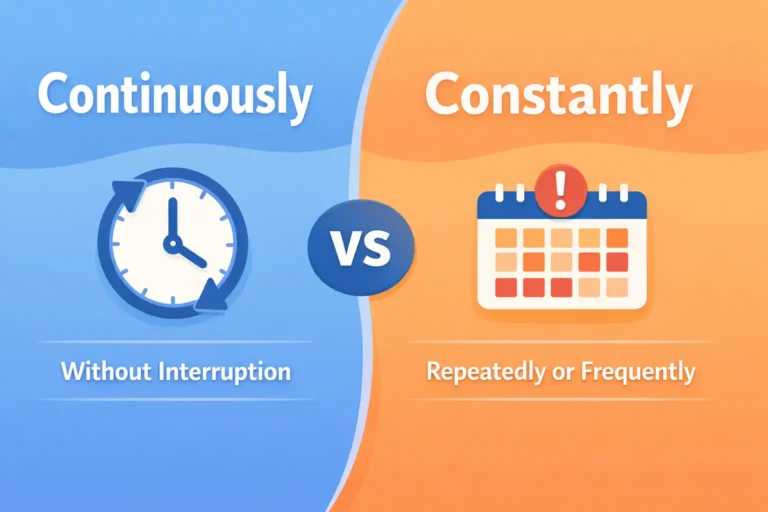
Continuously means something happens without stopping.
Constantly means something happens very often or repeatedly, but it may stop between times.
Meaning of continuously
• Action never stops
• Happens in an unbroken flow
• Example: The machine runs continuously.
Meaning of constantly
• Action repeats many times
• Small pauses may exist
• Example: She constantly checks her phone.
Easy rule:
Use continuously for something that never stops. Use constantly for something that happens again and again.
The Origin of Continuously vs Constantly
Understanding the origin helps explain the difference.
The word continuously comes from the Latin word continuus. It means unbroken or connected. The English word “continuous” appeared in the 1600s. Writers used it to describe actions that do not stop.
For example, scientists often use it when describing processes. A machine may run continuously. Water may flow continuously.
The word constantly comes from the Latin word constans. It means steady or firm. Over time, English speakers began using it to describe repeated actions.
So a person might constantly ask questions. A dog might constantly bark. The action repeats often, but it may pause between times.
This history explains why people confuse the words today. Both words suggest ongoing activity. However, one means unbroken action, while the other means frequent repetition.
British vs American English Spelling
Good news: there is no spelling difference between British and American English.
Both regions use the same spellings:
| Word | American English | British English |
| Continuously | continuously | continuously |
| Constantly | constantly | constantly |
The difference is not about spelling. It is about usage and meaning.
Examples in both styles:
American English
• The system runs continuously.
• The manager constantly checks reports.
British English
• The river flows continuously.
• The teacher constantly reminds students.
So writers around the world follow the same rule. The meaning difference stays the same everywhere.
How to Choose the Right Word Fast
Many writers want a quick way to decide.
Use continuously when the action never stops.
Examples
• The air conditioner runs continuously in summer.
• Rain fell continuously all night.
Use constantly when the action happens again and again.
Examples
• My phone constantly receives notifications.
• The baby constantly cries during the night.
Audience guidance
US writers
Both words appear in everyday writing. Choose based on meaning.
UK and Commonwealth writers
The usage rule stays the same. Context decides the word.
Global or professional writing
Use continuously for processes, machines, or flows. Use constantly for repeated actions or habits.
Quick decision rule
If the action has no pause, use continuously.
If it repeats many times, use constantly.
Common Mistakes with Continuously vs Constantly
Writers often confuse these words because both suggest ongoing activity.
Here are common mistakes.
❌ Incorrect: The alarm rang continuously all morning.
✅ Correct: The alarm rang constantly all morning.
Explanation: The alarm rang many times, not in one unbroken sound.
❌ Incorrect: The machine constantly runs during production.
✅ Correct: The machine runs continuously during production.
Explanation: Machines usually run without stopping.
❌ Incorrect: She continuously checks social media.
✅ Correct: She constantly checks social media.
Explanation: Checking social media happens many times, not nonstop.
Editors frequently see this mistake in essays and online articles. The confusion usually happens when people think both words mean “always.” In reality, the pattern of action is different.
Continuously vs Constantly in Real Life Examples
Seeing real usage makes the difference clearer.
Emails
Continuous usage
“The system runs continuously, so please monitor the temperature.”
Constant usage
“I constantly receive duplicate emails from the system.”
News writing
Continuous
“The river flowed continuously after the heavy rain.”
Constant
“Residents constantly complain about traffic noise.”
Social media
Continuous
“The livestream runs continuously for 24 hours.”
Constant
“I constantly refresh the page for updates.”
Professional writing
Continuous
“The factory operates continuously during peak demand.”
Constant
“The team constantly improves the product design.”
These examples show how context changes the word choice.
Continuously vs Constantly – Word Usage Patterns and Search Trends
Search interest for continuously vs constantly is common among students and ESL learners.
Many people search this topic when writing essays, reports, or emails. Grammar learners also look for the difference because the words appear similar in dictionaries.
Writers often confuse them when describing time or repetition. For example, someone might say “The phone rang continuously” when they actually mean repeated ringing.
Professional editors notice this issue often. It appears in academic writing, blog posts, and even news articles.
A real-world confusion example
Imagine a report that says:
“The machine stopped because it could not run constantly.”
This sounds strange. Machines usually run continuously, not constantly. Using the wrong word may confuse readers about the process.
Because of this, learning the difference improves clarity in writing.
Comparison Table: Continuously vs Constantly
| Feature | Continuously | Constantly |
| Meaning | Without stopping | Happening again and again |
| Part of speech | Adverb | Adverb |
| Context of use | Processes, machines, flows | Habits, repeated actions |
| Formal vs informal | Common in technical writing | Common in everyday speech |
| Common mistake | Used when repetition is meant | Used when nonstop action is meant |
| Correct example | The engine runs continuously. | She constantly checks her messages. |
This table helps readers quickly understand the difference.
Frequently Asked Questions
Is continuously the same as constantly?
No. Continuously means without stopping, while constantly means repeatedly.
Which word is correct in formal writing?
Both words are correct. However, technical writing often uses continuously for processes and systems.
Can continuously and constantly be used interchangeably?
Not usually. Using the wrong word can change the meaning of a sentence.
Why do people confuse continuously and constantly?
The words look similar and both describe ongoing activity. Many learners assume they mean the same thing.
Can grammar tools detect this mistake?
Sometimes. Tools may flag context errors, but many cannot detect meaning differences.
Is there a British vs American difference?
No. Both varieties of English use the same spelling and meaning rules.
Which word appears more in everyday speech?
Constantly appears more in casual conversation because people often describe repeated actions.
Conclusion
The difference between continuously vs constantly is simple once you understand the pattern of action.
Continuously describes something that never stops. Machines, rivers, and processes often run continuously. The action flows in one unbroken line.
Constantly describes something that happens again and again. The action repeats many times. However, small pauses may exist between events.
Writers often confuse these words because both describe ongoing activity. Yet using the wrong one can change the meaning of a sentence.
In everyday communication, this mistake appears in emails, essays, and news writing. Learning the correct usage helps readers understand your message clearly.
Overall, the easiest rule to remember is this:
If the action never stops, use continuously. If it repeats many times, use constantly.
Keeping this rule in mind will help you avoid one of the most common word comparison mistakes in English writing.

Daniel Morris writes about English word differences and spelling confusion. His focus is to provide clear, simple explanations with practical usage examples.