Many people stop and think when they see cuatro or quatro. The words look very similar. However, only one is correct in most cases. Therefore, confusion happens often, especially for students, beginners, and non-native speakers. Moreover, search results and social media posts can make the mistake look normal. As a result, users feel unsure about which spelling to trust.
This confusion usually appears when people write numbers, names, or short phrases. For example, learners of Spanish often mix English spelling habits with Spanish words. Meanwhile, writers may assume both forms are accepted. In contrast, language rules are much stricter.
In this guide, you will learn the clear difference between cuatro and quatro. Additionally, you will see why people confuse them and how to avoid errors. Finally, you will get simple rules that work every time. Overall, this article solves one clear problem: choosing the right spelling with confidence.
To compare foreign-language spelling differences, use the word comparison hub.
Cuatro or Quatro – Quick Answer
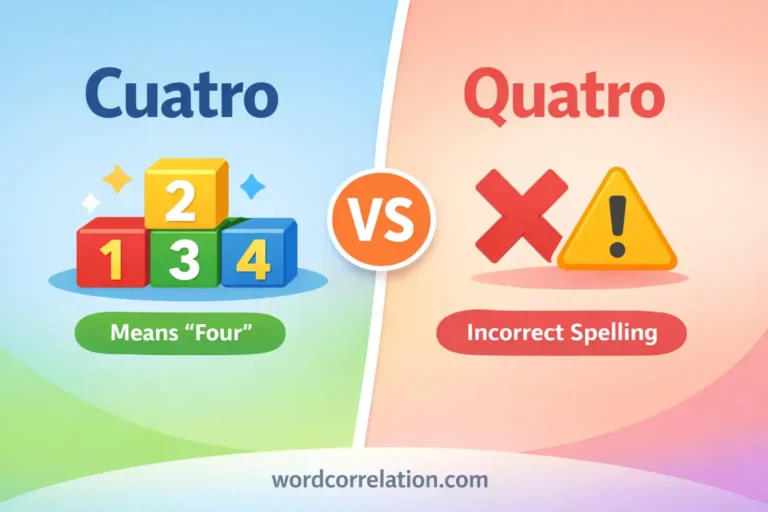
- Cuatro is correct in Spanish. It means the number four.
- Quatro is usually incorrect in Spanish.
- Some brand names use Quattro, but that is different.
Example:
- ✅ Tengo cuatro libros.
- ❌ Tengo quatro libros.
The Origin of Cuatro
The word cuatro comes from Latin. It started with quattuor, which also meant four. Over time, Spanish simplified the sound and spelling. Therefore, cuatro became the standard form.
However, confusion appeared later. Portuguese uses quatro with a “qu.” As a result, learners who see both languages often mix them. Moreover, English speakers expect “qu” before “a” in many words. This habit adds to the problem.
In contrast, Spanish spelling rules are very stable. The sound /kw/ is written as cu before “a” and “o.” Because of this rule, cuatro is correct. Meanwhile, quatro breaks Spanish spelling logic. Overall, history explains the error clearly.
This pair fits under our word confusion pillar.
British English vs American English Spelling
Some users think this is an English spelling issue. However, that idea is incorrect. Cuatro and quatro are not English number words. Therefore, British and American English do not change the spelling.
In contrast, the difference comes from Spanish vs Portuguese, not English varieties.
Key comparison:
| Language | Correct Form | Example |
| Spanish | cuatro | cuatro amigos |
| Portuguese | quatro | quatro pessoas |
| English | four | four people |
Whereas British and American English differ in words like colour and color, they agree here. As a result, English spelling rules do not apply.
Which Spelling Should You Use?
The right choice depends on your audience. Therefore, context matters a lot.
For US readers:
Use cuatro only when writing Spanish. Otherwise, write four.
For UK and Commonwealth readers:
Follow the same rule. Moreover, avoid quatro unless you write Portuguese.
For global or professional writing:
Stick to cuatro in Spanish text. Additionally, double-check brand names.
In short, language decides the spelling, not location. Another letter-based mix-up is patty or paddy.
Common Mistakes with Cuatro or Quatro
Many errors follow the same pattern. Therefore, spotting them is easy.
- ❌ Quatro (Spanish context) → ✅ Cuatro
Reason: Spanish never uses “qu” before “a.” - ❌ Cuatro (Portuguese sentence) → ✅ Quatro
Reason: Portuguese spelling rules are different. - ❌ Mixing with English → ✅ Keep languages separate
Reason: Each language has its own system.
Overall, mixing languages causes most mistakes.
Cuatro or Quatro in Everyday Examples
Seeing real use helps learning faster. Therefore, check these cases.
Emails:
- “I will learn cuatro new words today.”
News:
- “The class studied cuatro basic verbs.”
Social media:
- “Only cuatro days left!”
Formal writing:
- “The report lists cuatro key results.”
Meanwhile, quatro appears mainly in Portuguese posts or brand names.
Cuatro or Quatro – Google Trends & Usage Data
Search behavior shows clear patterns. Therefore, data supports the rule.
- Countries:
- Spain, Mexico: cuatro dominates
- Brazil, Portugal: quatro dominates
- User types:
- Students: often confused
- ESL learners: frequent mistakes
- Writers: usually correct
- Professionals: mostly accurate
Correct usage is rising. However, common mistakes still appear in mixed-language content.
Comparison Table: Cuatro vs Quatro
| Feature | Cuatro | Quatro |
| Meaning | Number four | Number four |
| Part of speech | Numeral | Numeral |
| Context of use | Spanish language | Portuguese language |
| Formal vs informal | Both | Both |
| Common mistakes | Spelled as quatro | Used in Spanish |
| Correct example | cuatro libros | quatro livros |
This table removes confusion instantly.
FAQs – People Also Ask
Is cuatro the same as quatro?
No. They belong to different languages.
Which one is correct in formal writing?
Use cuatro for Spanish. Use quatro for Portuguese.
Can they be used interchangeably?
No. Each fits only one language.
Why do people confuse them?
Because they look similar and sound alike.
Can grammar tools catch this mistake?
Sometimes. However, mixed languages confuse tools.
Is there a British vs American difference?
No. English does not affect this choice.
Conclusion
Overall, cuatro or quatro looks confusing at first. However, the rule is simple once you see it clearly. Cuatro belongs to Spanish. Quatro belongs to Portuguese. Therefore, language choice decides everything. A similar spelling confusion appears in arc or ark.
Many users make mistakes because they mix spelling habits. Moreover, online content often shows errors without correction. As a result, confusion spreads fast. In contrast, strong basics solve the problem.
When writing Spanish, always choose cuatro. When writing Portuguese, choose quatro. Finally, never guess based on looks alone. In short, one easy rule works every time: match the word to the language. Follow this rule, and you will never hesitate again.

Daniel Morris writes about English word differences and spelling confusion. His focus is to provide clear, simple explanations with practical usage examples.