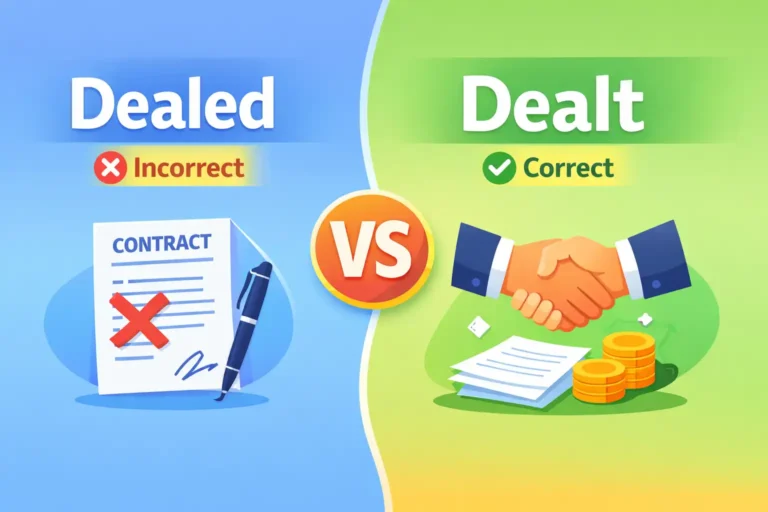
Many English learners type “dealed vs dealt” into Google because both words look possible. The verb deal is common in daily English. People use it in business, games, news, and conversation. Yet the past form often causes confusion.
Writers, students, and ESL learners frequently ask: Is “dealed” correct? Or should we always write “dealt”? The confusion happens because many English verbs add -ed in the past tense. So “dealed” feels logical. However, English does not always follow simple rules.
Editors often see this mistake in emails, blog posts, and school writing. A sentence may sound correct to the writer, but the grammar form is wrong. This can make the text look unprofessional or non-native.
This guide explains the difference between dealed vs dealt in very simple terms. You will learn the correct meaning, the history of the word, common mistakes, and how to choose the right form quickly in real writing.
Dealed vs Dealt – Quick Answer
Meaning of Dealed
- “Dealed” is not standard English.
- It appears only in rare dialect speech.
- Standard grammar does not accept it as the past tense of deal.
Examples
- ❌ He dealed the cards quickly.
- ❌ She dealed with the problem.
Meaning of Dealt
- “Dealt” is the correct past tense and past participle of deal.
- It appears in all standard writing.
Examples
- ✅ He dealt the cards quickly.
- ✅ She dealt with the problem calmly.
Easy rule:
If you talk about the past of deal, always use dealt.
The Origin of Dealed vs Dealt
The verb deal has a long history in English. It comes from the Old English word “dælan,” which meant to divide or distribute. Over time, the meaning expanded. People began using it when sharing cards, handling situations, or doing business.
English verbs developed in two main groups: regular verbs and irregular verbs. Regular verbs follow a simple rule. They add -ed in the past tense, like work → worked or play → played.
However, deal became an irregular verb. Its past tense changed internally rather than adding -ed. That is how deal → dealt formed.
So where did “dealed” come from?
The answer is simple. Many learners expect verbs to follow the normal -ed pattern. As a result, they create the form dealed by mistake. Some dialect speakers may also say it in casual speech. Yet modern grammar guides and dictionaries do not accept it as standard.
Therefore, confusion happens because English mixes regular patterns with older irregular verbs.
British vs American English Spelling
In some word comparisons, spelling differs between American and British English. For example, color vs colour. However, this is not the case with dealed vs dealt.
Both American English and British English use dealt as the correct past form.
Here is a quick comparison.
| Aspect | Dealed | Dealt |
| Standard spelling | ❌ Not accepted | ✅ Correct in US and UK |
| Grammar role | Incorrect past tense | Past tense and participle |
| Formal writing | Never used | Always used |
| Dictionaries | Rare dialect note | Standard form |
Because both regions use the same form, writers do not need to worry about regional spelling differences.
How to Choose the Right Word Fast
Choosing between dealed vs dealt is actually very easy once you know the rule.
For US writers
Always use dealt when describing something that already happened.
Example
- The company dealt with the issue yesterday.
For UK and Commonwealth writers
The rule is exactly the same. British English also uses dealt.
Example
- Police dealt with the situation quickly.
For global or professional writing
International writing, journalism, and academic texts all follow the same standard. Use dealt as the past form.
Example
- The negotiator dealt with several difficult questions.
In short, there is no situation in standard English where “dealed” is correct.
Common Mistakes with Dealed vs Dealt
Writers often make the same errors when using this verb. These mistakes usually come from applying the regular -ed rule.
Here are the most common examples.
❌ Incorrect:
He dealed the cards during the game.
✅ Correct:
He dealt the cards during the game.
Explanation
Deal becomes dealt, not dealed.
❌ Incorrect:
The manager dealed with many complaints.
✅ Correct:
The manager dealt with many complaints.
Explanation
The phrase deal with also uses the irregular past dealt.
❌ Incorrect:
They have dealed with the problem already.
✅ Correct:
They have dealt with the problem already.
Explanation
In perfect tense, the past participle is still dealt.
Editors frequently correct this error in student essays and online content.
Dealed vs Dealt in Real Life Examples
Seeing the word in real situations makes the rule clearer.
Emails
Correct
- Our support team dealt with your request this morning.
Incorrect
- Our support team dealed with your request this morning.
News writing
Correct
- The government dealt with rising inflation through new policies.
Journalists always follow standard grammar rules, so dealt appears in news reports.
Social media
People sometimes write quickly online. As a result, you may see mistakes like:
- “I dealed with this yesterday.”
However, correct grammar still uses:
- “I dealt with this yesterday.”
Professional writing
Business documents and reports require correct forms.
Example
- The company dealt with the supply issue last quarter.
Using dealed in professional communication may make writing look careless.
Dealed vs Dealt – Word Usage Patterns and Search Trends
Search behavior shows how often learners struggle with this verb. Many users type “is dealed correct?” or “dealed meaning.”
Students and ESL learners search this topic the most. They often follow the normal -ed pattern because it feels logical.
Content writers and bloggers also check this word before publishing. Grammar mistakes can reduce credibility.
A common real-world example happens in customer support communication. Someone might write:
- “We have dealed with your issue.”
Although the message is understandable, the incorrect form may make the company appear less professional.
Therefore, learning the correct past tense dealt helps writers maintain clear and accurate English.
Dealed vs Dealt Comparison Table
| Feature | Dealed | Dealt |
| Meaning | Attempted past form of “deal” | Correct past tense of “deal” |
| Part of speech | Non-standard verb form | Past tense / past participle |
| Context of use | Rare dialect speech only | Standard English everywhere |
| Formal vs informal | Not accepted in formal writing | Used in both formal and informal contexts |
| Common mistake | Created by adding -ed to deal | Correct irregular form |
| Correct example | ❌ She dealed with the issue | ✅ She dealt with the issue |
This simple table removes most confusion instantly.
Frequently Asked Questions
Is dealed the same as dealt?
No. Dealed is incorrect in standard English, while dealt is the proper past tense of deal.
Which word is correct in formal writing?
Formal writing always uses dealt. Professional documents, academic papers, and news articles follow this rule.
Can dealed ever be used?
Some dialect speakers may say it informally, but standard grammar does not accept it. Writers should avoid it.
Why do people confuse dealed vs dealt?
Many English verbs form the past tense with -ed. Because of this pattern, learners often assume deal → dealed.
Can grammar tools detect this mistake?
Yes. Most grammar checkers highlight dealed as an error and suggest dealt.
Is there a British vs American difference?
No. Both American and British English use dealt as the correct past form.
Is dealt also the past participle?
Yes. Dealt works as both the past tense and the past participle.
Examples
- Past tense: She dealt the cards.
- Present perfect: She has dealt the cards.
Conclusion
The confusion between dealed vs dealt happens because English mixes regular and irregular verb patterns. Many verbs add -ed in the past tense, so learners expect the same rule with deal. However, this verb follows a different pattern.
The correct past tense and past participle of deal is always dealt. Standard English uses this form in every context, including conversation, journalism, emails, and professional writing.
Writers often make the mistake of adding -ed, which creates the incorrect form dealed. Although some dialect speakers may say it casually, dictionaries and grammar guides do not recognize it as correct.
Remember one simple rule.
If you talk about the past action of deal, always write dealt.
Overall, keeping this rule in mind will help you avoid a very common grammar mistake and make your writing look clearer and more professional.

Daniel Morris writes about English word differences and spelling confusion. His focus is to provide clear, simple explanations with practical usage examples.