Many people search for discrepancy vs inconsistency because the two words look similar and often appear in the same situations. You may see them in reports, emails, audits, or news articles. Both words suggest that something does not match. Because of that, writers often mix them up.
However, these terms do not mean exactly the same thing. A small wording mistake can change the meaning of a sentence. For example, a financial report may mention a discrepancy, while a witness statement may show an inconsistency. These situations are not identical.
Students, ESL learners, and even experienced writers sometimes confuse the two. Editors also see this mistake often in professional writing. The problem happens because both words describe a difference, yet they focus on different types of problems.
This guide explains discrepancy vs inconsistency in clear, simple language. You will learn the meanings, origins, common mistakes, and real-life examples. By the end, you will know exactly which word to choose in each situation.
Discrepancy vs Inconsistency – Quick Answer
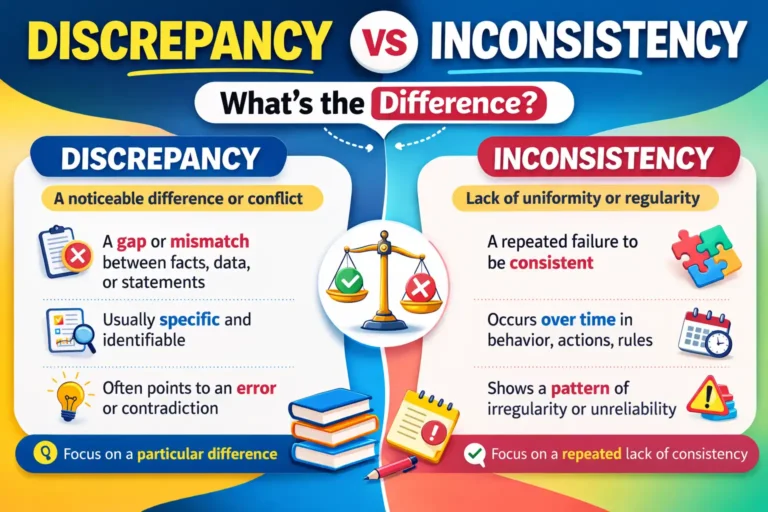
Discrepancy means a difference between two numbers, facts, or records that should match.
Inconsistency means something is not stable, logical, or the same over time.
Key idea:
• Use discrepancy for mismatched data or facts
• Use inconsistency for changing behavior, logic, or statements
Examples:
• The audit found a discrepancy in the sales numbers.
• The witness gave inconsistent answers during the interview.
Easy rule:
Numbers mismatch = discrepancy. Behavior or logic changes = inconsistency.
Meaning of Discrepancy
Discrepancy refers to a difference between two things that should match.
This word usually appears in data, reports, or records.
Common contexts include:
• financial reports
• statistics
• inventory records
• research results
Examples:
• The accountant found a discrepancy between the bank balance and company records.
• There is a discrepancy in the number of items shipped and received.
• The report shows a discrepancy in last year’s sales data.
The key idea is a mismatch between expected information.
Meaning of Inconsistency
Inconsistency describes something that does not stay the same or follow a clear pattern.
It often appears when behavior, statements, or ideas change.
Common contexts include:
• speech or testimony
• writing style
• behavior
• logical arguments
Examples:
• The manager noticed inconsistency in the employee’s work quality.
• The story contains several inconsistencies in the timeline.
• Investigators found inconsistency in the suspect’s statements.
The focus here is lack of stability or logical agreement.
The Origin of Discrepancy vs Inconsistency
Understanding the origin of these words helps explain why people confuse them today.
Discrepancy comes from the Latin word discrepantia, which means “difference or disagreement.” Early English writers used it mainly in scientific and mathematical contexts. Because of that history, the word still appears often in statistics, finance, and research.
Inconsistency comes from the Latin inconsistentia. The root idea means “not standing together.” This explains why the word often describes ideas or actions that do not align.
So the origins show a clear difference:
• Discrepancy → numerical or factual mismatch
• Inconsistency → lack of logical agreement
Today the confusion happens because both words suggest that something is “not matching.” However, they point to different kinds of problems.
British vs American English Spelling
There is no spelling difference between British and American English for these words.
Both regions use the same forms:
• discrepancy
• inconsistency
Pronunciation may vary slightly, but the spelling and meaning remain the same.
Example usage in both regions:
US example:
The audit revealed a discrepancy in the company records.
UK example:
The report noted inconsistency in the witness statements.
Because the spelling does not change, the focus should stay on correct usage, not regional variation.
How to Choose the Right Word Fast
Choosing between discrepancy vs inconsistency becomes easier when you look at the situation.
For US writing
American business writing often uses discrepancy in finance, accounting, and research reports.
Example:
The audit found a discrepancy in quarterly revenue.
For UK or Commonwealth writing
British and Commonwealth English follow the same usage pattern. Reports, research papers, and government documents often use discrepancy for data issues.
Example:
Officials discovered a discrepancy in census numbers.
For global or professional writing
In international communication, clarity matters. Many editors apply a simple rule:
• Use discrepancy for numbers or records
• Use inconsistency for behavior, logic, or statements
This rule works well across industries.
Common Mistakes with Discrepancy vs Inconsistency
Writers often use the wrong word when describing a problem.
Here are frequent errors.
❌ Incorrect: There is an inconsistency in the bank balance.
✅ Correct: There is a discrepancy in the bank balance.
Explanation: Bank balances involve numbers. So “discrepancy” is correct.
❌ Incorrect: The witness showed a discrepancy in his story.
✅ Correct: The witness showed inconsistency in his story.
Explanation: Stories or statements change over time. That creates inconsistency.
❌ Incorrect: The data inconsistency between totals is large.
✅ Correct: The data discrepancy between totals is large.
Explanation: Totals are numbers, so discrepancy fits better.
Editors often see these mistakes in reports, research papers, and news writing.
Discrepancy vs Inconsistency in Real Life Examples
These words appear often in everyday communication.
Email example
There is a discrepancy in last month’s invoice totals. Please check the attached report.
News example
Investigators noticed inconsistencies in the witness statements.
Social media example
Users pointed out an inconsistency in the company’s public message.
Professional writing example
The audit report identified a discrepancy between inventory records and warehouse counts.
Each example shows how the meaning changes depending on the context.
Discrepancy vs Inconsistency – Word Usage Patterns and Search Trends
Search interest for discrepancy vs inconsistency is common among students, ESL learners, and professional writers.
Students often see these words in academic writing or research papers. Because both terms describe differences, confusion happens easily.
Editors and journalists also check the difference because incorrect usage may change the meaning of a report.
A real-world example shows why this matters.
Imagine a financial news article that says:
“The company showed inconsistencies in its quarterly revenue.”
Readers may think the company changed its reporting style. However, the real issue may be a discrepancy in the numbers. That small wording mistake can cause misunderstanding.
Clear word choice helps readers understand the exact problem.
Discrepancy vs Inconsistency Comparison Table
Aspect | Discrepancy | Inconsistency
Meaning | A mismatch between facts, numbers, or records | Lack of stability or logical agreement
Part of speech | Noun | Noun
Context of use | Data, finance, research, statistics | Behavior, statements, logic
Formal vs informal usage | Mostly formal or professional | Used in both formal and everyday language
Common mistakes | Used for changing behavior | Used for data mismatch
Correct example | The audit revealed a discrepancy in the accounts. | The witness showed inconsistency in his statements.
This table helps readers see the difference instantly.
FAQs About Discrepancy vs Inconsistency
Is discrepancy the same as inconsistency?
No. A discrepancy means numbers or records do not match. An inconsistency means something changes or lacks logical agreement.
Which word is correct in formal writing?
Both words are correct. However, formal reports usually use discrepancy for data problems and inconsistency for logical or behavioral issues.
Can discrepancy and inconsistency be used interchangeably?
Not usually. Each word describes a different type of mismatch, so replacing one with the other may change the meaning.
Why do people confuse discrepancy and inconsistency?
Both words describe differences. Because they appear in similar contexts, writers sometimes treat them as synonyms.
Can grammar tools detect this mistake?
Some grammar tools flag the issue, but many do not. Writers often need to check the context themselves.
Is there a British vs American difference?
No. Both British and American English use the same spelling and meanings for these words.
Which word appears more in business reports?
Business and financial reports often use discrepancy, especially when discussing numbers or records.
Conclusion
Understanding discrepancy vs inconsistency becomes simple when you focus on the type of difference being described.
A discrepancy refers to numbers, facts, or records that do not match. This word appears often in audits, research reports, and financial documents. It highlights a clear mismatch between expected data.
An inconsistency, however, describes something that does not stay stable or logical. Writers use it when behavior changes, statements conflict, or ideas fail to align.
Many writers confuse the two because both suggest that something is wrong. Yet the context makes the difference clear. Numbers and records point to discrepancy, while logic and behavior point to inconsistency.
Overall, remembering one simple rule helps avoid mistakes.
If data does not match, use discrepancy. If behavior or statements change, use inconsistency.
This small distinction makes writing clearer and prevents confusion for readers.

Daniel Morris writes about English word differences and spelling confusion. His focus is to provide clear, simple explanations with practical usage examples.