Email vs. E-mail: Why the Spelling Confuses Writers
Many people pause when they type e-mail vs email. Both forms look correct, but only one often appears in modern writing. This small dash creates big confusion for students, writers, and even professionals.
The problem happens because language changes over time. At first, people wrote e-mail with a hyphen. But later, many style guides removed the hyphen and started using email instead. Today, both forms still exist, and different dictionaries or writing styles may prefer one.
You may see this question when writing messages, creating an email account, or searching your e mail inbox. You might also wonder what dictionaries like Oxford or Merriam-Webster say, or how British English and American English treat the word.
So which one is right?
In this guide, you will learn the simple history of the word, why the confusion still exists, and how to choose the correct spelling quickly in everyday writing.
e-mail vs email – Quick Answer
Meaning of e-mail vs email
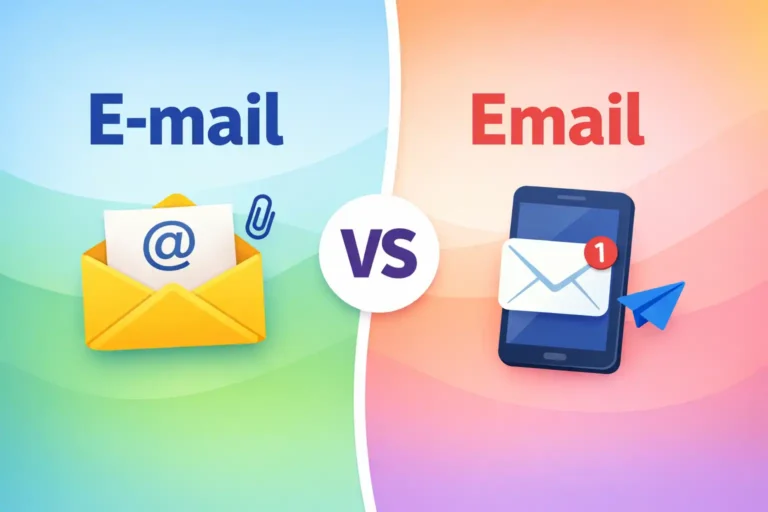
Both e-mail and email mean the same thing: a digital message sent through the internet.
- Email = modern spelling
- E-mail = older spelling with a hyphen
Examples:
- “I sent you an email yesterday.”
- “Please check your e-mail inbox.”
Easy rule:
Use email in most modern writing. Use e-mail only if a style guide requires the hyphen.
The Origin of e-mail vs email
The word started in the early days of the internet. It came from the phrase electronic mail.
At first, writers shortened the phrase to e-mail. The hyphen showed that the word combined two ideas:
- e = electronic
- mail = message delivery
Early computer manuals and technology news used e-mail almost everywhere.
Over time, English language habits changed. People started removing hyphens from many tech words. For example:
- online (once written on-line)
- website (once written web-site)
The same thing happened with email. By the 2000s, many newspapers and tech companies dropped the hyphen.
Today, dictionaries like the Oxford Dictionary and Merriam-Webster list email as the main spelling, while e-mail still appears as a variant.
Why People Still Confuse Email and E-mail
Even though language moved toward email, confusion still exists for several reasons.
First, older style guides still use e-mail. Some universities and government documents follow those older rules.
Second, some writing styles prefer consistency with other words starting with e-, such as e-commerce.
Third, people see both forms online. When you search phrases like e mail or email gmail or email or e mail login, both spellings appear in results.
Because of this mix, many writers are unsure which version is correct.
The good news is that the difference is mostly stylistic, not grammatical.
British English vs American English Spelling
Unlike many English words, email spelling does not strongly differ between British and American English.
Both regions mostly use email today.
However, some older publications in the UK once preferred e-mail. That is why people still ask: “Is it e mail or email in the UK?”
General spelling pattern
| Region | Most common spelling |
| United States | |
| United Kingdom | |
| Older publications |
UK and US Usage Examples
American English example
- “Send me an email after the meeting.”
British English example
- “I will reply to your email later today.”
So the spelling difference between countries is minimal today.
How to Choose the Right Word Fast
If you are unsure whether to write e-mail or email, use this simple audience guide.
US
Use email.
Most American style guides, newspapers, and technology companies prefer this form.
UK / Commonwealth
Use email in most modern writing.
Some older institutions may still use e-mail, but this is less common today.
Global or professional writing
Choose email.
International companies, online platforms, and business communication almost always use email. It looks modern and clear.
In short, email works everywhere unless a specific style guide tells you to keep the hyphen.
Common Mistakes with e-mail vs email
Writers usually make small formatting mistakes with this word.
1. Mixing both spellings
❌ Incorrect
- “Send me an e-mail and I will answer your email.”
✅ Correct
- “Send me an email and I will reply soon.”
Use one spelling consistently.
2. Adding spaces
❌ Incorrect
- “Check your e mail inbox.”
✅ Correct
- “Check your email inbox.”
The word should never be written with a space.
3. Capitalizing the letter incorrectly
❌ Incorrect
- “I sent you an Email.”
✅ Correct
- “I sent you an email.”
The word usually stays lowercase unless it begins a sentence.
e-mail vs email in Everyday Examples
Here are examples of how the word appears in real life.
Emails
- “Please confirm by email.”
- “Your email account was created successfully.”
News
Technology articles almost always write:
- “Users received a security email warning.”
Social media
Short posts usually prefer the simpler spelling:
- “DM or email us for details.”
Formal or professional writing
Business communication also uses email.
Example:
- “You will receive the contract by email today.”
Even in legal or corporate settings, the modern spelling is becoming standard.
e-mail vs email – Usage Patterns & Search Interest
Search patterns show that email is far more common today.
Students, writers, and ESL learners often search the phrase e-mail vs email because they want to know which spelling is correct.
Typical user groups include:
- students learning English grammar
- content writers and bloggers
- business professionals
- people creating an email account
One real-world confusion happens in professional writing. A report might switch between e-mail and email, which makes the text look inconsistent. Editors usually correct this by choosing one style.
Because modern usage favors email, most organizations adopt that version.
e-mail vs email Comparison Table
| Feature | ||
| Meaning | Electronic message sent online | Same meaning |
| Part of speech | Noun / verb | Noun / verb |
| Context of use | Older style guides | Modern writing |
| Formal vs informal | Acceptable but dated | Standard in most contexts |
| Common mistakes | Mixing with “email” in same text | Rare mistakes |
| Correct example | “Send an e-mail update.” | “Send an email update.” |
This table shows that the meaning stays the same. Only the style changes.
People Also Ask (FAQs)
Is it e mail or email in the UK?
In modern British English, the most common spelling is email. Older texts may still use e-mail, but it is less common today.
What is the difference between email and mail?
Email means electronic messages sent through the internet. Mail usually means physical letters or packages delivered by postal services.
Is the e in email capitalized?
No. The word email is usually lowercase. It only becomes capitalized if it starts a sentence.
When did e-mail become an email?
The change started in the late 1990s and early 2000s. Many dictionaries and style guides slowly removed the hyphen during that time.
Is e-mail correct or email?
Both are correct. However, email is the modern standard and appears more often in writing today.
Is Gmail an email or mail?
Gmail is an email service. It allows users to send and receive digital messages.
Can I say mail instead of email?
You can sometimes shorten email to mail in casual speech, but it may cause confusion because mail also means postal letters.
Is it e-mail or email in Chicago style?
The Chicago Manual of Style now recommends email without the hyphen.
Which one is correct in formal writing?
Most modern formal writing uses email. Only follow e-mail if a specific style guide requires it.
Final Answer: Should You Write Email or E-mail?
The debate around e-mail vs email exists because language evolves. In the early internet era, writers used e-mail with a hyphen to show it came from “electronic mail.” Over time, the word simplified to email, just like many other tech terms.
Today, both spellings still mean the same thing. But modern dictionaries, style guides, and professional writing strongly prefer email.
So when should you use each form?
Use email for everyday writing, business communication, social media, and academic work. It is the modern standard in both American and British English.
Use e-mail only if a style guide or organization specifically requires it.
One mistake to avoid is mixing both spellings in the same document. Consistency always improves clarity.
Overall, the easiest rule to remember is simple:
If you are unsure, choose “email.”
Meta Description:
e-mail vs email explained clearly. Learn the correct modern spelling, usage rules, and when to use each form in everyday writing.
SEO Title: e-mail vs email: Which Spelling Is Correct in 2026?

Daniel Morris writes about English word differences and spelling confusion. His focus is to provide clear, simple explanations with practical usage examples.