Many learners ask this because both words look like the same idea. In many sentences, they are near-synonyms. But small differences in tone and usage can change which one sounds more natural.
This guide explains the expensive vs costly meaning, shows real examples, and gives a fast rule you can use in daily writing, emails, and formal English.
expensive vs costly – Quick Answer
- Both words can mean “high in price.”
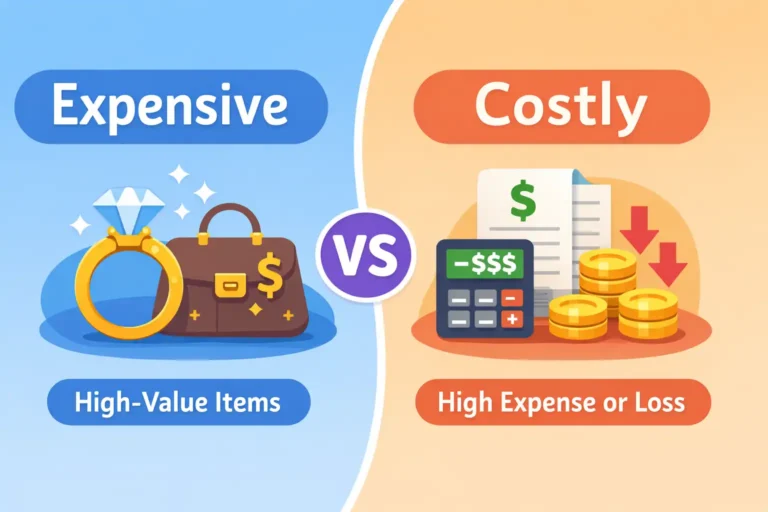
- Costly also often means causing loss, damage, or sacrifice (not only money).
- Example: The watch is expensive. / The delay was a costly mistake.
- Easy rule: Use expensive for everyday prices; use costly for formal tone or loss/damage.
The Origin of expensive vs costly (simple history)
The two words come from different paths, which helps explain their feel today.
- Expensive comes from expense and was used in English in the 1600s. Etymonline notes an early sense linked to spending a lot, and later the meaning “costly.”
- Costly is older in English. It comes from cost + -ly, and the root of cost goes back through Old French and Latin.
Reason for confusion today
People confuse them because dictionaries often define one with the other. Merriam-Webster lists costly as a synonym of expensive, and also defines both in terms of high price or heavy expense.
So yes, they overlap a lot. But usage patterns are not always the same.
British English vs American English Spelling
Here is the key point:
There is no British vs American spelling difference for these two words.
- ✅ expensive (UK and US)
- ✅ costly (UK and US)
Cambridge shows the same spellings for both words and gives UK/US pronunciation entries, which means the main difference is pronunciation style, not spelling.
Short examples
- UK/US: This hotel is expensive.
- UK/US: That error was costly.
Mini comparison table
| Word | UK Spelling | US Spelling | Notes |
| expensive | expensive | expensive | Same spelling |
| costly | costly | costly | Same spelling |
How to Choose the Right Word Fast
If spelling does not vary, focus on tone and meaning range.
US
In everyday US English, expensive is the safest choice for price:
- Gas is expensive.
- That laptop looks expensive.
People also say pricey in casual speech (yes, Americans do say “pricey”). Cambridge lists pricey as an informal synonym in its expensive-related examples.
UK / Commonwealth
UK English also uses expensive very often for normal price talk.
- London can be expensive.
- That coat is too expensive.
In UK/Commonwealth writing, costly works too, but it can sound a bit more formal or stronger in tone, especially in news or analysis.
Global or professional writing
Use costly when you mean:
- high price and/or
- loss, damage, risk, sacrifice
Examples:
- A costly delay
- A costly legal dispute
- A costly repair
Oxford Learner’s (snippet) labels costly as “somewhat formal” in a pricing sense, which matches common usage in professional writing.
Common Mistakes with expensive vs costly
Here are frequent errors learners make.
❌ Incorrect → ✅ Correct
- ❌ It was an expensive mistake.
✅ It was a costly mistake.
Why: “Expensive mistake” is possible, but costly mistake is the common, natural phrase. - ❌ This pen is very costly (casual chat, simple shopping context)
✅ This pen is very expensive.
Why: In daily speech, expensive sounds more natural. - ❌ The surgery was expensive in time and trust.
✅ The delay was costly in time and trust.
Why: Costly fits non-money loss better. - ❌ Hermès is costly and expensive same same.
✅ A Hermès bag can be expensive, and upkeep or mistakes can be costly.
Why: Use expensive for purchase price; use costly for losses or consequences.
Merriam-Webster also shows costly in examples like a costly mistake and costly victory, which supports this pattern.
Expensive vs Costly in Everyday Examples
Emails
- Natural: This option is less expensive than the premium plan.
- More formal: A delay now could be costly later.
- Polite version: This option may be too expensive for our current budget.
News
News writing often uses costly for damage, war, policy errors, or delays:
- The storm caused costly damage.
- The delay became a costly mistake.
It also uses expensive for markets, products, housing, and living costs:
- Housing is expensive in major cities.
Social media
Casual posts usually choose expensive:
- Coffee is so expensive now 😭
- Cute, but too expensive for me.
If you saw an expensive vs costly Reddit thread, you likely noticed this pattern: people use expensive for shopping talk and costly for consequences or formal tone.
Formal or professional writing
- The company adopted a less costly process.
- The project faced costly delays.
- This was the most expensive phase of construction.
Merriam-Webster examples also include less costly materials, which is very common in business writing.
Expensive vs Costly – Usage Patterns & Search Interest
General popularity trends (no exact numbers)
- Expensive appears more in daily speech and beginner learning.
- Costly appears more in formal writing, headlines, and analysis.
- Both words are common, but they do different jobs.
Typical user groups
People who search this topic often include:
- Students
- ESL learners
- Writers and bloggers
- Professionals writing emails or reports
- Puzzle users (for searches like costly, expensive crossword clue)
One real-world misuse that causes confusion
If someone writes “an expensive mistake” in a formal report, it may sound less precise. Readers may think only about money. But “a costly mistake” can include money, time, reputation, and risk. That makes the message clearer.
COMPARISON TABLE
Use this table when you need a fast answer.
| Feature | expensive | costly |
| Meaning | High in price | High in price; can also mean causing loss/damage |
| Part of speech | Adjective | Adjective |
| Context of use | Everyday speech, shopping, prices | Formal writing, news, business, consequences |
| Formal vs informal usage | Neutral/common | Often more formal (especially in some contexts) |
| Common mistakes | Using it for “mistake/delay” when “costly” is more natural | Using it in very casual shopping talk when “expensive” sounds simpler |
| Correct example | This phone is expensive. | The delay was costly. |
PEOPLE ALSO ASK (SEMANTIC FAQs)
What is the difference between costly and expensive?
Both can mean high price. Costly also often means causing loss, damage, or sacrifice. Expensive is more common in everyday price talk.
Does costly mean expensive?
Yes, often. But costly can also mean something that causes serious loss, not just a high price.
What does “costly” mean?
It means expensive, and it can also mean causing loss or damage, like a costly error.
What do we mean by “expensive”?
We mean something that costs a lot of money or needs a lot of spending.
How to use costly?
Use costly in formal or serious contexts:
- a costly mistake
- costly repairs
- a costly delay
How to use the word “expensive”?
Use expensive for common price talk:
- an expensive bag
- expensive rent
- too expensive for me
Is costly the same as expensive?
They are near-synonyms, not always exact twins. In many price sentences, yes. In “loss/damage” sentences, costly is often better.
Which one is correct in formal writing?
Both are correct. In formal writing, costly often works better for mistakes, delays, damage, or sacrifice. Expensive is great for direct price meaning.
What is another word for expensive?
Common options include costly, pricey (more informal), and high-priced. Choose based on tone and context.
CONCLUSION
The expensive vs costly question is common because the words overlap a lot. In simple price talk, both can work. That is why learners, writers, and even native speakers ask about it.
But the best choice depends on context and tone. Use expensive when you talk about the price of things in normal conversation: clothes, rent, food, phones, travel. Use costly when you want a more formal tone or when the meaning includes loss, damage, time, or sacrifice: a costly mistake, costly repairs, costly delays.
The one mistake to always avoid is using only dictionary meaning and ignoring real usage patterns. A sentence may be grammatically correct but still sound less natural.
Overall, both words are correct. In short, choose expensive for everyday prices and costly for formal writing or consequences. Finally, remember this easy rule: if it is about shopping, use expensive; if it is about damage or impact, use costly.

Daniel Morris writes about English word differences and spelling confusion. His focus is to provide clear, simple explanations with practical usage examples.