Many people search fowl or foul because both words sound the same. However, their meanings are very different. This confusion often appears in exams, emails, social posts, and even news writing. As a result, writers feel unsure and hesitate before using either word.
Moreover, spellcheck tools do not always help because both words are correct English. Therefore, mistakes keep happening again and again. This article solves that exact problem. It explains the clear difference between fowl and foul in very simple English. Additionally, it shows when to use each word without guessing.
You will also learn why people confuse them so often. Furthermore, you will see real examples from daily life. By the end, you will have one easy rule that works every time. In short, this guide removes doubt and builds confidence for students, ESL learners, and professionals alike.
For words that sound the same but differ in meaning, use the word comparison hub.
Fowl or Foul – Quick Answer
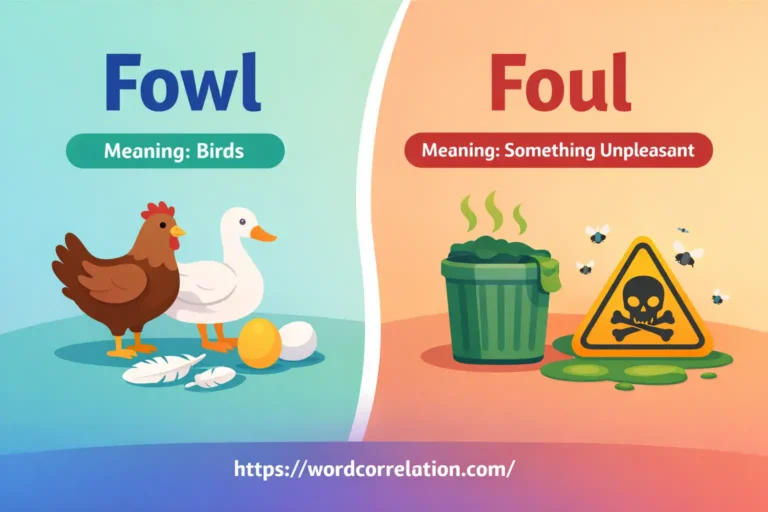
- Fowl means a bird, especially one kept for meat or eggs.
- Foul means bad, dirty, unfair, or against rules.
- They sound the same but mean very different things.
- Example:
- The fowl lived on the farm.
- That was a foul move in the game.
The Origin of Fowl or Foul
The confusion between fowl and foul comes from history and sound. Long ago, English spelling changed slowly. However, pronunciation changed faster. As a result, different words started to sound the same.
Fowl comes from Old English fugol, meaning bird. Over time, the spelling changed, but the meaning stayed the same. In contrast, foul comes from Old English ful, meaning dirty or evil. Therefore, the roots are different, even though the sound is identical.
Because English kept both spellings, learners now face confusion. Moreover, modern speech makes both words sound exactly alike. As a result, many writers mix them up in daily writing.
This is a classic example in our word confusion pillar.
British English vs American English Spelling
Both British English and American English use fowl and foul in the same way. There is no spelling difference between regions. However, usage context still matters a lot.
| Aspect | Fowl | Foul |
| Meaning | Bird | Bad or unfair |
| Region | UK & US | UK & US |
| Change in spelling | None | None |
In contrast to many other words, geography does not affect these spellings. Therefore, focus only on meaning, not location.
Which Spelling Should You Use?
The right spelling depends on what you want to say. Therefore, think about context first.
- In the US:
Use fowl for birds. Use foul for bad actions or smells. - In the UK or Commonwealth:
The same rule applies. Meaning decides the spelling. - In global or professional writing:
Always check meaning. Never choose based on sound.
In short, meaning always wins. Sound never decides.
Common Mistakes with Fowl or Foul
People often choose the wrong word because they write fast. However, these mistakes are easy to fix.
- ❌ The referee called a fowl.
✅ The referee called a foul. - ❌ The kitchen had a fowl smell.
✅ The kitchen had a foul smell. - ❌ Chickens are a type of foul.
✅ Chickens are a type of fowl.
Each error comes from ignoring meaning. Therefore, pause and check context.
Fowl or Foul in Everyday Examples
Emails
- Please remove the foul language from the report.
- The farmer sold fresh fowl today.
News
- The player committed a foul during the match.
- Bird flu affects domestic fowl worldwide.
Social Media
- That joke was foul, not funny.
- Look at this cute baby fowl 🐥.
Professional Writing
- Company policy bans foul behavior.
- Poultry farms raise fowl for food.
These examples show clear separation. Therefore, confusion becomes avoidable.
Fowl or Foul – Google Trends & Usage Data
Search data shows that students and ESL learners search fowl or foul the most. Moreover, writers and bloggers also check this difference often.
- High search countries: US, UK, India, Pakistan
- User types:
- Students
- ESL learners
- Content writers
- Professionals
Correct usage appears more in formal writing. However, mistakes often appear on social media. As a result, clear guides like this remain important.
Comparison Table: Fowl vs Foul
| Feature | Fowl | Foul |
| Meaning | Bird | Bad, unfair, dirty |
| Part of speech | Noun | Adjective / Noun / Verb |
| Context of use | Animals, farming | Sports, behavior, smell |
| Formal or informal | Both | Both |
| Common mistake | Used for “bad” | Used for “bird” |
| Correct example | The fowl laid eggs. | That was a foul act. |
This table removes doubt instantly. Therefore, save it for quick checks. Another sound-alike confusion is sole or soul.
Semantic FAQs (People Also Ask)
Is fowl the same as foul?
No. They sound the same but mean different things.
Which one is correct in formal writing?
Both are correct when used with the right meaning.
Can fowl and foul be used interchangeably?
No. Each word has a fixed meaning.
Why do people confuse fowl and foul?
Because they sound identical when spoken.
Can grammar tools catch this mistake?
Sometimes. However, manual checking works better.
Is there a British vs American difference?
No. Both regions use them the same way.
Conclusion
Overall, fowl and foul create confusion because they sound the same. However, their meanings never overlap. Fowl always relates to birds, especially farm birds. In contrast, foul describes something bad, dirty, unfair, or against rules. Therefore, checking meaning before spelling solves the problem. A similar pronunciation issue appears in arc or ark.
Many mistakes happen in fast writing. As a result, writers lose confidence. However, one simple rule fixes everything. If you talk about a bird, use fowl. If you talk about something bad or unfair, use foul. In short, never decide by sound. Always decide by meaning. Finally, remember this rule, and you will never confuse these words again.

Daniel Morris writes about English word differences and spelling confusion. His focus is to provide clear, simple explanations with practical usage examples.