Graduate vs Graduant: Why People Get Confused
Many people feel unsure about the words graduate and graduant. They look very similar, so mistakes happen often. Students, writers, and even professionals sometimes mix them up. You may see both words online, in speeches, or in school discussions. But only one of them is commonly correct.
The confusion usually happens because English already has several related words. For example, there is graduation, graduand, and graduating student. Some people also ask questions like: Is there a word “graduant”? or What do you call a person who graduated?
Because of this, many learners search for graduate vs graduant to understand the real difference.
In this guide, you will learn the simple meaning of each word, where confusion comes from, and which one is correct in modern English. You will also see real examples, common mistakes, and easy rules to remember. By the end, you will know exactly which word to use and when.
graduate vs graduant – Quick Answer
Graduate vs graduant is simple once you know the rule.
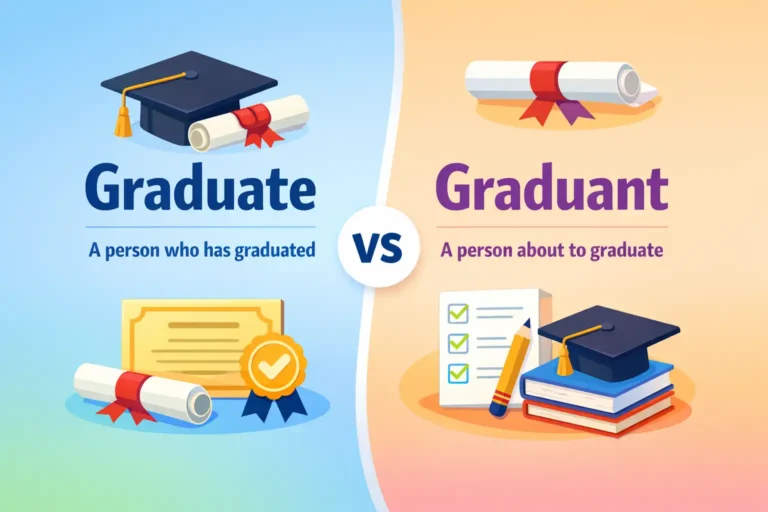
- Graduate = a person who has finished a degree or school program.
- Graduant = not a standard English word. It is usually a mistake.
Examples:
- She is a graduate of Harvard.
- He will graduate next year.
Easy rule:
If you talk about someone who finished school, always use graduate, not graduant.
Origin of Graduate, Graduand, and the Confusion Around Graduant
The word graduate comes from the Latin word gradus, which means step. In education, it meant moving to the next step of learning. Over time, the word entered English and became common in universities.
Today, graduate has two main meanings:
- A noun: a person who finished a degree
- A verb: the act of completing school
Example:
- She graduated from college last year.
- He is a university graduate.
Another related word is graduand. A graduand is a student who will receive a degree at a graduation ceremony but has not yet officially graduated.
Example:
- The graduand waited on stage for the ceremony.
The word graduant, however, does not come from traditional English usage. It likely appears because people confuse graduate and graduand and try to form a new word.
Why People Confuse Graduate, Graduand, and Graduant
Several things cause confusion:
- Similar spelling
Graduate, graduand, and graduant look almost the same. - International English differences
In some countries, universities use the word graduand. - Internet mistakes
Once a wrong word spreads online, people repeat it.
Because of this, many people ask questions like:
- Is graduant a word?
- What is the definition of a graduant?
The simple answer: graduate is correct; graduant is usually incorrect.
British English vs American English Spelling
For graduate vs graduant, there is no spelling difference between British and American English.
Both regions use graduate as the correct word.
The word graduant is not accepted in standard dictionaries in either variety.
Short examples
US English:
- She is a college graduate.
UK English:
- He is a university graduate.
Commonwealth countries sometimes use graduand during ceremonies.
Example:
- The graduands will enter the hall at noon.
Small comparison table
| Word | Status | Meaning |
| Graduate | Correct | Person who finished studies |
| Graduand | Correct (formal/ceremony) | Student about to receive a degree |
| Graduant | Incorrect | Usually a spelling mistake |
So the confusion in graduate vs graduant is not about regional spelling. It is about correct vs incorrect usage.
How to Choose the Right Word Fast
US
In American English, always use graduate.
Example:
- She is a medical school graduate.
The word graduand is rare in the US.
UK / Commonwealth
In the UK, Australia, and some Commonwealth countries:
- Graduate = person who already completed a degree
- Graduand = student about to receive the degree at the ceremony
Example:
- The graduands will collect their diplomas today.
Global or professional writing
In international or professional writing:
Use graduate because it is clear everywhere.
Example:
- Our company hires recent graduates.
Important note:
The word graduant should not be used in professional writing.
Common Mistakes with graduate vs graduant
Many learners create incorrect sentences because of spelling confusion.
Here are the most common errors.
❌ Incorrect → ✅ Correct
❌ She is a graduant from Oxford.
✅ She is a graduate from Oxford.
Explanation: Graduant is not a standard English word.
❌ I will become a graduant next year.
✅ I will graduate next year.
Explanation: The verb is graduate.
❌ The ceremony welcomed new graduants.
✅ The ceremony welcomed new graduates.
Explanation: Use the plural graduates.
Another related point is the plural of graduate.
Correct form:
- graduate → graduates
Example:
- The university honored its graduates.
Graduate vs Graduant: Real-Life Examples
Understanding graduate vs graduant becomes easier with real examples.
Emails
Correct:
- Congratulations on becoming a graduate of our program.
Incorrect:
- Congratulations on becoming a graduant.
News
Correct:
- The university celebrated 2,000 new graduates this year.
Social media
Correct:
- Proud graduate of engineering today!
Incorrect:
- Proud graduant today!
Formal or professional writing
Correct:
- She is a PhD graduate in physics.
Many companies also use the term graduate program or graduate scheme for new degree holders.
Example:
- The company offers a graduate internship program.
This leads to questions like: Can a graduate be an intern?
Yes, a graduate internship often refers to entry-level work after finishing a degree.
Who Searches “Graduate vs Graduant” and Why
Search interest for graduate vs graduant usually comes from three groups:
Students
Students often ask:
- Can I call myself a graduate?
- What is a graduating student meaning?
Answer:
If you finished your degree requirements, you can call yourself a graduate.
ESL learners
English learners search for pronunciation and spelling questions like:
- graduand pronunciation
- graduand in a sentence
- graduand synonym
They often encounter the word graduant online and want to check if it is correct.
Writers and professionals
Editors and writers search for graduate vs graduant to confirm correct language in reports, resumes, or news articles.
Real-world confusion example
Imagine a resume that says:
“Recent graduant seeking job.”
A recruiter may see this as a spelling mistake. This can affect the writer’s professional image.
Using graduate avoids that problem.
Comparison Table: graduate vs graduant
| Feature | Graduate | Graduant |
| Meaning | Person who completed a degree or school | Not a recognized English word |
| Part of speech | Noun and verb | Usually a misspelling |
| Context of use | Education, jobs, universities | Informal internet mistakes |
| Formal vs informal | Accepted in all writing | Not accepted in formal writing |
| Common mistakes | Confused with graduand | Used instead of graduate |
| Correct example | She is a graduate of Stanford. | Incorrect: She is a graduant of Stanford. |
This table makes the difference in graduate vs graduant clear.
People Also Ask (FAQs)
What is the difference between a graduate and a graduant?
A graduate is a person who completed a degree or school program. A graduant is not a standard English word and is usually a spelling mistake.
Is there a word “graduant”?
No. Most dictionaries do not recognize graduant as a correct English word.
What is the definition of a graduant?
There is no official definition because graduant is not a standard term in English.
Is it correct to say graduant?
No. The correct word is graduate. In some formal ceremonies, graduand may be used.
What do you call a person who graduated?
You call them a graduate.
Example:
- She is a university graduate.
Is a graduant the same as an intern?
No. Graduate refers to education. An intern refers to a temporary work position, often for training.
What are the top 3 graduates called?
In many schools, the top students are called:
- Valedictorian
- Salutatorian
- Honors graduate
How do you pronounce the word graduant?
Because graduant is not standard English, pronunciation varies. The correct word graduate is pronounced GRAD-joo-it (noun) or GRAD-joo-ate (verb).
Can I call myself a graduate?
Yes. If you completed your degree or program requirements, you can call yourself a graduate.
Final Answer: Graduate Is Correct, Graduant Is Not
The confusion around graduate vs graduant is common, but the answer is simple. The word graduate is the correct and widely accepted term in English. It refers to someone who has completed a degree or educational program. It can also function as a verb that describes finishing school.
The word graduant, on the other hand, is not part of standard English. It usually appears because people mix up graduate and graduand, or because of spelling mistakes online.
In some countries, universities use graduand to describe students who are about to receive their degrees at a ceremony. However, once the degree is awarded, they become graduates.
The one mistake to always avoid is writing graduant in formal communication, resumes, or academic writing.
Overall, the easiest rule to remember is this:
If someone finished school, call them a graduate.

Daniel Morris writes about English word differences and spelling confusion. His focus is to provide clear, simple explanations with practical usage examples.