Many people mix up hurt vs injured. You hear both words every day. In sports. At work. In movies. But they do not always mean the same thing.
You may ask, “Are you hurt or injured?” and not know which word is right. Students often confuse them in writing. ESL learners also struggle because both words relate to pain. But pain and injury are not equal.
So what is the real difference? When should you use each word? Is hurt a synonym for injured? And what about sore, harm, or damage?
In this guide, you will learn the clear meaning of each word. You will see simple examples. You will also get one easy rule to help you decide fast.
Now let’s make hurt vs injured simple.
Hurt vs Injured – Quick Answer
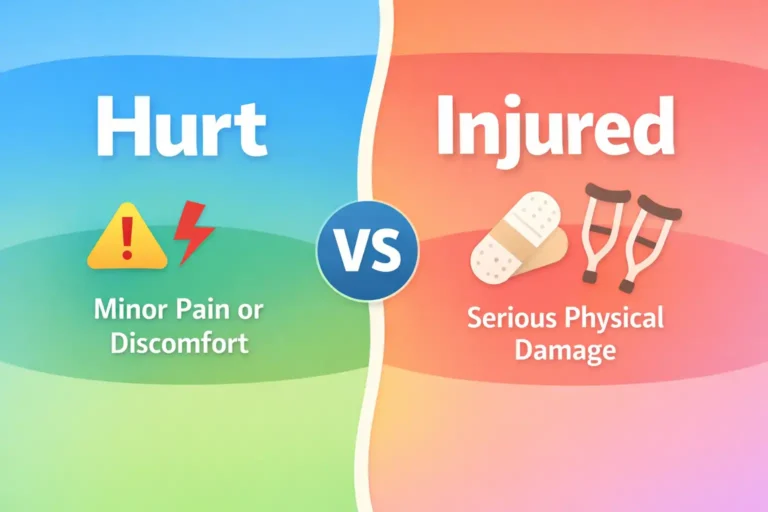
- Hurt = feel pain (physical or emotional)
- Injured = physical damage to the body
Example 1:
“My arm hurts.” → I feel pain.
“I injured my arm.” → I damaged it.
Easy rule:
If there is real physical damage, use injured.
If you talk about pain only, use hurt.
The Origin of Hurt vs Injured (Simple History)
The word hurt comes from old French and old English words that meant “to strike” or “to damage.” Over time, it became common in daily speech. Now it often means to feel pain.
The word injured comes from Latin. It meant “wrong” or “damage.” It entered English through French. From the start, it had a more formal tone.
So from history, we see a pattern:
- Hurt = common, everyday word
- Injured = formal, legal, or medical word
Reason for confusion today
Today, both words appear in news, sports, and daily talk. A football player may say, “I’m hurt.” But the news may say, “He was injured in the game.”
So people think they are the same. But the difference is about damage vs feeling pain.
British English vs American English Spelling
Good news: There is no spelling difference between British and American English.
- Hurt = same in US and UK
- Injured = same in US and UK
So the confusion is not about spelling. It is about meaning and tone.
Short examples
US English:
- “Are you hurt?”
- “Three players were injured.”
UK English:
- “She hurt her knee.”
- “He was injured in the accident.”
Both regions use them the same way.
How to Choose the Right Word Fast
Here is quick guidance based on the audience.
US
In daily talk, Americans often say:
- “I hurt my back.”
- “Are you hurt?”
In medical or sports news:
- “He was injured during practice.”
UK / Commonwealth
Same pattern:
- Casual talk → hurt
- News, reports → injured
Global or professional writing
In professional writing:
- Use injured for official reports.
- Use hurt for a general feeling of pain.
There is no spelling change worldwide. The key difference is tone and clarity.
Common Mistakes with Hurt vs Injured
Here are frequent errors.
❌ Incorrect → ✅ Correct
❌ “He is very injured today.”
✅ “He is injured.”
(Injured does not usually take “very.”)
❌ “I injured because I feel sad.”
✅ “I feel hurt.”
(Injured is physical, not emotional.)
❌ “My feelings are injured.”
✅ “My feelings are hurt.”
(Hurt works for emotional pain.)
❌ “He hurt in the car crash.”
✅ “He was injured in the car crash.”
(Injured fits accidents better.)
Hurt vs Injured in Everyday Examples
Let’s see real-life use.
Emails
- “I hurt my ankle yesterday, so I may work from home.”
- “I was injured in a minor accident and need medical leave.”
News
- “Two workers injured in the fire.”
- “No one seriously hurt.”
Notice: News often uses both words in one report.
Social media
- “My legs hurt after leg day!”
- “He injured his shoulder during training.”
Formal or professional writing
- “The employee injured during duty.”
- “The patient reports back pain but no visible injury.”
In formal settings, injured meaning refers to actual physical harm.
Hurt vs Injured – Usage Patterns & Search Interest
People search for hurt vs injured meaning because both words relate to pain. Students and ESL learners often look for a simple rule.
Sports fans also search for hurtvs injured sports. In sports, players may say they hurt, but teams report them as injured.
Typical users:
- Students
- ESL learners
- Writers
- Journalists
- Sports fans
Real-world confusion
A coach says, “He hurt.”
Fans wonder: Is it serious? Is there damage?
If the report says, “He injured,” people expect real physical harm.
So misuse can change how serious a situation sounds.
Comparison Table: Hurt vs Injured
| Category | Hurt | Injured |
| Meaning | Feel pain (physical or emotional) | Physical damage to the body |
| Part of speech | Verb, adjective | Adjective, verb (past form of injure) |
| Context of use | Daily speech | Medical, sports, legal, news |
| Formal vs informal | More informal | More formal |
| Common mistakes | Using for serious accidents | Using for emotions |
| Correct example | “My back hurts.” | “He was injured in the crash.” |
This table helps remove confusion instantly.
FAQs
What is the difference between injured and hurt?
Hurt means feeling pain. Injured means physical damage. Injury is more serious.
What’s the difference between sore and injured?
Sore means mild pain, often from exercise. Injured means real damage, like a torn muscle.
Are you injured or just hurt?
If there is no damage, you hurt. If a doctor confirms damage, you injured.
What’s the difference between hurt and harm?
Hurt usually means pain. Harm means damage or bad effect. Harm can be physical or emotional.
Is being hurt the same as being injured?
No. Hurt can be emotional or mild pain. Injured is physical damage.
When to use hurt?
Use hurt for:
- Feelings
- Mild pain
- Casual speech
Example: “My foot hurts.”
Is hurt a synonym for injured?
Not always. They overlap, but injured is more serious and formal.
Is my back sore or injured?
If pain is mild after exercise, it is sore. If there is sharp pain or damage, it may injured.
Is hurt the same as pain?
No. Pain is a noun. Hurt is a verb or adjective. Hurt describes the experience of pain.
Which one is correct in formal writing?
In formal writing about accidents or reports, injured is usually better.
Extra Related Clarifications
Injury and wound difference
An injury is general physical harm. A wound is a type of injury that breaks the skin.
Hurt vs harm
Hurt = feel pain.
Harm = cause damage.
Difference between injury and damage in plants
In plants, we use damage, not injured.
Example: “The frost damaged the leaves.”
Plants do not feel pain, so “hurt” does not apply.
Conclusion
Now you clearly understand hurt vs injured.
Hurt focuses on pain. It can be physical or emotional. It is common in daily speech. Injured focuses on physical damage. It sounds more formal and serious. News and medical reports prefer injured.
The biggest mistake people make is using injured for emotions. Feelings can hurt, but they not injured.
Finally, keep this easy rule in mind:
Damage = injured.
Pain only = hurt.

Daniel Morris writes about English word differences and spelling confusion. His focus is to provide clear, simple explanations with practical usage examples.