Have you ever typed impliment and felt unsure? You are not alone. Many students and writers mix up impliment vs implement because the words look almost the same. The problem is simple: one spelling is correct, and the other is not. But spell check does not always explain why.
This confusion happens in school essays, work emails, and even news articles. It also appears in search queries like “impliment vs implement meaning” or “impliment vs implement grammar.” People want a clear answer.
So what will you learn here? You will learn which word is correct, what “implement” means, how to use it in a sentence, and how to avoid common mistakes. You will also see simple examples and a comparison table that makes everything clear. Let’s fix the confusion now.
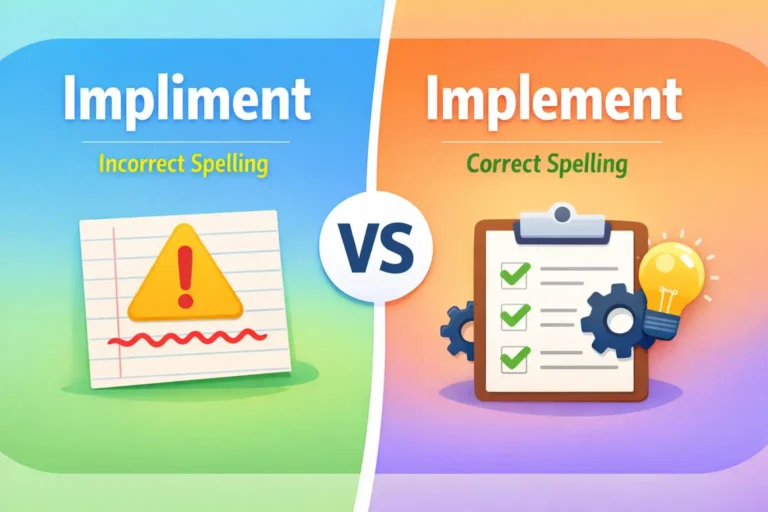
Impliment vs Implement – Quick Answer
- Correct spelling: implement
- Incorrect spelling: impliment
Meaning:
“Implement” means to carry out or put a plan into action.
Example:
- We will implement the new policy tomorrow.
- The company plans to implement changes next week.
Easy rule:
If you mean start or carry out a plan, always use implement.
Never use impliment.
Where ‘Implement’ Comes From (Etymology)
The word implement comes from Latin. It comes from implere, which means “to fill up” or “to complete.” Later, it moved into Old French, and then into English.
At first, “implement” was used as a noun. It meant a tool or object. For example, a farmer uses farm implements. Over time, it also became a verb. As a verb, it means to carry out a plan.
The spelling has always been implement in standard English. The spelling impliment has never been correct in formal dictionaries.
Reason for Confusion Today
Many people mix up impliment vs implement for simple, everyday reasons:
- Typing error: When you type fast, your fingers may hit “i” instead of “e.” The letters sit close on the keyboard, so mistakes happen easily.
- Phonetics (how it sounds): “Implement” sounds like im-pluh-ment. The middle vowel is soft. So some people guess the spelling and write “impliment.”
- Memory pattern: Many English words end in “-ment,” but the vowel before it changes (government, movement, management). That makes guessing harder.
Concrete example:
A student writes, “The company will impliment new rules.”
The teacher marks it wrong because the correct spelling is implement.
So the confusion is not about meaning. It is about spelling and sound.
British English vs American English Spelling
Good news: there is no spelling difference between British English and American English for this word.
Both use:
- implement ✅
- impliment ❌ (wrong in both)
Short Examples
US English:
- The school will implement new rules.
UK English:
- The council will implement safety measures.
Quick Comparison
| Version | Correct Spelling |
| American English | implement |
| British English | implement |
| Australian English | implement |
There is no variation. The spelling stays the same everywhere.
How to Choose the Right Word Fast
The choice is easy.
US
Use implement in all writing: school, business, legal, or casual.
UK / Commonwealth
Use implement only. There is no other correct form.
Global or Professional Writing
Always use implement. It is correct in academic papers, business reports, and emails.
If you see impliment, treat it as a spelling mistake.
Common Mistakes with impliment vs implement
Here are frequent errors.
❌ We will impliment the plan next week.
✅ We will implement the plan next week.
❌ The company is implimenting changes.
✅ The company is implementing changes.
Why These Mistakes Happen
- People guess the spelling
- They hear the sound and write what they hear
- They do not double-check
The verb form is always implement.
The noun form is also implement.
Impliment vs Implement in Everyday Examples
Let’s see how to use implement correctly in real life.
Emails
- We plan to implement the new system on Monday.
- Please implement the updated design today.
News
- The government will implement new tax rules.
- The company implemented safety steps after the accident.
Social Media
- Time to implement my fitness plan.
- We finally implemented the update!
Formal or Professional Writing
- The organization will implement the strategy in phases.
- The school implemented a new curriculum.
Now you can also understand searches like “implement in a sentence” or “implement meaning in English with example.”
impliment vs implement – Usage Patterns & Search Interest
The search term impliment vs implement is common. Many users type the wrong spelling first. Then they search to check which is correct.
Typical Users
- Students
- ESL learners
- Bloggers
- Business professionals
Real-World Confusion Example
Imagine sending a job application email and writing:
“We will impliment your ideas.”
That mistake can look unprofessional. Even small spelling errors can change how others see your writing.
So checking spelling matters.
Clear Comparison Table
| Feature | implement | impliment |
| Meaning | To carry out a plan; also a tool | No meaning (misspelling) |
| Part of Speech | Verb and noun | Not a real word |
| Context of Use | Business, school, news, daily speech | Never correct |
| Formal vs Informal | Used in both formal and informal writing | Incorrect in all cases |
| Common Mistake | Spelling errors like “impliment” | Entire word is a mistake |
| Correct Example | We will implement the policy tomorrow. | No correct example |
This table removes confusion instantly: only implement is correct.
People Also Ask (FAQs)
What is the difference between impliment and implement?
There is no real difference. “Implement” is correct. “Impliment” is a spelling mistake.
What does “to implement” mean?
To implement means to put a plan or idea into action.
Is impliment the same as implement?
No. “Impliment” is wrong. Only “implement” is correct in writing.
Which one is correct in formal writing?
“Implement” is correct in all formal writing. “Impliment” is never correct.
What is a synonym for implement?
Some synonyms are: carry out, execute, apply, enforce, or perform.
What’s the opposite of implement?
The opposite could be ignore, cancel, or stop, depending on context.
What is the difference between implement and implementing?
“Implement” is the base verb.
“Implementing” is the present continuous form.
Example: We are implementing changes now.
What is an example of implementation?
The implementation of the new law began in January.
Here, “implementation” means the act of putting something into action.
Does implement mean start?
Not exactly. It means more than start. It means to actively carry out a plan.
Conclusion
The mix-up in impliment vs implement comes from spelling, not meaning. Implement is the standard form in English, and it means to put a plan, rule, or idea into action. You will see it in emails, school work, news, and professional writing. The other spelling shows up mostly because people type quickly or spell by sound.
The one mistake to avoid is using impliment in formal writing, where it can look careless and distract from your message.
Memorable rule:
“Implement = put it into action.”
If you mean action, choose implement.

Daniel Morris writes about English word differences and spelling confusion. His focus is to provide clear, simple explanations with practical usage examples.