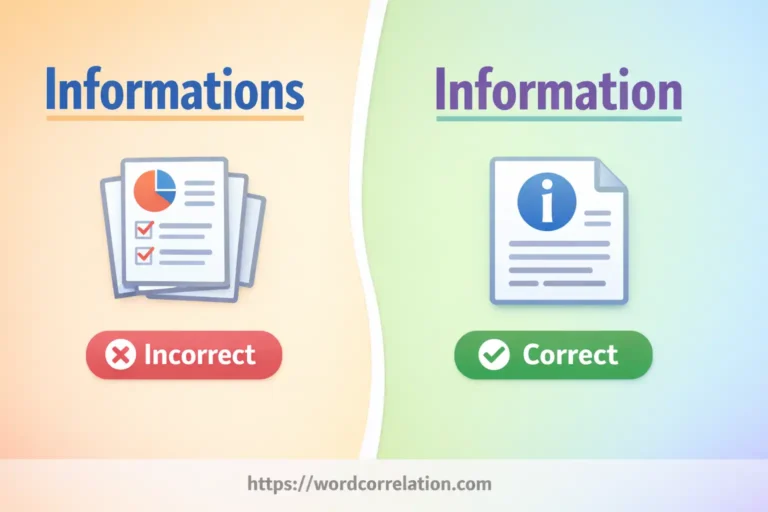
Many people stop and think when they write informations or information. The words look almost the same. However, English treats them very differently. Therefore, confusion appears often. Students use the plural by mistake. Writers add an s without thinking. Moreover, non-native speakers follow rules from their own language. As a result, errors spread across emails, essays, and reports.
However, this problem has a clear solution. English uses information in a special way. In contrast to many nouns, it does not take a plural form. Additionally, grammar tools may not always explain why the plural feels wrong. Therefore, learners keep repeating the same mistake.
This article fixes that issue step by step. You will learn why people search for informations or information. You will also see where mistakes usually happen. Moreover, you will understand the origin of the word. Finally, you will gain one easy rule to remember forever. With this guide, your writing will sound natural and correct.
For usage differences like this, the word comparison hub is helpful.
Informations or Information – Quick Answer
- Information is correct in all cases.
- Informations is incorrect in standard English.
Use information as an uncountable noun.
Add phrases like pieces of or types of if you need quantity.
Example:
✅ This information is helpful.
❌ These informations are helpful.
The Origin of Informations or Information
The word information comes from Latin informare. It meant “to shape” or “to instruct.” Later, French carried the word into English. Over time, English kept it as a mass noun.
However, many European languages treat the same word as countable. Therefore, learners add s by habit. Moreover, English already allows plurals for many nouns. As a result, the error feels logical.
In contrast, English groups information with words like advice and knowledge. These nouns describe a concept, not separate items. Therefore, English blocks the plural form. This historical path explains the confusion clearly.
This belongs to our grammar rules pillar for uncountable nouns.
British English vs American English Spelling
British and American English follow the same rule here. However, usage style may differ slightly.
In British English, writers often use formal phrases. For example, they write a piece of information.
In American English, writers use simpler structures. For example, they write some information.
Whereas tone changes, grammar does not change.
Small Comparison Table
| Feature | British English | American English |
| Correct form | information | information |
| Plural allowed | No | No |
| Common phrase | a piece of information | some information |
Which Spelling Should You Use?
The answer stays simple for every audience. Therefore, remember one rule.
For US readers
Always write information. Add details or facts if needed.
For UK or Commonwealth readers
Still write information. Use pieces of information for clarity.
For global or professional writing
Choose information only. This form sounds correct everywhere. Moreover, it avoids embarrassment in formal texts.
Common Mistakes with Informations or Information
Errors follow predictable patterns. However, each mistake has an easy fix.
❌ These informations are important.
✅ This information is important.
❌ I received many informations today.
✅ I received a lot of information today.
❌ Can you give me an information?
✅ Can you give me some information?
Writers add s because they count items mentally. Therefore, switch to quantity phrases instead.
Informations or Information in Everyday Examples
Emails
Please send the information by tomorrow.
This information will help the team.
News
The report contains new information.
Officials shared important information.
Social Media
Here is some useful information.
That information cleared my doubt.
Formal or Professional Writing
The document provides accurate information.
Confidential information must stay secure.
Each example shows the same pattern. Therefore, practice builds confidence.
Informations or Information – Google Trends & Usage Data
Search data shows strong interest in this keyword. Students search it before exams. ESL learners check it while writing assignments. Writers also verify it before publishing.
However, most searches happen because of plural confusion. Many users type informations first. As a result, correction guides attract steady traffic.
By country, India, Pakistan, France, and Germany show high search volume. By user type, learners dominate. Professionals follow next. Correct usage improves with exposure. However, the mistake still appears often online.
Understanding plural or possessive helps avoid this mistake.
Comparison Table: Informations vs Information
| Feature | Informations | Information |
| Meaning | ❌ Not standard | Facts or knowledge |
| Part of speech | ❌ Invalid plural | Uncountable noun |
| Context of use | ❌ Incorrect | All contexts |
| Formal vs informal | ❌ Always wrong | Works everywhere |
| Common mistake | Adding “s” | None |
| Correct example | ❌ — | This information helps. |
This table removes confusion instantly. Therefore, save it for revision.
Semantic FAQs (People Also Ask)
Is informations the same as information?
No. Informations is incorrect in English.
Which one is correct in formal writing?
Only information works.
Can they be used interchangeably?
No. Grammar blocks that.
Why do people confuse them?
Other languages allow the plural.
Can grammar tools catch this mistake?
Most tools flag it correctly.
Is there a British vs American difference?
No. Both follow the same rule.
Conclusion
Overall, informations or information causes trouble for many writers. However, the rule stays simple. English treats information as uncountable. Therefore, the plural form never works.
In short, avoid adding s. Use quantity phrases instead. Moreover, remember that clarity matters more than habit. When you need numbers, write pieces of information or types of information. This lesson clarifies how certain words remain singular regardless of quantity.
Finally, keep one easy rule in mind: If the word names knowledge, not items, do not pluralize it. Follow this rule every time.
Usage confusion also appears in well or good.

Daniel Morris writes about English word differences and spelling confusion. His focus is to provide clear, simple explanations with practical usage examples.