Many people stop and think when they write kabob or kebab. The words look similar. The food looks the same. However, the spelling changes across countries and cultures. As a result, writers feel unsure. Students hesitate. ESL learners pause. Even professionals double-check.
This confusion happens because English borrows words from many languages. Therefore, spellings change with time, place, and habit. Moreover, food words often keep local styles. For example, menus, recipes, and blogs use different spellings for the same dish. In contrast, grammar rules feel clear, yet spelling rules here feel flexible.
This article solves that problem. First, it explains why people search for kabob or kebab. Next, it shows where mistakes usually happen. Then, it gives clear rules you can follow. Additionally, you will see real examples from daily writing. Finally, you will know which spelling to use with confidence, every time.
To compare alternate spellings and forms, visit the word comparison hub.
Kabob or Kebab – Quick Answer
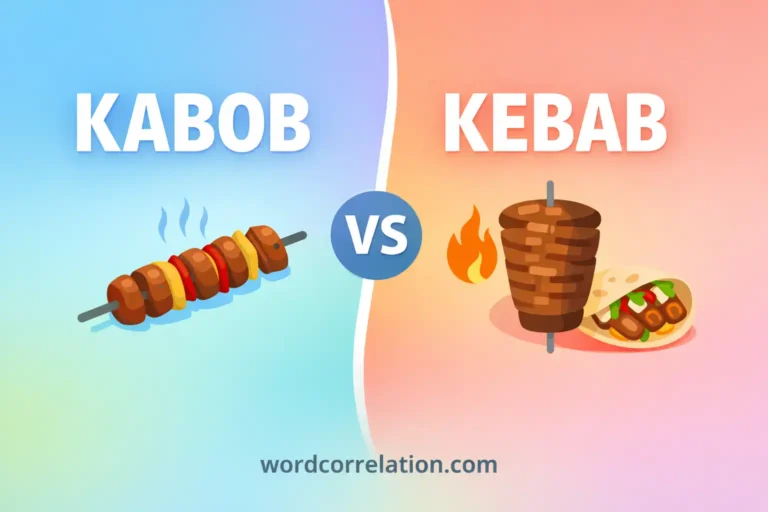
Kabob and kebab mean the same food.
- Kebab is the standard spelling in British English and globally.
- Kabob is a common American spelling.
For example:
- UK menu: chicken kebab
- US menu: beef kabob
The Origin of Kabob or Kebab
The word comes from the Middle East. Originally, it described meat cooked over fire. Over time, traders and travelers spread the dish. Therefore, the word entered many languages.
In Turkish and Persian, the sound stayed close to kebab. However, English speakers changed the spelling. Americans preferred kabob because it matched local pronunciation. Meanwhile, British English kept kebab. As a result, both spellings became accepted.
Confusion started because English has no single authority for borrowed food words. Moreover, dictionaries list both forms. Consequently, writers see mixed usage online and offline.
This sits in our word variants pillar where multiple forms are acceptable.
British English vs American English Spelling
Spelling depends on location. However, meaning stays the same.
- British English uses kebab
- American English often uses kabob
In contrast, global English prefers kebab because it matches original usage.
Examples:
- UK article: Street food kebabs are popular.
- US cookbook: Grilled vegetable kabobs are easy.
| Variant | Preferred Spelling | Region |
| British English | kebab | UK |
| American English | kabob | USA |
| International | kebab | Global |
Which Spelling Should You Use?
Your audience decides the spelling. Therefore, think before you write.
For the US audience:
Use kabob. It feels familiar and natural.
For the UK or Commonwealth:
Choose kebab. Readers expect this form.
For global or professional writing:
Use kebab. It looks standard and widely accepted.
Overall, consistency matters more than choice. Pick one spelling and keep it.
Common Mistakes with Kabob or Kebab
Writers often mix spellings. As a result, text looks careless.
❌ I love chicken kebab and lamb kabob.
✅ I love chicken kebab and lamb kebab.
❌ Kabeb is my favorite food.
✅ Kebab is my favorite food.
❌ Kabobs are popular in London.
✅ Kebabs are popular in London.
Each mistake happens due to guessing. Therefore, choose once and stay consistent.
Kabob or Kebab in Everyday Examples
Emails:
- Let’s order kebabs for lunch.
News:
- Street kebab stalls attract tourists.
Social media:
- Grilling kabobs tonight!
Professional writing:
- The menu includes vegetarian kebab options.
Different settings allow both spellings. However, clarity always comes first. Another informal spelling choice is wienie or weenie.
Kabob or Kebab – Google Trends & Usage Data
Search data shows strong interest in kabob or kebab. People want clarity.
- Country:
- USA searches “kabob” more
- UK searches “kebab” more
- User type:
- Students seek spelling rules
- Writers check correctness
- ESL learners need examples
- Professionals want standard usage
Correct usage appears less often than mixed usage. Therefore, clear guidance helps users greatly.
Comparison Table: Kabob vs Kebab
| Feature | Kabob | Kebab |
| Meaning | Grilled meat on skewers | Same meaning |
| Part of speech | Noun | Noun |
| Context of use | American English | British & global English |
| Formal vs informal | Informal to neutral | Neutral to formal |
| Common mistakes | Mixed spelling | Misspelled as “kabeb” |
| Correct example | Beef kabobs on the grill | Chicken kebab wrap |
This table removes confusion instantly.
Semantic FAQs (People Also Ask)
Is kabob the same as kebab?
Yes. Both words mean the same food.
Which one is correct in formal writing?
Kebab works best for formal or global writing.
Can they be used interchangeably?
Yes, but stay consistent within one text.
Why do people confuse them?
Different regions use different spellings.
Can grammar tools catch this mistake?
Sometimes. However, tools may accept both.
Is there a British vs American difference?
Yes. British uses kebab. American uses kabob.
Conclusion
Overall, kabob or kebab is a spelling choice, not a meaning change. Both words describe the same delicious food. However, region and audience matter. American readers expect kabob. British and global readers prefer kebab. Therefore, smart writers decide early and stay consistent. You may also like uncollectable or uncollectible for another variant case.
Mistakes happen when spellings mix. As a result, text feels unpolished. This article showed the origin, usage, and correct context clearly. Moreover, real examples made the rule simple.
In short, pick the spelling that fits your audience. Avoid mixing forms. Finally, remember one easy rule: Use “kebab” for global writing and “kabob” for American-only content.

Daniel Morris writes about English word differences and spelling confusion. His focus is to provide clear, simple explanations with practical usage examples.