Many English learners search for “near vs close” because the two words seem the same. Both talk about distance. Both appear in daily speech. Because of this, writers often mix them up.
The confusion grows in real writing. A student may write “My school is close the park” instead of “close to the park.” Someone else may say “Come near to me” when “come near me” sounds more natural. Small mistakes like this appear often in emails, essays, and even online posts.
So people want a clear answer. They want to know when each word works best.
This guide explains near vs close in simple English. You will learn their meaning, origin, common mistakes, and real usage. You will also see clear examples from daily writing. By the end, you will know a simple rule that helps you choose the right word every time.
Near vs Close – Quick Answer
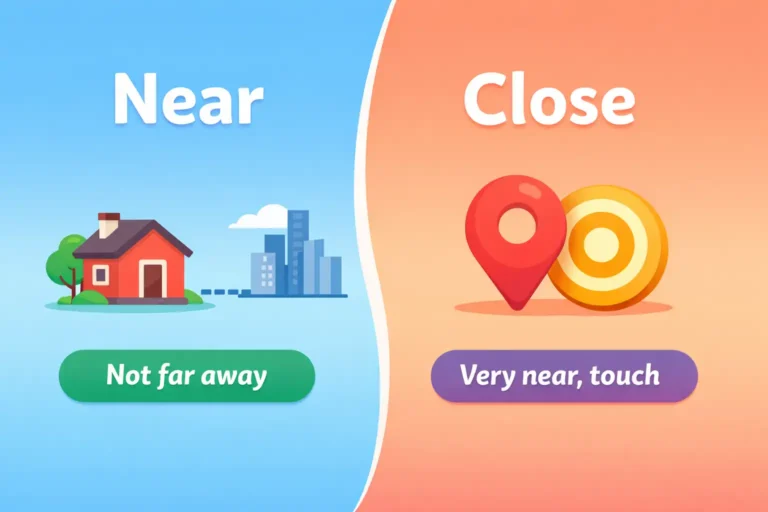
Near and close both describe short distance, but they are used a little differently.
Meaning of Near
- Shows short distance or closeness in space or time
- Often used as a preposition or adjective
- Examples:
- The café is near my house.
- Winter is near.
Meaning of Close
- Shows short distance, often in a more personal or physical sense
- Usually needs “to” before the object
- Examples:
- The library is close to the station.
- Stay close to me.
Easy rule:
Use near for simple location. Use close to when you describe distance between two things.
The Origin of Near vs Close
The history of these words explains why they feel similar today.
The word near comes from Old English “neah.” It meant not far away. People used it for both place and time. Old texts used it in phrases like “near the river” or “the day is near.” The word stayed stable for centuries, so its meaning changed very little.
The word close comes from Latin “clausus,” which means shut or enclosed. Later, English adopted the French word “clos.” At first, close meant something shut or sealed. Over time, it also began to describe objects that were tightly placed together.
Because of this shift, close started to describe short distance. Writers began to use phrases like “close to the door” or “close to the city.”
Today both words show short distance. However, their structure in sentences still differs. That small grammar difference causes most confusion.
British vs American English Spelling
For near vs close, spelling does not change between British and American English. Both regions use the same spelling and the same forms.
However, sentence patterns may feel slightly different in style.
| Feature | Near | Close |
| Spelling (US) | near | close |
| Spelling (UK) | near | close |
| Common phrase | near the station | close to the station |
| Informal speech | very common | also common |
Both words appear often in everyday speech in the US, UK, Canada, Australia, and other English-speaking regions.
So the main difference is grammar usage, not spelling.
How to Choose the Right Word Fast
Choosing between near and close becomes easy once you know the sentence pattern.
In American English
Writers often prefer close to when describing distance between two places.
Example:
- The restaurant is close to the hotel.
However, near also appears often in maps, travel writing, and directions.
Example:
- The museum is near the river.
In UK and Commonwealth English
Both forms are common. British writers may slightly prefer near in formal or descriptive writing.
Example:
- A small village lies near the coast.
For global or professional writing
Many editors choose near because it is simple and direct. It does not require an extra word like to.
Example:
- Our office is near the airport.
If clarity matters, both words remain correct. The choice often depends on sentence flow.
Common Mistakes with Near vs Close
Writers often confuse these words because their meaning overlaps. However, grammar structure matters.
❌ Incorrect: The shop is close the park
✅ Correct: The shop is close to the park
Explanation:
Close usually needs the preposition to.
❌ Incorrect: Stay near to me
✅ Correct: Stay near me
Explanation:
Near normally does not need “to.”
❌ Incorrect: The exam is close
✅ Correct: The exam is near
Explanation:
When talking about time, near sounds more natural.
❌ Incorrect: The houses are very near to each other
✅ Correct: The houses are very close to each other
Explanation:
When describing two objects together, close to is common.
Editors often notice these small mistakes in essays and reports. Learning the pattern quickly improves writing clarity.
Near vs Close in Real Life Examples
Understanding real usage helps learners remember the difference.
Emails
- Our office is near the main station, so travel is easy.
- Please stay close to the group during the tour.
News writing
- Police found the missing car near the highway.
- Several houses stand close to the riverbank.
Social media
- I live near the beach, so sunsets look amazing.
- My friends live close to me, so we meet often.
Professional writing
- The research center is located near the university campus.
- The factory operates close to the industrial zone.
These examples show how both words appear in daily communication.
Near vs Close – Word Usage Patterns and Search Trends
Search interest in near vs close is common among English learners. Students, ESL writers, and language learners often look for quick grammar explanations.
Many learners first meet these words when studying prepositions of place. At that stage, grammar patterns still feel new. Because close needs to but near does not, confusion appears quickly.
Professional writers also search for this comparison. They want to avoid awkward phrasing.
One common real-world example appears in travel writing. A guide may write:
“The hotel is close the airport.”
Readers understand the meaning, but the grammar looks incorrect. The correct form is:
“The hotel is close to the airport.”
Small grammar details like this help writing look more natural and professional.
Near vs Close Comparison Table
| Feature | Near | Close |
| Core meaning | Short distance | Short distance |
| Part of speech | Adjective, adverb, preposition | Adjective, adverb |
| Typical structure | near + place | close to + place |
| Usage context | Directions, location, time | Distance between objects |
| Formal vs informal | Neutral in all writing | Neutral but conversational |
| Common mistake | Adding “to” unnecessarily | Forgetting “to” |
| Correct example | The school is near the park | The school is close to the park |
This table shows the difference clearly and removes most confusion.
FAQs About Near vs Close
Is near the same as close?
They have similar meaning. Both describe short distance. However, close usually needs the word to, while near does not.
Which word is better in formal writing?
Both words work in formal writing. Many editors prefer near because it is shorter and simpler.
Can near and close be used interchangeably?
Often yes. However, grammar may change. For example:
“near the park” → “close to the park.”
Why do learners confuse near and close?
The meaning overlaps. Both describe distance, but the sentence structure differs.
Can grammar tools catch this mistake?
Yes, many grammar tools detect missing prepositions such as close the park instead of close to the park.
Is there a British vs American difference?
No major difference exists. Both forms appear in British and American English.
Can near describe time?
Yes. Near often describes time. Example: The deadline is near.
Conclusion
The comparison near vs close looks simple at first, yet many learners still struggle with it. Both words describe short distance, so their meaning overlaps in everyday English.
However, grammar structure creates the real difference.
Near usually works alone before a place. Writers use it in phrases like near the station or near my house. It also works when talking about time, such as the holiday is near.
Close, in contrast, normally needs to before the object. This pattern appears in sentences like close to the river or close to the city center.
Because of this small rule, many writers make mistakes like close the park or near to me. Editors often notice these errors in essays, travel guides, and online posts.
Overall, both words remain correct and common in modern English. The choice often depends on sentence structure and writing style.
Easy rule to remember:
Use near directly before a place. Use close to when describing distance between two things.
Once you remember this pattern, the confusion between near vs close disappears quickly.

Daniel Morris writes about English word differences and spelling confusion. His focus is to provide clear, simple explanations with practical usage examples.