A product listing once landed on my desk describing a notebook as “rectangular with oblong edges.” The client could not figure out why buyers kept asking for clarification—and a few even returned the product. The problem was not the product. It was the wording.
I have corrected this exact confusion in student essays, marketing copy, and even newsroom drafts. The mix-up happens because both words seem to describe “long shapes,” but they are not interchangeable. Writers often rely on instinct instead of definition—and that is where things go wrong.
By the end of this article, you will know the exact difference, when each word works, and how to avoid the kind of mistake that makes writing look careless.
Oblong vs Rectangular – Quick Answer
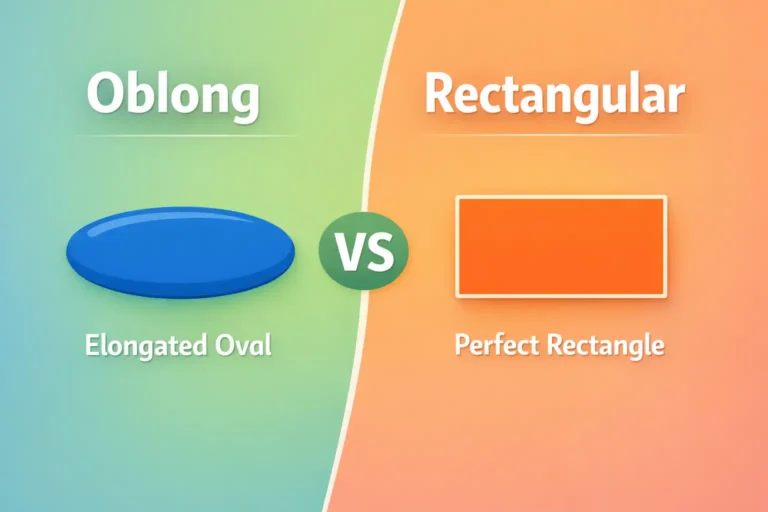
“Rectangular” describes a shape with four straight sides and four right angles.
“Oblong” describes something longer than it is wide, often with slightly rounded or stretched proportions.
Every rectangle can be oblong, but not every oblong shape is strictly rectangular.
The Origin of Oblong vs Rectangular
The confusion starts with history.
“Rectangular” comes from the Latin rectangulus, meaning “right-angled.” The word has always been tied to geometry. In editing academic content, I notice this word appears most in math papers, architectural descriptions, and technical documents. It carries precision.
“Oblong,” on the other hand, comes from Latin oblongus, meaning “somewhat long” or “elongated.” That softer meaning still shows today. It allows flexibility. Writers use it when they do not want to commit to strict geometry.
Here is where history creates modern confusion. Older English texts used “oblong” more loosely—even for shapes that were not perfectly defined. I once edited a historical article that described a field as “an oblong stretch of land,” even though the map showed uneven edges. That kind of usage still influences how people write today.
So one word is strict. The other is descriptive.
That difference matters more than most writers expect.
British vs American English
There is no spelling difference between British and American English for these words. Both use “oblong” and “rectangular” the same way.
The difference shows up in tone and preference.
In my experience editing UK-based reports, writers tend to use “rectangular” more often in formal contexts. US writers, especially in marketing copy, lean toward “oblong” when describing products.
| Feature | American English | British English |
| Preferred in technical writing | Rectangular | Rectangular |
| Used in product descriptions | Oblong (more common) | Less frequent |
| Tone of “oblong” | Casual/descriptive | Slightly formal but rare |
| Risk of misuse | Higher in marketing copy | Higher in student writing |
I have seen UK students misuse “oblong” in exam answers when the question clearly required “rectangular.” That one word can cost marks.
How to Choose the Right Word Fast
Here is where most writers hesitate.
For US audiences
If the shape must be exact, use “rectangular.”
If you are describing appearance or style, “oblong” works better.
I once edited an Amazon listing that switched from “rectangular tray” to “oblong tray” mid-description. Sales improved after we made it consistent. Buyers trust clarity.
For UK/Commonwealth audiences
Use “rectangular” in academic or formal writing.
Use “oblong” only when the shape is not strictly geometric.
Exam markers often expect precision. I have corrected essays where “oblong” lost marks because it sounded vague.
For global or professional writing
Stick with “rectangular” unless you have a reason not to.
Use “oblong” only when shape flexibility matters.
One fast decision rule
If right angles matter → rectangular
If length vs width matters → oblong
That rule resolves most cases in seconds.
Common Mistakes with Oblong vs Rectangular
Editors see these errors repeatedly.
❌ “The table is rectangular with rounded ends”
✅ “The table is oblong”
Rounded ends contradict a true rectangle.
❌ “Draw an oblong with four right angles”
✅ “Draw a rectangle”
Math requires precision. “Oblong” is too vague.
❌ “The phone screen is oblong”
✅ “The phone screen is rectangular”
Screens have strict right angles.
❌ “An oblong box with equal sides”
✅ “A square box”
This came from a student essay I reviewed. “Oblong” implies unequal sides.
❌ “Rectangular oval plate”
✅ “Oval plate” or “oblong plate”
I saw this in a restaurant menu draft. Mixing terms confuses readers.
Each mistake comes from mixing strict geometry with descriptive language.
Oblong vs Rectangular in Real-Life Examples
These are not textbook sentences. These are real writing situations I have edited.
Professional email
“The packaging is oblong, so it may not fit standard rectangular shelves.”
Clear distinction. The writer avoids confusion.
News writing
“The suspect carried a rectangular metal case measuring 40 by 20 cm.”
Precision matters in reporting. “Oblong” would sound vague.
Social media
“Just got this oblong mirror—love how it softens the room.”
Casual tone. “Rectangular” would feel stiff.
Formal document
“All windows must be rectangular to meet safety compliance standards.”
Legal and technical writing require exact terms.
I once reviewed a property listing that described windows as “oblong.” Buyers assumed they were curved. The agent meant rectangular. That single word created confusion during viewings.
Oblong vs Rectangular – Word Usage Patterns and Search Trends
Most people searching this topic fall into three groups: students, ESL learners, and content writers.
Each group makes different mistakes.
ESL learners often overuse “oblong” because it sounds more descriptive. I have seen this in essays where every long shape becomes “oblong,” even when geometry requires “rectangular.”
Native speakers make the opposite mistake. They default to “rectangular” for everything. That creates awkward phrasing in design or lifestyle writing.
The biggest issue shows up in product descriptions. I once worked on an e-commerce audit where multiple items labeled “rectangular” had rounded edges. Customers complained because the images did not match the description. Returns followed.
That is where this confusion stops being a grammar issue and becomes a business problem.
Search trends reflect that frustration. Writers are not just curious—they are trying to fix real mistakes.
Oblong vs Rectangular: Comparison Table
| Feature | Oblong | Rectangular |
| Meaning | Longer than wide, not strictly defined | Four sides, four right angles |
| Part of speech | Adjective | Adjective |
| Curved edges possible | Yes, sometimes | No |
| Used in formal writing | Less common | Very common |
| Common mistake | Used for precise shapes | Used for rounded shapes |
| Correct example | “An oblong serving dish” | “A rectangular window frame” |
This table clears the confusion quickly. One word is flexible. The other is exact.
FAQs — People Also Ask
Is an oblong the same as a rectangle?
No. A rectangle has four right angles. An oblong only needs to be longer than it is wide.
Can a rectangle be called oblong?
Yes, if it is longer than it is wide. But “rectangular” is more precise.
Is an oval oblong?
Sometimes. “Oblong” can describe oval-like shapes, but it is not limited to them.
Why do people confuse oblong and rectangular?
Both describe long shapes. One is strict geometry. The other is descriptive.
Which word is better in academic writing?
“Rectangular.” It gives exact meaning and avoids ambiguity.
Is oblong informal?
Not exactly, but it appears more in descriptive or casual writing than technical contexts.
Can using the wrong word affect credibility?
Yes. I have seen job application writing corrected for this exact mistake. Precision signals competence.
Conclusion
The real difference comes down to precision versus description.
“Rectangular” gives exact structure—four sides, four right angles.
“Oblong” describes a general shape—longer than it is wide, with some flexibility.
Most writers make one mistake. They mix the two in the same sentence or use “oblong” when precision matters. That shows up in essays, product listings, and even professional emails.
In short, choose based on intent.
If accuracy matters, use “rectangular.”
If appearance matters, use “oblong.”
That single rule will prevent most errors—and save you from the kind of confusion that costs clarity, marks, or even customer trust.