Many people write ok and okay every day. You see both in emails, texts, and online posts. Because of that, many writers feel confused. They ask a simple question: Which one is correct, ok or okay?
The confusion happens because both words sound the same and mean the same thing. Some style guides prefer one spelling. Other writers use both without thinking. Students and ESL learners often worry about making mistakes in formal writing.
This small spelling choice matters more than people think. Teachers, editors, and professional writers often notice it. The wrong form in a formal message may look careless. On the other hand, the right form can make writing look clean and professional.
In this guide, you will learn the real difference between ok vs okay. You will see where each form comes from. You will also learn when to use each one in real life. By the end, choosing the correct word will feel easy.
OK vs Okay – Quick Answer
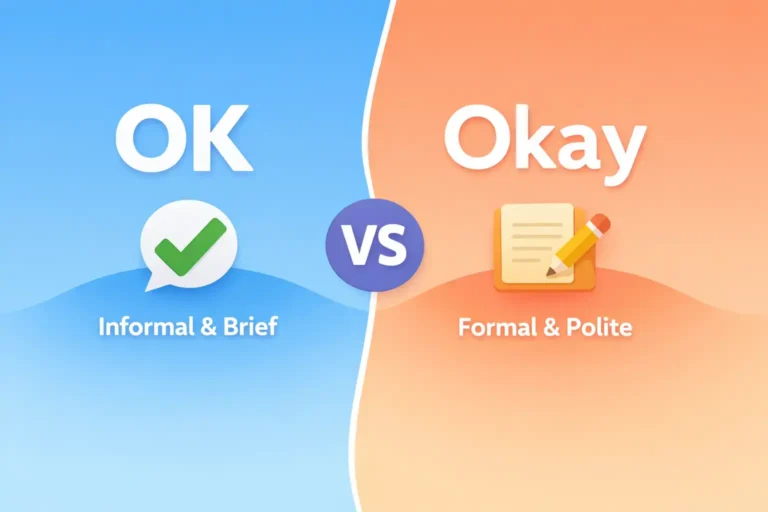
OK and okay have the same meaning. Both show agreement, approval, or that something is acceptable.
Meaning of OK
• Short form spelling
• Very common in casual writing
• Often used in texts or quick replies
Examples:
• “OK, I will send the file.”
• “Are you OK?”
Meaning of Okay
• Full spelling of the same word
• Looks slightly more natural in formal writing
Examples:
• “Okay, I understand the plan.”
• “Is everything okay?”
Easy rule:
Use OK in short messages. Use okay when you want smoother or slightly more formal writing.
The Origin of OK vs Okay
The word OK has a strange and interesting history.
It began in the United States in the 1800s. At that time, people liked playful spelling jokes. Newspapers often used funny abbreviations.
One joke spelling was “oll korrect”, which meant “all correct.”
Writers shortened it to O.K.
Soon, the short form became very popular. It appeared in newspapers, letters, and political campaigns. By the late 1800s, the word OK spread across the world.
Later, people started writing okay as a normal spelled-out word. This happened because the original abbreviation looked unusual to some readers.
So today both forms exist. They carry the same meaning, but the spelling style is different.
Writers often confuse them because both are widely accepted.
British vs American English Spelling
Both OK and okay appear in American English and British English. There is no strict rule that limits one spelling to one country.
However, some small patterns appear in modern writing.
| Style | Preferred Form |
| American journalism | OK |
| Academic or narrative writing | okay |
| British casual writing | OK |
| Online communication | ok / OK |
American newspapers often use OK because it looks shorter and clearer in headlines.
Meanwhile, books and blogs sometimes use okay because it reads like a normal word.
In contrast, casual digital writing often uses ok in lowercase.
Still, all forms are widely understood.
How to Choose the Right Word Fast
Choosing between ok vs okay becomes simple once you know the context.
For US writing
Many newspapers and style guides use OK. It looks clean and short.
Example:
“OK, the meeting starts at 10.”
For UK or Commonwealth writing
Both spellings appear. Writers often choose OK in quick messages and okay in longer text.
Example:
“Okay, I will review the report.”
For global or professional writing
Many writers prefer okay because it feels slightly more natural in sentences.
Example:
“Everything looks okay now.”
Overall, the difference is about tone, not meaning.
Common Mistakes with OK vs Okay
Many writers make small mistakes with these words. These errors are easy to fix.
Using both forms randomly
❌ The report is ok but the results are okay.
✅ The report is okay but the results are okay.
Consistency improves clarity.
Using lowercase in formal writing
❌ ok, I understand your request.
✅ OK, I understand your request.
Capital letters look more professional.
Using OK inside formal sentences too often
❌ The proposal is OK for the company strategy.
✅ The proposal is acceptable for the company strategy.
In very formal writing, a stronger word may work better.
Editors often see these mistakes in student essays and emails.
OK vs Okay in Real Life Examples
You can see both spellings everywhere in daily communication.
Emails
“OK, I will send the document tomorrow.”
“Everything looks okay on my side.”
News
“Government says the plan is OK to move forward.”
Social Media
“ok thanks!”
“Okay that makes sense.”
Professional Writing
“The design appears okay after the update.”
These examples show how flexible the word is. The meaning stays the same even when the spelling changes.
OK vs Okay – Word Usage Patterns and Search Trends
Both spellings remain extremely common around the world.
Students, ESL learners, and writers often search ok vs okay because they want to avoid mistakes. The words look simple, yet many people worry about using the wrong one.
Short digital communication made ok even more popular. Text messages and chat apps often use it as a quick reply.
Meanwhile, editors and bloggers sometimes prefer okay because it blends better into sentences.
A real-world problem appears in professional emails. Imagine a message that simply says “ok.” It may look cold or careless. Writing “Okay, thank you” feels clearer and more polite.
Small spelling choices can change tone.
OK vs Okay Comparison Table
| Feature | OK | Okay |
| Meaning | Agreement or acceptance | Same meaning |
| Part of speech | Interjection, adjective | Interjection, adjective |
| Context of use | Casual writing, quick replies | Sentences and slightly formal writing |
| Formal vs informal | Mostly informal | Neutral to informal |
| Common mistake | Writing lowercase in formal text | Mixing both forms randomly |
| Correct example | “OK, I will join the call.” | “Okay, I understand the issue.” |
This table shows that the difference is mainly style, not meaning.
Frequently Asked Questions
Is OK the same as okay?
Yes. Both words mean the same thing. They show agreement or that something is acceptable.
Which one is correct in formal writing?
Both are correct. However, okay often looks smoother in formal sentences.
Can OK and okay be used interchangeably?
Yes. Most writers use them interchangeably. The meaning stays the same.
Why do people confuse OK and okay?
The confusion happens because OK started as an abbreviation, while okay looks like a normal word.
Can grammar tools catch this mistake?
Most grammar tools allow both forms. They rarely mark either spelling as wrong.
Is there a British vs American difference?
No strict difference exists. Both spellings appear in British and American English.
Is “ok” lowercase acceptable?
Lowercase ok is common in texting and chat. Formal writing usually prefers OK or okay.
Conclusion
The difference between ok vs okay is much smaller than many people think.
Both spellings mean the same thing. They show agreement, approval, or that something is acceptable. The difference mostly comes from writing style.
OK started as a historical abbreviation. It remains very common in quick messages, headlines, and casual communication. On the other hand, okay looks more like a normal word. Because of that, many writers use it in sentences, articles, or professional writing.
Consistency matters more than the spelling choice itself. Mixing both forms inside the same text can look messy. Editors often recommend choosing one style and using it throughout the document.
Overall, both words are correct and widely understood.
In short, remember one simple rule: Use OK for short replies, and use okay when the word sits naturally inside a sentence.

Daniel Morris writes about English word differences and spelling confusion. His focus is to provide clear, simple explanations with practical usage examples.