A SaaS client once sent me a blog draft that said the company’s “net income fell, so its core business got weaker.” That sentence looked tidy, but it was wrong. After a quick edit, I found the business had actually improved its day-to-day operations. The drop came from taxes and a one-off expense, not from the main business itself. One loose phrase changed the whole meaning.
I have seen this mix-up in student essays, startup pitch decks, earnings summaries, and even news copy written on tight deadlines. Writers often treat operating profit vs net income as if the terms were interchangeable because both sound like “profit.” They are not. One points to profit from normal business operations. The other shows what is left after nearly everything else gets counted.
By the end of this article, you will know what each term means, where writers confuse them, how to choose the right one fast, and how to avoid the kind of wording mistake that makes a report sound careless.
Operating Profit vs Net Income – Quick Answer
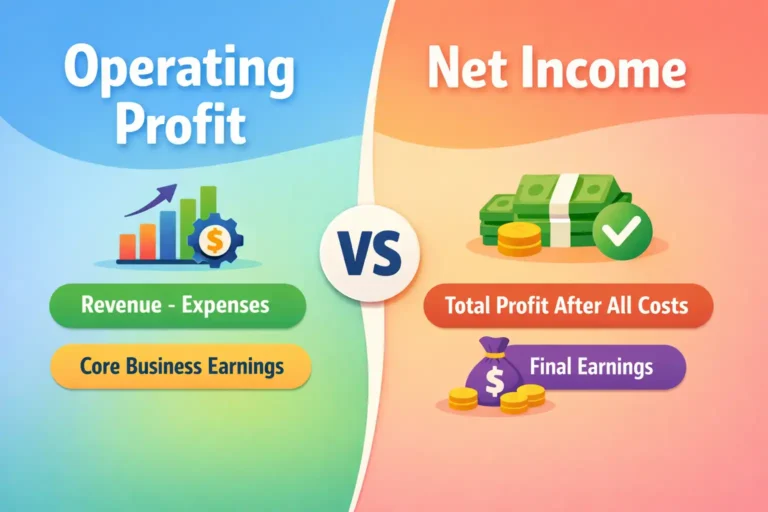
Operating profit is the money a business makes from its main operations before interest and taxes. Net income is the final profit after interest, taxes, and other gains or losses. The first shows operating performance. The second shows the bottom-line result.
Meaning of Operating Profit
Operating profit shows how much profit a company makes from its normal business activity. It leaves out interest, taxes, and often unusual non-operating items.
Meaning of Net Income
Net income shows the final amount left after the company subtracts all expenses and adds or subtracts other items outside core operations.
One decision rule
Use operating profit when you mean core business performance. Use net income when you mean the final bottom-line profit.
The Origin of Operating Profit vs Net Income
The confusion starts with the words themselves. Profit comes through Old French profit and Latin proficere, which carries the sense of making progress or gaining advantage. Net came into English with the sense of something left clean or clear after deductions. Income traces back to the idea of money coming in.
That history explains why writers slide into error. “Profit” feels broad, so many people use it for any gain. “Net income” sounds like a polished version of profit, almost like a style choice instead of a technical distinction. In editing, I see this most in drafts written by people who know the general story of a business but not the accounting labels used to tell it.
A small historical note matters here. Older business writing often used “net profit” and “net income” in overlapping ways, especially outside formal financial statements. That legacy still causes trouble. A student may read one source using “net profit,” then another using “net income,” and assume “operating profit” belongs in the same bucket. It does not. Operating profit sits earlier in the chain.
British vs American English
There is no major spelling difference between operating profit and net income in British and American English. The real difference shows up in preferred wording. American business writing often uses net income more often in formal reporting. British and Commonwealth writing may lean more often toward profit before tax, operating profit, or profit after tax, depending on the context.
I have edited UK-facing retail reports where the writer used “net income” in a way that felt slightly imported from US corporate reporting. The number was correct, but the tone felt off for the audience.
| Usage point | American English | British/Commonwealth English |
| Operating profit | Common and standard | Common and standard |
| Net income | Very common in reports and media | Understood, but sometimes less natural than profit after tax |
| Tone in journalism | Often “net income rose” | Often “profit after tax rose” or “pre-tax profit fell” |
| Writer risk | Mixing operating profit with net income | Mixing operating profit with profit after tax |
How to Choose the Right Word Fast
For a US audience, ask one question: Are you describing the business before interest and taxes, or after everything? If it is before those items, write operating profit. If it is the final result, write net income.
For a UK or Commonwealth audience, the same logic works, but check whether the publication prefers profit after tax instead of net income. In one annual-summary rewrite I handled for a Commonwealth client, the editor kept the figure but changed the label because the local style guide favored profit language over income language.
For global or professional writing, the safest move is precision over habit. Use the exact term shown in the source statement. Do not swap labels just to avoid repetition. That is where many writers get into trouble. I have seen product managers turn “operating income” into “net income” in a slide deck simply because they wanted variety. The finance team pushed the deck back.
The fastest rule is simple: If the number measures core operations, choose operating profit. If it measures the final bottom line, choose net income.
Common Mistakes with Operating Profit vs Net Income
❌ The company’s operating profit fell after taxes increased.
✅ The company’s net income fell after taxes increased.
Taxes affect net income, not operating profit.
❌ Net income shows how well the core business performed before financing costs.
✅ Operating profit shows how well the core business performed before financing costs.
Net income includes more than core operations.
❌ The retailer posted strong net income from store operations alone.
✅ The retailer posted strong operating profit from store operations alone.
“Store operations alone” points to operating profit.
❌ A student essay: “Operating profit is the last line on the income statement.”
✅ Net income is usually the last line on the income statement.
I see this in school reports when students memorize one term and force it into every answer.
❌ A news brief said a company’s net income proved its factories became more efficient.
✅ A news brief should say operating profit improved if factory efficiency drove the gain.
A better factory result belongs to operations, not automatically to the final bottom line.
Operating Profit vs Net Income in Real-Life Examples
Here is where most writers go wrong: they choose the term that sounds more familiar, not the term that matches the number.
In a professional email, a startup founder might write: “Q4 operating profit improved because our subscription renewals grew.” That works if the sentence focuses on core business performance. If the founder writes “net income improved” while the gain actually came from lower taxes, the message shifts meaning. I corrected exactly that kind of investor update last year.
In news writing, precision matters even more. A reporter on deadline may write, “The chain’s net income rose as restaurant traffic improved.” That line only works if traffic drove the final bottom-line increase. If interest expense or a tax adjustment changed the final result, the cleaner sentence is: “The chain’s operating profit rose as restaurant traffic improved.”
On social media, the mistake usually gets shorter and sloppier. I have seen founders post, “Our net income proves the product is working.” That claim can mislead readers because net income may include items unrelated to product performance. Operating profit makes the point more honestly.
In a formal document, such as a board summary, label discipline matters. One consulting memo I edited used operating profit in one table and net income in the paragraph below for the same figure. That inconsistency made the document look unreliable even though the math was right.
Operating Profit vs Net Income – Word Usage Patterns and Search Trends
The people who search this phrase usually fall into clear groups: students studying accounting terms, ESL learners writing business English, content writers covering earnings reports, and professionals checking that they are labeling a figure correctly.
The real-world cost of getting it wrong is credibility. I once reviewed a job application assignment for a junior analyst role. The candidate described a company’s “strong operating profit after tax effects.” That one phrase signaled shaky term control. The recruiter may not have cared about perfect accounting depth, but they did care about precise language.
ESL learners and native speakers often make different mistakes. In my experience editing multilingual teams, ESL learners tend to group both terms under the broad idea of “money earned,” so they blur the line between operational and final profit. Native speakers make a different error. They often know the terms sound technical, but they swap them casually for style variation. That creates a polished-sounding mistake, which can be harder to catch.
This confusion shows up most sharply in earnings summaries, investor blog posts, classroom writing, and business journalism. Those are high-risk zones because readers expect exact wording there.
Here is the comparison table writers usually need:
| Feature | Operating profit | Net income |
| Meaning | Profit from core business operations | Final profit after most expenses and other items |
| Part of speech | Noun phrase | Noun phrase |
| Curved edges possible | Not applicable | Not applicable |
| Used in formal writing | Yes, especially in operating performance analysis | Yes, especially in final financial results |
| Common mistake | Used as if it already includes taxes and interest | Used as if it only reflects core operations |
| Correct example | “Operating profit rose because store margins improved.” | “Net income fell after higher tax expense.” |
FAQs — People Also Ask
Is operating profit the same as net income?
No. Operating profit shows profit from core operations. Net income shows the final result after interest, taxes, and other items.
Which is higher, operating profit or net income?
Either can be higher in unusual cases, but net income often ends up lower because more deductions come later.
Is operating profit the same as EBIT?
Often, yes. Many writers use operating profit and EBIT in close ways, though a company’s reporting style can differ.
Why do journalists confuse operating profit and net income?
Deadline pressure causes it. Writers grab the familiar term and miss where the number sits in the income statement.
Should I use net profit or net income?
Use the term your source uses. In many formal US contexts, net income is more common. In other regions, net profit may sound more natural.
Can a company have strong operating profit but weak net income?
Yes. High interest costs, taxes, or one-off losses can drag down net income even when operations stay strong.
Which term sounds better in a student paper?
Neither is “better.” The right term depends on the figure you describe. Accuracy beats sounding technical.
Conclusion
Overall, the key difference is simple: operating profit measures the business itself, while net income measures the final result after more items pass through the statement. That is the distinction writers need to hold onto.
The most common mistake is treating net income as proof of strong day-to-day operations. I have corrected that error in client articles, school assignments, and short earnings summaries where one wrong label changed the whole message. Readers may not always spot the accounting detail, but they do notice when the wording feels off or inconsistent.
In short, use operating profit when you want to talk about core business performance. Use net income when you mean the bottom line. Finally, remember the rule that saves the most edits: operations first, bottom line last.