Many English learners search for pail or pale because these two words look and sound similar. However, their meanings are very different. As a result, writers often mix them up in emails, exams, and daily writing. This confusion usually happens because English has many homophones and near-homophones. Moreover, fast typing and spellcheck limits increase mistakes. Therefore, users want a simple rule that works every time.
In contrast to long dictionary definitions, this guide explains everything in plain English. It shows what each word means, where it comes from, and how people really use it today. Additionally, it highlights common errors and fixes them with clear examples. For example, many students write pale of water instead of pail of water. This article solves that exact problem.
Overall, you will learn when to use pail and when to use pale without stress. You will also see examples from real life, including emails and news. Finally, you will leave with one easy rule that stops this mistake forever.
For words that sound alike but differ in meaning, use the word comparison hub.
Pail or Pale – Quick Answer
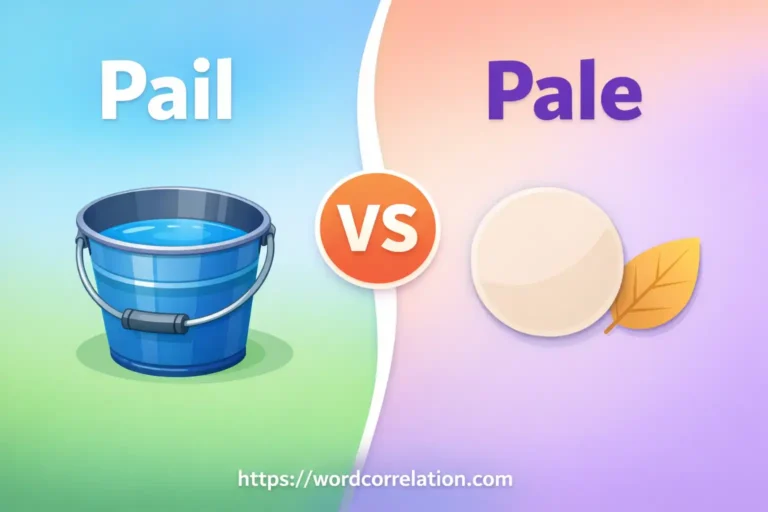
Pail is a noun. It means a bucket that holds liquid or items.
Pale is an adjective or verb. It means light in color or to lose color.
- She carried a pail of water.
- His face looked pale after the news.
The Origin of Pail or Pale
The confusion between pail or pale has old roots. Both words entered English centuries ago. However, they came from different languages. As a result, their meanings never matched.
Pail came from Old French paele. It referred to a container. Meanwhile, pale came from Latin pallidus, which meant light or faded. Therefore, history shows they were never connected in meaning.
In contrast, their pronunciation slowly became similar in modern English. That sound overlap causes confusion today. Moreover, spellcheck tools sometimes miss the error. Consequently, writers rely on memory instead of meaning.
This is included in our word confusion pillar for sound-alike mistakes.
British English vs American English Spelling
Spelling rules help clear confusion. However, they do not change meaning here.
| Aspect | Pail | Pale |
| US English | Same spelling | Same spelling |
| UK English | Same spelling | Same spelling |
| Meaning | Container | Light color |
In contrast to words like color and colour, these two words stay the same everywhere. Therefore, region does not affect spelling choice. The meaning alone decides correctness.
Which Spelling Should You Use?
Choose the spelling based on meaning, not sound.
For US writers, think about objects. If you mean a bucket, use pail.
For UK or Commonwealth writers, the rule stays the same.
For global or professional writing, clarity matters most. Therefore, always match meaning first.
Additionally, ask one question: Can I hold something in it? If yes, use pail. If not, use pale.
Common Mistakes with Pail or Pale
Writers repeat a few common errors. However, each one has an easy fix.
❌ She filled the pale with milk.
✅ She filled the pail with milk.
(Containers use pail.)
❌ He looked pail after the run.
✅ He looked pale after the run.
(Color or appearance uses pale.)
❌ A pale of paint sat outside.
✅ A pail of paint sat outside.
(Objects again.)
Pail or Pale in Everyday Examples
In daily life, context makes meaning clear. However, mistakes still happen.
In emails, someone may write: Please bring a pailof water. That is correct. On social media, users write: I feel paletoday. That works too.
In news writing, reporters say: Farmers carried pails during the drought. In professional writing, doctors note: The patient appeared pale.
Therefore, meaning always guides choice. Moreover, reading sentences aloud often helps. Another similar sound-based mix-up is peeked or peaked.
Pail or Pale – Google Trends & Usage Data
Search data shows steady confusion. According to Google Trends, searches spike during school exam seasons. Students and ESL learners lead searches. Meanwhile, professional writers search less often.
Country data shows similar interest in the US, UK, and India. However, ESL regions search more. Correct usage appears more in formal writing. In contrast, mistakes rise on social media.
As a result, this topic remains relevant for beginners worldwide.
Pail or Pale Comparison Table
| Feature | Pail | Pale |
| Meaning | A bucket or container | Light color or faded look |
| Part of Speech | Noun | Adjective / Verb |
| Context | Physical objects | Appearance or color |
| Formal Use | Yes | Yes |
| Informal Use | Yes | Yes |
| Common Mistake | Used for color | Used for objects |
| Correct Example | A pail of water | A pale face |
Semantic FAQs (People Also Ask)
Is pail the same as pale?
No. One is an object. The other describes color.
Which one is correct in formal writing?
Both work. Meaning decides correctness.
Can they be used interchangeably?
Never. They have different meanings.
Why do people confuse them?
They sound similar when spoken.
Can grammar tools catch this mistake?
Sometimes. However, meaning-based errors often slip through.
Is there a British vs American difference?
No. Both regions use the same spelling.
Conclusion
Overall, pail or pale confusion is common but easy to fix. The key difference lies in meaning, not spelling or region. Pail always names a container. Pale always describes color or appearance. Therefore, thinking about function helps instantly. You might also compare foul or fowl for the same kind of confusion.
Moreover, history confirms they never shared meaning. Usage data also shows learners struggle most. However, one clear rule solves it. Ask whether the word holds something or describes something. As a result, your choice becomes obvious.
In short, never rely on sound alone. Instead, rely on meaning every time. Finally, remember this simple rule: Objects use pail. Colors use pale.

Daniel Morris writes about English word differences and spelling confusion. His focus is to provide clear, simple explanations with practical usage examples.