Many people stop and think when they write patty or paddy. The words look alike. The sound feels close. However, the meaning changes a lot. As a result, writers often make small but clear mistakes. Students confuse them in exams. Bloggers mix them in food posts. ESL learners feel unsure. Therefore, this topic matters more than it seems.
In contrast, each word has its own job. One talks about food. The other talks about rice or names. Because spellcheck tools sometimes miss context, errors still appear. Moreover, Google searches show strong confusion around this pair. That confusion causes embarrassment in formal writing. It also hurts clarity in professional content.
Therefore, this guide solves one clear problem. It explains patty or paddy in plain English. You will learn the meaning, origin, and correct use. Additionally, you will see real examples. As a result, you can choose the right word with confidence. Finally, you will remember one easy rule that works every time.
To understand meaning differences, check the word comparison hub.
Patty or Paddy – Quick Answer
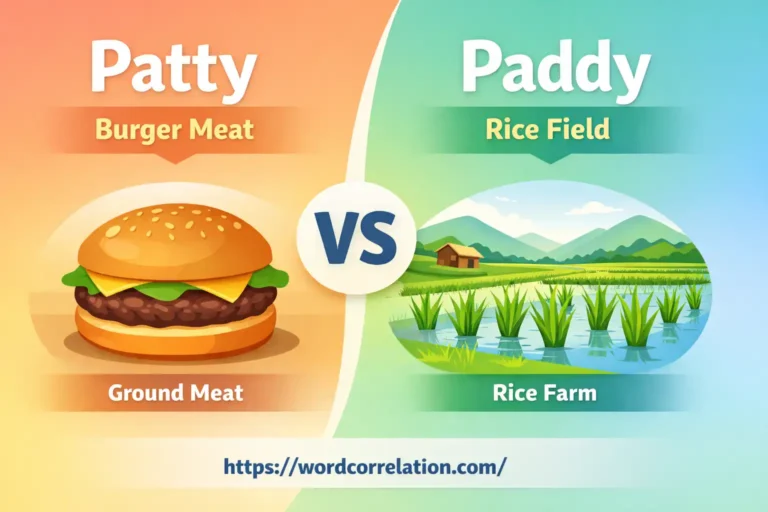
- Patty means a small, flat piece of food.
- Paddy means rice fields or unprocessed rice.
- Patty = food item.
- Paddy = rice or a proper name.
Example:
✅ Beef patty
✅ Rice paddy
The Origin of Patty or Paddy
The history explains the confusion. Therefore, origin matters.
Patty comes from the French word pâté. It referred to a small pie or minced meat dish. Over time, English shortened the meaning. As a result, today it means a flat piece of food. For example, burger patties fit this use well.
Paddy, however, comes from the Malay word padi. That word means rice in the field. English adopted it during trade and farming contact. Therefore, paddy relates to rice or rice fields.
Because both words sound similar, people mix them. Moreover, fast typing increases mistakes. In contrast, the meanings never overlap.
This pair is included in our word confusion pillar.
British English vs American English Spelling
Spelling rules stay the same in both systems. However, usage frequency changes.
| Aspect | Patty | Paddy |
| Main use | Food | Rice / Name |
| US English | Very common | Less common |
| UK English | Common | Common in farming |
In contrast, patty appears more in American food writing. Meanwhile, paddy appears more in agriculture texts. However, spelling never changes by region. Therefore, rules stay simple.
Which Spelling Should You Use?
The choice depends on meaning, not location.
For the US audience:
Use patty for food writing. Use paddy only for rice or names.
For UK or Commonwealth readers:
Rules stay the same. However, farming content may use paddy more often.
For global or professional writing:
Always focus on meaning. As a result, clarity stays strong. Moreover, editors expect accuracy.
Common Mistakes with Patty or Paddy
Mistakes happen often. Therefore, watch these examples.
❌ I ate a chicken paddy.
✅ I ate a chicken patty.
❌ Rice grows in patty fields.
✅ Rice grows in paddy fields.
❌ The burger has two paddies.
✅ The burger has two patties.
Each error changes meaning. As a result, readers get confused fast.
Patty or Paddy in Everyday Examples
You see these words everywhere. Therefore, practice helps.
Emails:
“I ordered a veggie patty for lunch.”
News:
“Floods damaged the rice paddy in the region.”
Social Media:
“This burger patty looks perfect!”
Formal Writing:
“The farmers prepared the rice paddy before planting.”
Each context shows clear separation. Therefore, confusion fades.
Patty or Paddy – Google Trends & Usage Data
Search behavior explains the issue. Therefore, trends matter.
- Students often search grammar rules.
- ESL learners look for simple meaning.
- Writers check correct usage.
- Food bloggers confuse food terms.
By country, food-related searches dominate in the US. Meanwhile, rice-related searches rise in Asia. However, mistakes appear globally. As a result, clear guidance stays valuable. Another sound-based mix-up is pail or pale.
Patty or Paddy Comparison Table
| Feature | Patty | Paddy |
| Meaning | Flat piece of food | Rice field or rice |
| Part of speech | Noun | Noun |
| Context | Food, cooking | Farming, agriculture |
| Formal use | Yes | Yes |
| Informal use | Yes | Yes |
| Common mistake | Used for rice | Used for food |
| Correct example | “Beef patty” | “Rice paddy” |
This table removes doubt instantly.
Semantic FAQs: Patty or Paddy
Is patty the same as paddy?
No. Each word has a different meaning.
Which one fits formal writing?
Both fit formal writing when used correctly.
Can they replace each other?
No. They never work interchangeably.
Why do people confuse them?
They sound similar. That causes mistakes.
Can grammar tools catch this error?
Sometimes. However, context errors may slip.
Is there a British vs American difference?
No spelling difference exists.
Conclusion
Overall, patty or paddy looks simple. However, meaning makes all the difference. One word belongs to food. The other belongs to rice and farming. Because the sound feels close, confusion spreads fast. As a result, many writers hesitate. A similar pronunciation issue appears in hale or hail.
In short, remember the core idea. Patty always goes on a plate. Paddy always grows in fields. Therefore, food equals patty. Rice equals paddy. Moreover, spelling never changes by country. Finally, focus on meaning first. If you follow this one rule, you will never make this mistake again.

Daniel Morris writes about English word differences and spelling confusion. His focus is to provide clear, simple explanations with practical usage examples.