Many writers feel unsure about people’s vs peoples’. Both forms look almost the same. However, they do not mean the same thing. A small apostrophe changes the meaning.
This confusion happens often in essays, emails, news writing, and social media. Students, ESL learners, and even experienced writers pause when they need to show possession with the word people. Should the apostrophe come before s or after s? The answer depends on the number of groups you are talking about.
Because of this, many sentences become unclear. Readers may not know if you mean one group of people or many different peoples or cultures. That small detail matters in formal writing and academic work.
This article explains the difference in a simple way. You will learn the meaning of people’s and peoples’, where writers usually make mistakes, and how to choose the correct form quickly.
People’s vs Peoples’ – Quick Answer
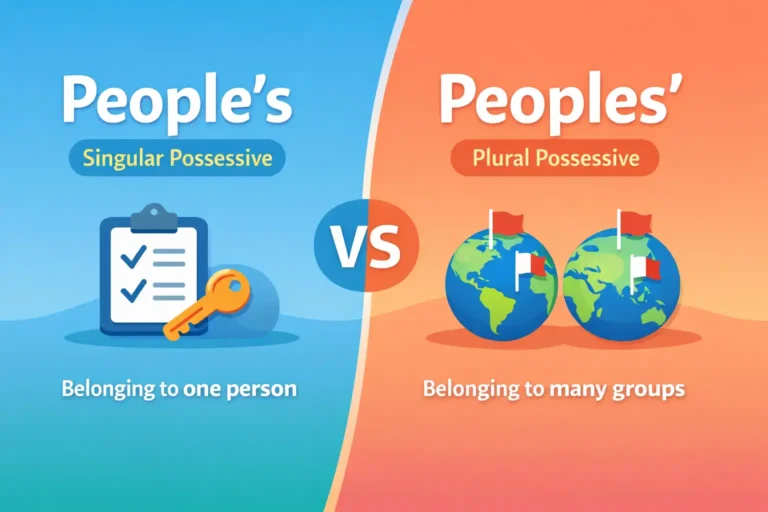
Meaning of people’s
People’s is the possessive form of “people.”
It shows something that belongs to one group of people.
Examples:
- People’s opinions matter.
- The people’s voice was strong.
Meaning of peoples’
Peoples’ is the possessive form of “peoples.”
It shows something that belongs to many different groups, cultures, or nations.
Examples:
- The traditions of the world’s peoples’ cultures.
- Indigenous peoples’ rights must be protected.
Easy rule:
Use people’s for one group of people.
Use peoples’ for many distinct groups or cultures.
The Origin of people’s vs peoples’
To understand the difference, it helps to know the history of the word people.
The word comes from the Latin word “populus.” It meant a nation, tribe, or group of citizens. Over time, English adopted the word people to describe a group of humans.
Later, English also formed the plural peoples. This form does not mean many individuals. Instead, it refers to many nations, ethnic groups, or cultures.
For example:
- the peoples of Africa
- the Indigenous peoples of Canada
Because English uses apostrophes to show possession, writers then formed two different possessive forms:
- people’s → belonging to one group of people
- peoples’ → belonging to multiple cultural groups
Editors often see confusion here because everyday English usually uses people, not peoples. So many writers forget that peoples can also exist.
However, the distinction becomes important in history, politics, culture, and academic writing.
British vs American English Spelling
In this case, there is no spelling difference between British and American English.
Both writing systems use the same grammar rules for possessive nouns.
| Form | Meaning | Example |
| people’s | possession of one group | The people’s decision |
| peoples’ | possession of many groups | Indigenous peoples’ land |
However, usage frequency can differ.
American writing often prefers people’s because it refers to a general population. Meanwhile, academic or international texts sometimes use peoples’ when discussing cultures or nations.
Examples:
- US news: The people’s vote changed the election.
- Global studies: The rights of Indigenous peoples’ communities.
Despite these style differences, the spelling rule stays the same everywhere.
How to Choose the Right Word Fast
Choosing between people’s vs peoples’ becomes easier when you focus on the number of groups.
First, ask a simple question:
Are you talking about one group or many groups?
Use people’s when you mean one general population.
Examples:
- the people’s choice
- the people’s concerns
- the people’s trust
Now use peoples’ when you refer to many cultures, nations, or ethnic groups.
Examples:
- Indigenous peoples’ traditions
- the world’s peoples’ languages
- the Arctic peoples’ history
Audience also affects your choice.
US writing:
Journalism and everyday writing mostly use people’s.
UK and Commonwealth writing:
Usage remains the same, although peoples’ appears more often in academic or cultural studies.
Global or professional writing:
Researchers and historians frequently use peoples’ when discussing different civilizations.
A quick mental check works well:
If you can replace the phrase with “one population,” use people’s.
If it means “many cultures or nations,” use peoples’.
Common Mistakes with people’s vs peoples’
Writers often make small punctuation errors with these words. The apostrophe location creates the confusion.
Here are frequent mistakes editors notice.
❌ Peoples voice matters.
✅ People’s voice matters.
Explanation: One group of people owns the voice.
❌ The peoples culture is rich.
✅ The peoples’ culture is rich.
Explanation: Multiple peoples share cultures.
❌ Indigenous people’s rights (when talking about many tribes)
✅ Indigenous peoples’ rights
Explanation: Many groups are involved.
❌ The people’s of Europe
✅ The peoples of Europe
Explanation: No possession here, so no apostrophe.
These mistakes happen because many writers rarely use the word peoples. When they do, they forget the correct possessive form.
people’s vs peoples’ in Real Life Examples
Understanding real usage helps the rule become clear.
Email writing
- The people’s feedback helped improve the project.
- We must respect Indigenous peoples’ traditions.
News writing
- The leader promised to protect the people’s rights.
- The agreement supports Arctic peoples’ livelihoods.
Social media
- The people’s voice should always matter.
- We celebrate the cultures of the world’s peoples.
Professional or academic writing
- The people’s trust in government declined.
- The museum studies Indigenous peoples’ history.
In each case, the number of groups decides the form.
people’s vs peoples’ – Word Usage Patterns and Search Trends
Search data shows that many users look up people’s vs peoples’ when writing essays or reports. Students often face the question while editing sentences about culture, politics, or society.
ESL learners also search for this topic because possessive grammar can be confusing. The apostrophe position feels small, yet it changes meaning.
Professional writers encounter the issue when discussing human rights, global cultures, or anthropology. Academic articles often refer to Indigenous peoples, which naturally leads to the possessive peoples’.
A common real-world problem happens in news headlines. For example, writing Indigenous people’s rights may accidentally suggest one group, even when the article discusses many tribes or nations. That small difference can affect clarity and accuracy.
Because of this, editors usually double-check the form before publication.
Quick Comparison Table
| Feature | People’s | Peoples’ |
| Meaning | Belonging to one group of people | Belonging to multiple cultural groups |
| Base word | people | peoples |
| Part of speech | possessive noun | possessive noun |
| Context of use | general population | nations, ethnic groups, tribes |
| Formal vs informal | common in everyday writing | common in academic or cultural writing |
| Common mistake | writing peoples’ instead | writing people’s when many groups are meant |
| Correct example | The people’s opinion matters. | Indigenous peoples’ rights must be respected. |
This table shows that the difference depends mainly on how many groups exist in the sentence.
Frequently Asked Questions
Is people’s the same as peoples’?
No. People’s shows possession for one group of people. Peoples’ shows possession for many cultures or nations.
Which one is correct in formal writing?
Both are correct. The right choice depends on meaning. Formal writing often uses peoples’ when discussing ethnic groups or civilizations.
Can they be used interchangeably?
No, they cannot. Using the wrong form can change the meaning of the sentence.
Why do people confuse people’s and peoples’?
The words look almost identical. Also, everyday English rarely uses the plural word peoples, so writers forget it exists.
Can grammar tools detect this mistake?
Some grammar tools can detect it. However, many tools only check punctuation. Writers still need to understand the meaning.
Is there a British vs American difference?
No. Both British and American English use the same grammar rules for people’s vs peoples’.
Is peoples always plural?
Yes. Peoples refers to multiple distinct groups or cultures, not just many individuals.
Conclusion
The difference between people’s vs peoples’ becomes simple once you focus on the number of groups in the sentence.
People’s shows possession for one general group of people. It appears often in everyday writing, news, and social media.
Peoples’ shows possession for many distinct cultures, tribes, or nations. Academic writing and global topics use it more often.
Writers often confuse the two because the spelling looks almost identical. However, the meaning changes when the apostrophe moves.
In short, the key rule is easy to remember.
If the sentence talks about one population, use people’s.
If the sentence talks about many cultures or nations, use peoples’.
Overall, paying attention to that single apostrophe helps your writing stay clear, accurate, and professional.

Daniel Morris writes about English word differences and spelling confusion. His focus is to provide clear, simple explanations with practical usage examples.