Phone vs Cell Phone: Introduction
Many people use the words phone and cell phone every day. But they often wonder if these two words mean the same thing. Some people say phone, others say cell phone, and sometimes people use mobile phone. This creates confusion.
The confusion happens because technology changed. Years ago, a phone meant a device connected to a wall with a wire. Later, wireless devices appeared, so people started saying cell phone. Now smartphones are everywhere, so people often shorten everything to just phone.
Because of this change, students, writers, and ESL learners often ask: Is a phone the same as a cell phone? Or which word should I use?
In this guide, you will learn the clear difference in phone vs cell phone, where each word is used, and how to choose the right word quickly. You will also see simple examples, common mistakes, and real-world usage patterns.
Phone vs Cell Phone – Quick Answer (40–60 words)
Meaning of phone vs cell phone
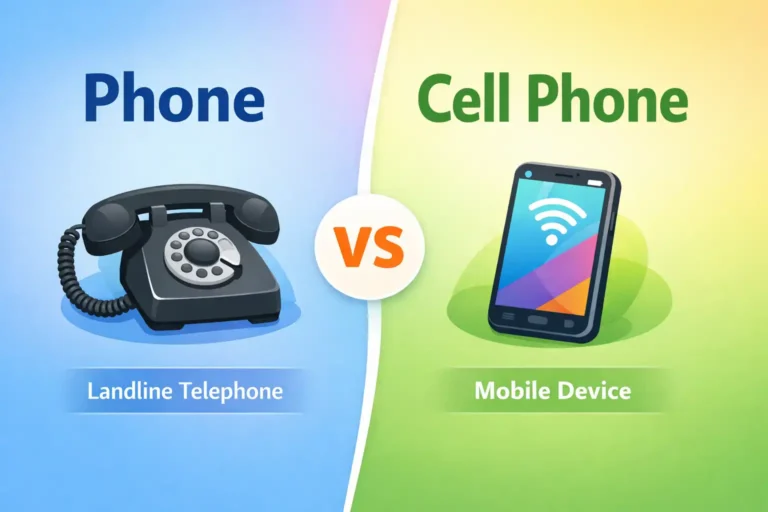
Phone: A general word for any device used to make calls.
Cell phone: A wireless phone that connects to cellular networks.
Examples:
- “Call me on the phone.”
- “My cell phone battery died.”
Easy rule:
If the device uses a cellular network, it is a cell phone.
The Origin of Phone vs Cell Phone
Word Origin and Background
The word phone comes from the word telephone. The telephone was invented in the late 1800s. Early phones were fixed devices connected by wires.
People used them in homes, offices, and public places. Because there was only one kind of phone, people simply called it a phone.
Later, wireless technology appeared. Engineers created networks made of cells. Each cell had a tower that carried signals. Because of this system, the new wireless device became known as a cell phone.
So the difference started with technology.
- Phone → traditional wired telephone
- Cell phone → wireless phone using cellular towers
Over time, smartphones replaced many landlines. Because of this shift, the word phone now often refers to a smartphone or mobile device.
Reason for Confusion Today
Today the confusion happens because the meaning of phone expanded.
For example:
- People say “I left my phone at home.”
- They usually mean a smartphone, not a landline.
Also, many countries prefer the term mobile phone instead of cell phone. Because of this global difference, people mix the terms.
So the confusion mainly comes from:
- changing technology
- regional language differences
- everyday informal speech
British vs American English: Cell Phone or Mobile Phone?
The spelling of phone and cell phone does not change between British English and American English.
However, the preferred word choice often differs.
In the United States, people usually say cell phone.
In the United Kingdom and many other countries, people say mobile phone.
US vs UK Usage Examples
US English
- “My cell phone battery is dead.”
UK English
- “My mobile phone battery is dead.”
Global informal speech
- “Check your phone.”
Regional Usage Comparison Table
| Region | Common Term |
| United States | Cell phone |
| United Kingdom | Mobile phone |
| Canada | Cell phone / mobile phone |
| Global casual speech | Phone |
Even though the spelling stays the same, the preferred word changes by region.
How to Choose the Right Word Fast
Choosing between phone vs cell phone is usually simple. The best word depends on your audience.
US Audience
Use cell phone when clarity matters.
Example:
“Turn off your cell phone during the exam.”
Americans clearly understand this term.
UK / Commonwealth
Use mobile phone instead of cell phone.
Example:
“Please switch off your mobile phone on the plane.”
Global or Professional Writing
Use phone if the exact technology does not matter.
Example:
“Contact us by phone.”
This keeps the sentence simple and universal.
If you need technical clarity, say:
- cell phone
- smartphone
- mobile phone
Common Mistakes with Phone vs Cell Phone
Many learners make small but common mistakes.
1. Mixing the Terms Incorrectly
❌ Incorrect → “My phone landline is broken.”
✅ Correct → “My landline phone is broken.”
Explanation: Landline phones are not cell phones.
2. Using Cell Phone for All Devices
❌ Incorrect → “Office cell phone system.”
✅ Correct → “Office phone system.”
Explanation: Offices often use desk phones.
3. Confusing Phone with Phone Number
❌ Incorrect → “Send me your phone.”
✅ Correct → “Send me your phone number.”
Explanation: The device and the number are different.
4. Using Cell Phone in Non-US Writing
❌ Incorrect (UK context) → “Turn off your cell phone.”
✅ Correct → “Turn off your mobile phone.”
Explanation: Word choice should match the audience.
Phone vs Cell Phone in Everyday Examples
Understanding real examples helps the most.
Emails
“Please confirm your phone number so we can call you.”
“Contact support from your cell phone if the app fails.”
News
“The new smartphone improves battery life and camera quality.”
“Emergency alerts were sent to cell phones across the city.”
Social Media
“I forgot my phone at home today!”
“My cell phone storage is full again.”
Formal or Professional Writing
“Customers may contact the company by phone or email.”
“Employees must keep cell phones silent during meetings.”
Phone vs Cell Phone – Usage Patterns & Search Interest
Online search patterns show that many users ask about phone vs cell phone.
People usually search this topic because:
- they study English
- they write essays
- they compare devices
- they learn technical terms
Students often search phrases like:
- phone vs cell phone essay
- cell phone vs mobile phone
- smartphone comparison chart
Professionals also search when writing guides or manuals.
Real-World Confusion Example
Imagine a hotel sign that says:
“Phones are not allowed.”
Guests may wonder:
- desk phones?
- smartphones?
- cell phones?
A clearer message would be:
“Cell phones must be on silent.”
This removes confusion immediately.
Phone vs Cell Phone – Comparison Table
| Feature | Phone | Cell Phone |
| Meaning | General word for calling devices | Wireless phone using cellular networks |
| Part of Speech | Noun | Noun |
| Context of Use | General communication | Mobile wireless communication |
| Formal vs Informal | Works in both | Slightly technical or specific |
| Common Mistakes | Used when phone number is meant | Used for landline phones |
| Correct Example | “Call me on the phone.” | “My cell phone battery is low.” |
This table shows that cell phone is a specific type of phone.
People Also Ask (FAQs)
What is the difference between a phone and a cell phone?
A phone is a general term for devices used to make calls. A cell phone is a wireless phone that connects to cellular towers.
What is the difference between a basic cell phone and a smartphone?
A basic cell phone mainly makes calls and sends texts. A smartphone has internet access, apps, cameras, and advanced features.
Is it a cell phone or mobile phone?
Both are correct. Cell phone is common in the United States. Mobile phone is common in the UK and many other countries.
What is the full form of cell phone?
“Cell phone” is short for cellular phone, meaning a phone that uses cellular network cells.
Is an iPhone a cell phone?
Yes. An iPhone is a smartphone, and smartphones are a type of cell phone.
What’s the difference between 4G and 5G?
Both are mobile network technologies. 5G usually offers faster speeds and lower delay than 4G.
Is phone the same as mobile phone?
Not always. Phone can mean any phone, including landlines. Mobile phone specifically means a portable wireless phone.
Which one is correct in formal writing?
Both are correct. However, phone works better for general communication, while cell phone adds technical clarity.
Conclusion
Understanding phone vs cell phone becomes easy once you know the context. The word phone is a general term. It can refer to any device used for calls, including landline phones and smartphones.
A cell phone, however, is more specific. It describes a wireless device that connects to cellular towers. In everyday conversation, people often shorten everything to simply phone, especially when they mean a smartphone.
Regional language also matters. Americans commonly say cell phone, while people in the UK and many other countries say mobile phone. When writing for a global audience, the word phone usually works best.
The most common mistake is confusing the device with a phone number or using cell phone when referring to landlines.
Overall, remember this simple rule:
All cell phones are phones, but not all phones are cell phones.
Finally, when clarity matters, choose the word that best matches the device and the audience.

Daniel Morris writes about English word differences and spelling confusion. His focus is to provide clear, simple explanations with practical usage examples.