Many people stop when they write possess or posses. The words look almost the same. However, one spelling is correct, while the other is usually wrong. Because of this, students, writers, and ESL learners feel confused. Moreover, spellcheck tools do not always help. As a result, the mistake keeps appearing in emails, exams, and posts.
This confusion happens for a simple reason. English spelling does not always follow sound rules. Therefore, writers often guess. In contrast, guessing leads to errors. Additionally, teachers mark this mistake often, which creates stress. Meanwhile, professionals worry about credibility.
This article solves that exact problem. First, you will learn what possess really means. Then, you will see why posses causes confusion. After that, you will learn clear rules. For example, you will see how to use the word in real sentences. Finally, you will know one easy rule to remember forever. By the end, you will write with confidence. Moreover, you will never pause again when typing this word.
To confirm correct spelling, use the word comparison hub.
Possess or Posses – Quick Answer
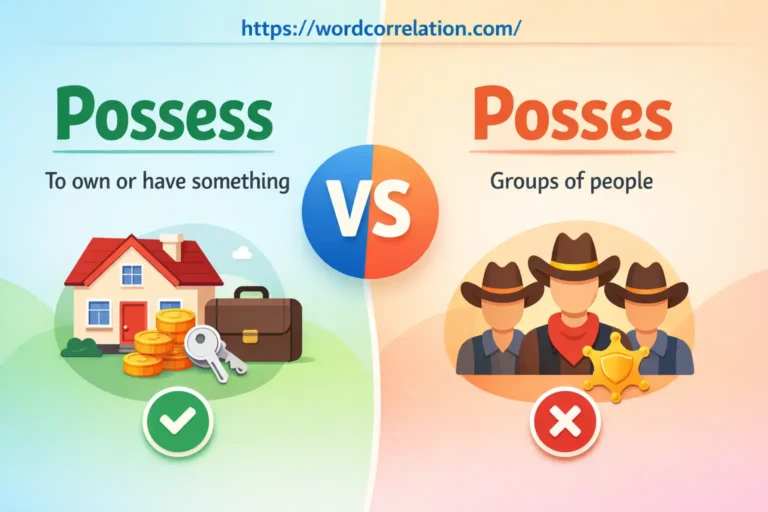
Possess is the correct word in almost all cases.
Posses is usually wrong spelling.
- Possess means to own or have something.
- Example: She possesses strong skills.
Posses is only correct as a plural noun for posse, which is very rare.
The Origin of Possess or Posses
The word possess comes from Latin. The Latin word possidere means to own or occupy. Later, French adopted it. Finally, English took it with the same meaning. Therefore, the spelling stayed long.
The confusion started because English adds -es to verbs. For example, he runs or she watches. As a result, people see possesses and think the base word is posses. However, that idea is wrong.
In contrast, posse comes from Latin too. It means power. In modern English, it means a group, often in law settings. The plural of posse is posses. However, this use is rare. Because of this, most people never need it. Overall, history explains the confusion clearly.
This belongs to our spelling errors pillar.
British English vs American English Spelling
Both British and American English use possess. There is no spelling difference here. However, learners still worry. Therefore, clarity helps.
Key Rule
- US English: possess
- UK English: possess
- No variation exists
Examples
- US: They possess advanced technology.
- UK: She possesses great patience.
Quick Comparison
| Feature | Possess | Posses |
| Common use | Yes | No |
| Verb form | Correct | Incorrect |
| Regional difference | None | None |
In contrast to many words, this one stays the same everywhere.
Which Spelling Should You Use?
You should use possess in almost every situation. This rule works globally.
- For US writers: Always use possess.
- For UK writers: Use possess without doubt.
- For global or professional writing: Choose possess every time.
However, there is one rare case. If you talk about groups like a sheriff’s team, then posses may appear. Even then, most writers avoid it.
Therefore, the safe choice is simple.
Common Mistakes with Possess or Posses
Many errors follow patterns. Once you see them, you avoid them easily.
- ❌ She posses strong leadership.
✅ She possesses strong leadership. - ❌ They posses the required skills.
✅ They possess the required skills. - ❌ He posses a rare talent.
✅ He possesses a rare talent.
The mistake happens because writers remove one s. Moreover, fast typing increases errors.
Another spelling issue appears in hazzard or hazard.
Possess or Posses in Everyday Examples
Real-life use makes learning easier. Therefore, check these examples.
Emails
- We possess all required documents.
News
- The country possesses natural resources.
Social Media
- I possess the mindset to grow.
Formal Writing
- The organization possesses legal authority.
In contrast, posses rarely appears in daily writing. Most readers never see it.
Possess or Posses – Google Trends & Usage Data
Search behavior shows the problem clearly. Many users type both spellings. However, possess dominates results.
Popularity by Country
- USA: High confusion, high correction searches
- UK: Moderate confusion
- Non-native regions: Very high confusion
User Types
- Students: Frequent mistakes
- Writers: Occasional slips
- ESL learners: Common confusion
- Professionals: Concern about correctness
Correct usage appears far more often than mistakes. As a result, learning this rule improves writing quality fast.
Comparison Table: Possess vs Posses
| Feature | Possess | Posses |
| Meaning | To own or have | Plural of posse |
| Part of speech | Verb | Noun |
| Context of use | Daily language | Rare, legal |
| Formal usage | Yes | Rare |
| Common mistake | Missing one “s” | Used instead of possess |
| Correct example | She possesses talent | The sheriff formed posses |
This table removes confusion instantly.
Semantic FAQs (People Also Ask)
Is possess the same as posses?
No. Possess is a verb. Posses is a rare plural noun.
Which one is correct in formal writing?
Possess is always correct.
Can they be used interchangeably?
No. They serve different roles.
Why do people confuse them?
Spelling patterns mislead writers.
Can grammar tools catch this mistake?
Sometimes, but not always.
Is there a British vs American difference?
No difference exists.
Conclusion
Overall, possess or posses causes stress because English spelling feels tricky. However, the solution is simple. The word possess is correct almost every time. In contrast, posses appears only in rare cases about groups. A similar incorrect form is despite or inspite.
Remember the meaning. Possess means to own or have. Moreover, it works the same in all English regions. Additionally, professional writing always prefers it. As a result, choosing the correct form builds trust.
In short, never drop an s from possess. Finally, keep one easy rule in mind:
If you mean “to own,” always write “possess.” That single rule solves the problem forever.

Daniel Morris writes about English word differences and spelling confusion. His focus is to provide clear, simple explanations with practical usage examples.