Many English learners search for possible vs potential because both words talk about things that may happen. At first glance, they seem almost the same. Both describe a chance or a future outcome. However, their real meaning and use are different.
Writers often confuse these words in emails, essays, and reports. Editors usually see sentences like “a potential solution” when the writer actually means “a possible solution.” This small mistake can change the meaning of a sentence. In professional writing, that difference matters.
The confusion happens because possible talks about something that can happen, while potential talks about something that has the ability to happen in the future. The ideas are related, but they are not identical.
In this guide, you will learn the clear difference between possible vs potential, how to choose the right word fast, and how each word appears in real life writing. The examples are simple and practical, so beginners, ESL learners, and students can understand them easily.
Possible vs Potential – Quick Answer
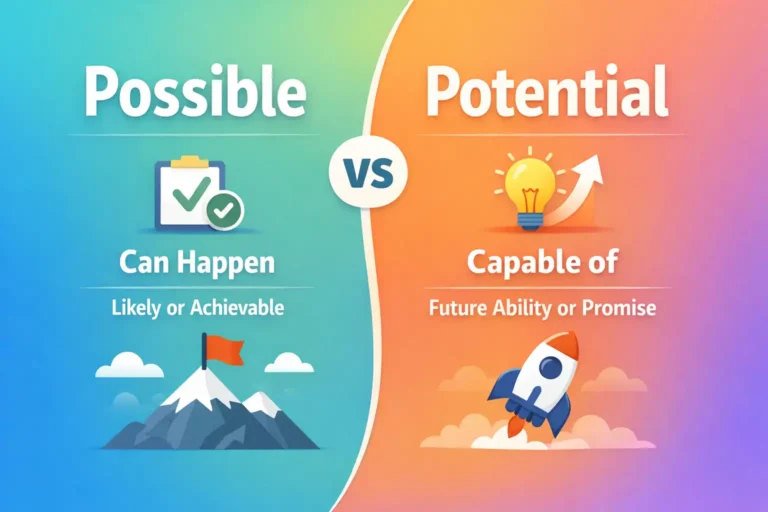
Possible means something can happen or exist.
Potential means something has the ability to happen in the future.
Meaning of Possible
- Something can happen
- Something is allowed or realistic
Examples
- It is possible to finish the project today.
- A meeting tomorrow is possible.
Meaning of Potential
- Hidden ability or future power
- Something may develop later
Examples
- She has great potential as a leader.
- The startup has potential to grow.
Easy rule:
Use possible for chance. Use potential for future ability.
The Origin of Possible vs Potential
Understanding the origin of these words helps explain why they feel similar today.
The word possible comes from the Latin word possibilis. It means “able to be done.” The word entered English in the 14th century. Writers used it to describe things that could happen or could exist.
The word potential comes from the Latin word potentia. That word means “power” or “ability.” English adopted it later, around the 15th century. Early writers used it to describe hidden strength or future power.
Because both words connect to the idea of ability, people often mix them. However, their focus is different.
Possible focuses on chance or permission.
Potential focuses on future ability or development.
This difference remains the same in modern English.
British vs American English Spelling
There is no spelling difference between British and American English for these two words.
Both regions use the same spelling and meaning.
Possible and Potential spelling comparison
Word | American English | British English
Possible | possible | possible
Potential | potential | potential
Since spelling does not change, confusion comes only from meaning and context, not from regional spelling rules.
Examples
US writing: This plan is possible.
UK writing: This plan is possible.
Both versions are identical.
How to Choose the Right Word Fast
Choosing between possible vs potential becomes easy when you focus on the idea behind the sentence.
If the sentence talks about chance, use possible.
If the sentence talks about ability or future growth, use potential.
Examples
Possible
- It is possible to travel by train.
- A delay tomorrow is possible.
- Finishing today is possible.
Potential
- The company has potential to expand.
- He shows potential in science.
- The new design has potential value.
Audience guidance
US writing
Use the same rules. Meaning stays the same.
UK / Commonwealth writing
The meaning and usage remain identical.
Global or professional writing
Professionals often use potential in business, research, and leadership contexts. However, they use possible when discussing outcomes or chances.
Common Mistakes with Possible vs Potential
Writers often mix these words because both relate to future events. However, the wrong word can change the meaning.
❌ Incorrect: This is a potential solution today.
✅ Correct: This is a possible solution today.
Explanation
The solution exists now. So the correct word is possible.
❌ Incorrect: She is a possible leader.
✅ Correct: She has potential as a leader.
Explanation
Leadership may develop in the future. So potential is correct.
❌ Incorrect: It has possible to grow fast.
✅ Correct: It has potential to grow fast.
Explanation
Growth ability refers to future capacity, not present chance.
Editors often notice these mistakes in academic essays and business writing.
Possible vs Potential in Real Life Examples
Understanding real usage makes the difference clear.
Email example
Possible
“It is possible to finish the report today.”
Potential
“This idea has potential for future projects.”
News example
Possible
“Rain is possible tomorrow in the city.”
Potential
“The young athlete shows Olympic potential.”
Social media example
Possible
“Is it possible to download the file today?”
Potential
“This startup has huge potential!”
Professional writing
Possible
“A price change is possible next month.”
Potential
“The technology has potential to improve energy use.”
These examples show the difference between chance and future ability.
Possible vs Potential – Word Usage Patterns and Search Trends
The search term possible vs potential appears often in grammar questions, ESL lessons, and writing guides.
Students frequently search this phrase while writing essays. ESL learners also look for the difference because both words appear similar in dictionaries.
Editors and teachers also notice the confusion. Many people write potential problem when they mean possible problem.
Typical user groups searching this topic
- Students learning academic English
- ESL learners improving vocabulary
- Writers editing reports or articles
- Professionals writing emails or proposals
A real-world confusion example appears in business writing.
Incorrect sentence
“This is a potential risk today.”
Correct sentence
“This is a possible risk today.”
The risk already exists, so possible is correct. The word potential would suggest a future ability instead.
Possible vs Potential Comparison Table
Feature | Possible | Potential
Meaning | Something can happen | Ability for future development
Part of Speech | Adjective | Adjective / noun
Context of Use | Chance, probability | Hidden ability or future growth
Formal vs Informal | Used in both | Often used in professional or academic contexts
Common Mistake | Used instead of potential | Used when “possible” is correct
Correct Example | It is possible to solve this problem. | The idea has potential to grow.
This table helps readers quickly understand the difference.
FAQs About Possible vs Potential
Is possible the same as potential?
No. Possible means something can happen. Potential means something has future ability or hidden power.
Which word is correct in formal writing?
Both words are correct. However, potential appears more often in business, science, and academic writing.
Can possible and potential be used interchangeably?
Sometimes they appear similar. However, their meaning differs. Possible refers to chance, while potential refers to ability.
Why do people confuse possible vs potential?
Both words describe future situations. Because of that, learners often treat them as synonyms.
Can grammar tools catch this mistake?
Some grammar tools may flag the error. However, many tools cannot detect meaning differences.
Is there a British vs American difference?
No. Both regions use the same spelling and meaning.
Is potential also a noun?
Yes. Potential can work as a noun. Example: “She has great potential.”
Conclusion
The difference between possible vs potential becomes clear when you focus on the idea behind each word.
Possible describes chance or possibility. It tells us something can happen or exist right now. Writers use it for options, outcomes, and realistic situations.
Potential describes future ability or hidden power. It suggests growth, talent, or development that may appear later.
Many learners mix these words because both refer to future events. However, the meaning changes depending on whether you talk about chance or ability.
In real writing, the mistake usually appears when someone says potential solution instead of possible solution. Editors often correct this because the solution already exists.
Overall, the easiest rule is simple.
Use possible for things that can happen.
Use potential for things that may develop in the future.
If you remember this rule, choosing the correct word will become quick and natural.

Daniel Morris writes about English word differences and spelling confusion. His focus is to provide clear, simple explanations with practical usage examples.