People often pause when they write about protestors or protesters. Both look right. Both appear online. So confusion grows. This small spelling choice can affect clarity, tone, and even trust in your writing. Students, ESL learners, and even editors see this mix-up often.
Now, the problem is simple but important. Many users do not know if the words mean the same thing or if one is wrong. Some tools accept both. Others flag one as an error. So writers feel unsure.
In this guide, you will learn the real difference, if any. You will see where each form comes from, how people use them today, and how to choose the right one fast. You will also get clear examples so you can write with confidence.
Protestors vs Protesters – Quick Answer
- Both words refer to people who protest
- Protesters is the standard and widely accepted spelling
- Protestors exists but is rare and often avoided
Easy rule: Use protesters in almost all writing
Meaning of Protestors
- Refers to people who take part in a protest
- Rare spelling form
- Not preferred in modern English
Examples:
- A few protestors gathered early
- The protestors blocked the road
Meaning of Protesters
- Refers to people who take part in a protest
- Standard and correct modern spelling
- Used in news, books, and formal writing
Examples:
- Protesters filled the streets
- Police spoke to the protesters
The Origin of Protestors vs Protesters
The word protest comes from Latin. It means “to declare publicly.” Over time, English added endings like -er and -or to form nouns. These endings often show a person who does an action.
In early English, both -er and -or endings appeared. However, patterns changed with time. Words like actor kept -or, while many action words used -er, such as runner or writer.
Now, protester has become the dominant form because English favors -er for people who perform actions. On the other hand, protestor stayed rare and never became standard.
So, the confusion today comes from older spelling habits and mixed usage online. Writers see both forms and assume both are equal. But modern usage clearly favors one.
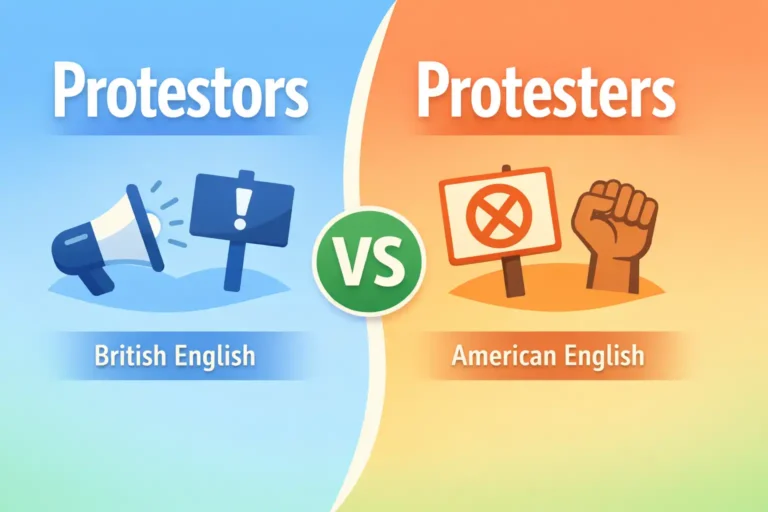
British vs American English Spelling
There is no major difference between British and American English for this word.
Both forms prefer:
- Protesters ✅
- Protestors ❌ (rare and discouraged)
Small comparison:
| Aspect | Protesters | Protestors |
| Usage | Common worldwide | Rare |
| Accepted form | Yes | Limited |
| Seen in news | Yes | Very rare |
However, English does use -or in some words like actor and doctor. This can confuse learners. But protester follows a different pattern.
How to Choose the Right Word Fast
Choosing the correct form is easy once you know the rule.
- US: Use protesters
- UK / Commonwealth: Use protesters
- Global writing: Use protesters
There is no strong case where protestors is better. Even in formal writing, editors prefer protesters.
So, the fastest choice is simple: always pick protesters.
Common Mistakes with Protestors vs Protesters
Writers often make small but clear errors.
❌ The protestors marched downtown
✅ The protesters marched downtown
❌ News covered angry protestors
✅ News covered angry protesters
Why this happens:
People think -or sounds more formal. But in this case, it does not follow modern usage.
Protestors vs Protesters in Real Life Examples
Let’s see how this appears in real writing.
Emails:
- Correct: The protesters gathered outside the office
- Wrong: The protestors gathered outside the office
News:
- Correct: Protesters demand new laws
- Wrong: Protestors demand new laws
Social Media:
- Correct: Protesters are trending today
- Wrong: Protestors are trending today
Professional Writing:
- Correct: The report mentions protesters in the city
- Wrong: The report mentions protestors in the city
In real life, almost all trusted sources use protesters.
Protestors vs Protesters – Word Usage Patterns and Search Trends
Today, protesters dominate usage. It appears in:
- News articles
- Academic writing
- Blogs and websites
Meanwhile, protestors show up less often. It may appear in:
- Older texts
- User-generated content
- Misspellings
Students and ESL learners often search for this keyword because they want clarity. Writers also check it when editing.
A real problem happens in formal writing. If someone uses protestors, readers may see it as a mistake. This can reduce trust in the content.
Comparison Table: Protestors vs Protesters
| Feature | Protestors | Protesters |
| Meaning | People who protest | People who protest |
| Part of speech | Noun | Noun |
| Context of use | Rare | Common |
| Formal usage | Not preferred | Preferred |
| Common mistakes | Used instead of correct form | Rarely misused |
| Correct example | (Avoid using) | Protesters gathered in the square |
This table shows one clear point: both mean the same, but only one is correct in modern usage.
FAQs
Are protestors the same as protesters?
Yes, both mean the same thing. But only protesters are widely accepted today.
Which one is correct in formal writing?
Use protesters. It is the standard form in all formal contexts.
Can they be used interchangeably?
Technically yes, but you should avoid protestors. It may look incorrect.
Why do people confuse them?
Because English uses both -er and -or endings. This creates doubt.
Can grammar tools catch this mistake?
Some tools flag protestors. Others may not. So manual checking helps.
Is there a British vs American difference?
No, both prefer protesters.
Is protestors outdated?
It is not fully outdated, but it is rare and not recommended.
Conclusion
The difference between protestors vs protesters is simple once you see the pattern. Both words share the same meaning. However, modern English clearly prefers one form.
Protesters are correct, common, and trusted. It appears in news, formal writing, and daily use. On the other hand, protestors is rare and often avoided. Using it may confuse readers or weaken your writing.
In short, always choose clarity. Avoid forms that look uncertain. This small change can improve your writing quality.
Final rule to remember:
If you mean people who protest, always write about protesters.

Daniel Morris writes about English word differences and spelling confusion. His focus is to provide clear, simple explanations with practical usage examples.