English spelling often causes confusion. One common example is realised vs realized. Both words look almost the same, but the spelling changes slightly. Many writers wonder which one is correct.
The confusion happens because British English and American English spell some words differently. Words that end in -ise or -ize often cause mistakes. You may see realised in one article and realized in another. Both may look correct, but they follow different language rules.
Students, ESL learners, and writers often ask questions like: Is realise spelled with S or Z?, Which one is correct, realised or realized?, or Does the UK use Z or S?
The good news is that the difference is simple once you understand the rule. In this guide, you will learn:
- the meaning of realised
- why two spellings exist
- when to use realised or realized
- real examples from everyday writing
By the end, you will know exactly which spelling to choose.
Realised vs Realized – Quick Answer
Both realised and realized are correct. The difference is spelling style.
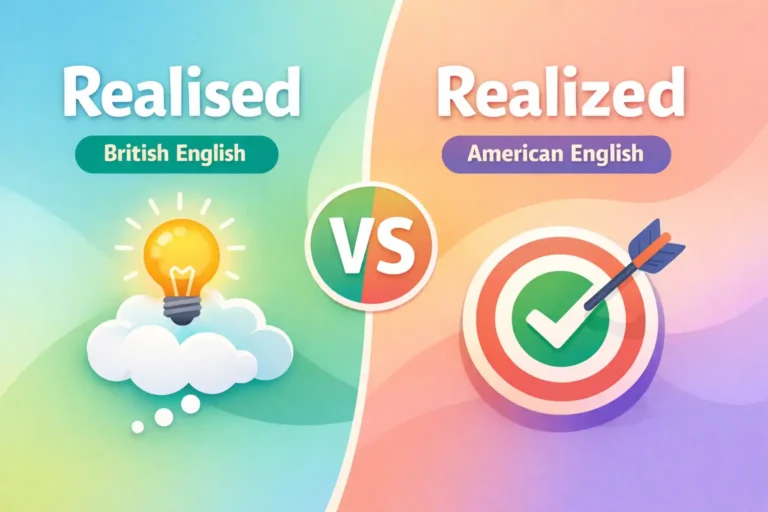
Realised vs realized refers to the difference in spelling between British English and American English for the same word.
Both words mean to understand something suddenly, become aware of something, or make something real or achieved.
- Realised → British English spelling
- Realized → American English spelling
Example:
- I realised I forgot my wallet. (UK spelling)
- I realized I forgot my wallet. (US spelling)
Simple meaning:
Both words describe the moment when someone understands or becomes aware of something.
Easy rule:
Use realised for UK or Commonwealth writing, and realized for American writing.
The Origin of realised vs realized (Why Both Spellings Exist)
The word comes from the verb realise / realize, which means to understand something clearly or to become aware of something.
The root comes from Latin “realis,” meaning “actual or real.” Later, the word moved through French before entering English. Over time, the spelling changed slightly depending on language traditions.
Early spelling patterns
In early English writing, -ize endings were common. Many scholars note that the Oxford English Dictionary often prefers “-ize” forms, even in British writing.
However, over time, everyday British spelling shifted toward -ise endings, which created the modern difference we see today.
Reason for confusion today
Today, global internet content mixes both styles. A British article may use realised, while an American blog uses realized. When readers see both forms online, they may think one is wrong.
But in reality, both spellings are valid. The only difference is the regional spelling preference.
Realised vs Realized in British and American English
The main difference between realised vs realized grammar is the spelling convention.
British English
British English often uses -ise endings.
Examples:
- realise
- organise
- recognise
So the past tense becomes realised.
Example sentence:
- I realised I left my phone at home.
American English
American English prefers -ize endings.
Examples:
- realize
- organize
- recognize
So the past tense becomes realized.
Example sentence:
- He realized the plan would not work.
Quick spelling comparison
| Language Style | Base Verb | Past Tense |
| British English | realise | realised |
| American English | realize | realized |
Both forms have the same meaning and pronunciation.
How to Choose Between Realised and Realized
Choosing between realised vs realized is easy when you think about your audience.
For US readers
Use realized.
American schools, newspapers, and professional writing follow this spelling.
Example:
The scientist realized the experiment needed changes.
For UK / Commonwealth readers
Use realised.
Countries that usually follow British spelling include:
- United Kingdom
- Australia
- New Zealand
- South Africa
Example:
She realised the meeting had already started.
For global or professional writing
Choose one style and stay consistent.
If you follow American spelling rules, keep using -ize forms. If you follow British rules, stay with -ise forms.
Consistency is more important than the spelling itself.
Common Mistakes When Using Realised vs Realized
Writers often make small errors when using these spellings.
Mixing spelling styles
❌ The manager realised the project needed more time and later realized the budget issue.
✅ The manager realised the project needed more time and later realised the budget issue.
Explanation:
Use the same spelling style throughout the document.
Using the wrong style for the audience
❌ UK academic paper: She realized the importance of the discovery.
✅ UK academic paper: She realised the importance of the discovery.
Confusing base verb forms
❌ I realiseed the answer later.
✅ I realised the answer later.
Explanation:
The correct past tense adds -ed to realise/realize.
Realised or Realized Examples in Context
Understanding real usage helps you remember the rule.
Emails
- I realised the report was missing an attachment.
- I realized we scheduled the meeting for the wrong time.
News writing
- The government realised the policy needed changes.
- Officials realized the storm could cause serious damage.
Social media
- Just realised I forgot my wallet at home.
- I just realized today is Friday!
Formal or professional writing
- The researcher realised the data required further analysis.
- The company realized the importance of digital security.
In every example, the meaning stays the same. Only the spelling changes.
Why People Search for “Realised or Realized
Many people search realised vs realized online because English learners see both spellings. Students often encounter different styles in books, websites, and exams.
Who searches for this topic?
Typical users include:
- ESL learners
- students writing essays
- bloggers and writers
- professionals working with international audiences
Why confusion happens
Global content mixes spelling systems. A UK news site may use realised, while an American news site uses realized.
This mixture can make readers believe one spelling is wrong.
Real-world confusion example
Imagine a student writing an essay using British spelling, but their teacher follows American English. The student might think the teacher corrected the word because it was wrong. In reality, it was simply a different spelling style.
realised vs realized – Comparison Table
| Feature | Realised | Realized |
| Meaning | To understand or become aware | Same meaning |
| Part of speech | Past tense verb | Past tense verb |
| Context of use | British English writing | American English writing |
| Formal vs informal | Used in both formal and informal UK writing | Used in both formal and informal US writing |
| Common mistake | Mixing with realized in same text | Mixing with realised in same text |
| Correct example | She realised the truth later. | She realized the truth later. |
This table shows that the meaning and usage are identical.
People Also Ask
Which one is correct, realised or realized?
Both are correct. Realised is the British spelling, and realized is the American spelling.
Is “realisation” just a British spelling?
Yes. Realisation is the British spelling, while realization is the American version.
Is realise spelled with S or Z?
It can be spelled with S or Z, depending on the English style. British English often uses realise, and American English uses realize.
Is it grey or gray?
Both are correct. Grey is common in British English, and gray is used more in American English.
What tense is realized?
Realized is the past tense and past participle of the verb realize.
Does the UK use Z or S?
British English mostly uses S in words like realise or organise, but some publishers also accept -ize forms.
What is the UK spelling of focussed?
In British English, focussed is often used, though focused is also widely accepted today.
Is cancelled UK spelling?
Yes. Cancelled with double L is common in British English, while American English uses canceled.
Is realized a real word?
Yes. Realized is a standard word in American English.
Is realised the same as realized?
Yes. Both words have the same meaning and pronunciation. Only the spelling style changes.
Conclusion
The difference between realised vs realized is simple once you know the rule. Both spellings describe the same action: becoming aware of something or understanding something clearly.
The key difference is regional spelling style. British English usually uses realised, while American English prefers realized. The meaning, grammar, and pronunciation stay exactly the same.
Many writers feel unsure because they see both versions online. However, the real issue is consistency, not correctness. Mixing spelling styles in one document can confuse readers.
Overall, choose the spelling that matches your audience. Use realised for UK or Commonwealth writing, and realized for American writing.
Finally, remember one simple rule:
UK writing → realised | US writing → realized.

Daniel Morris writes about English word differences and spelling confusion. His focus is to provide clear, simple explanations with practical usage examples.