Many people search for relieve or relief because these two words look similar. However, their use is different. As a result, confusion happens often. Students mix them in exams. Writers misuse them in emails. ESL learners feel unsure in daily talk. Therefore, mistakes repeat again and again.
This problem matters because wrong usage changes meaning. Moreover, it can make writing look weak or unclear. For example, one word shows an action. The other shows a result. In contrast, many users treat them as the same word.
In this guide, you will learn the clear difference. Additionally, you will see when to use each word. You will also learn common errors to avoid. Meanwhile, real-life examples will make learning easy. Overall, this article solves one clear problem. It helps you choose the right word every time.
To choose the correct form, the word comparison hub is useful.
Relieve or Relief – Quick Answer
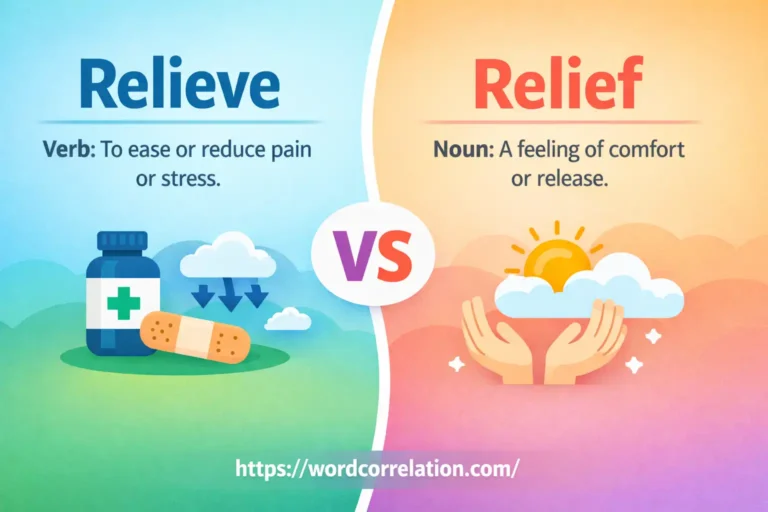
Relieve is a verb. It shows an action.
Relief is a noun. It shows a feeling or result.
- Use relieve when someone does something.
- Use relief when you feel better after pain or stress.
Example:
- Medicine can relieve pain.
- The medicine brought relief.
The Origin of Relieve or Relief
Both words come from the same root. However, their roles changed over time. Relieve came from Latin relevare, meaning “to raise” or “to ease.” Meanwhile, relief developed later as the name of the result.
Because they share history, people confuse them. Moreover, they look and sound alike. As a result, learners often swap them. In contrast, grammar rules keep them separate. One acts. The other names the effect.
This pair belongs under our meaning usage pillar.
British English vs American English Spelling
Spelling causes no issue here. Both relieve and relief stay the same in US and UK English. However, usage style may differ slightly.
| Aspect | American English | British English |
| Spelling | Relieve / Relief | Relieve / Relief |
| Usage | More direct | Slightly formal |
| Context | Everyday + formal | Formal writing |
In contrast to words like color and colour, these words stay stable.
Which Spelling Should You Use?
Choice depends on meaning, not location.
- US writers: Follow grammar rules.
- UK writers: Same rule applies.
- Global writing: Focus on sentence role.
- Professional writing: Double-check verb vs noun.
Therefore, meaning decides the word. Location does not.
Common Mistakes with Relieve or Relief
Mistakes happen when roles mix.
❌ This medicine will relief your pain.
✅ This medicine will relieve your pain.
❌ She felt relieve after the exam.
✅ She felt relief after the exam.
❌ He needs to relief stress.
✅ He needs to relieve stress.
Overall, verbs act. Nouns name results.
Relieve or Relief in Everyday Examples
Emails
- We hope this update will relieve your concerns.
- Thank you for your relief message.
News
- New policy aims to relieve inflation pressure.
- Citizens felt relief after the decision.
Social Media
- Yoga helps me relieve stress.
- That nap was pure relief.
Professional Writing
- Steps to relieve workload are listed below.
- The change brought immediate relief.
Relieve or Relief – Google Trends & Usage Data
Search data shows strong interest. Students search before exams. Writers search while editing. ESL learners search for clarity. Professionals search for accuracy.
Correct usage appears less often than mistakes. However, guides like this close the gap. Therefore, learning this pair improves writing fast. Another noun-versus-verb choice is proof or prove.
Comparison Table: Relieve vs Relief
| Feature | Relieve | Relief |
| Meaning | To reduce pain or stress | Feeling of comfort |
| Part of speech | Verb | Noun |
| Context | Action | Result |
| Formal use | Yes | Yes |
| Informal use | Yes | Yes |
| Common mistake | Used as noun | Used as verb |
| Correct example | This helps relieve pain | I felt relief |
This table clears confusion instantly.
Semantic FAQs (People Also Ask)
Is relieve the same as relief?
No. One is a verb. The other is a noun.
Which one is correct in formal writing?
Both are correct when used properly.
Can they be used interchangeably?
No. Grammar rules stop that.
Why do people confuse them?
They look similar and share origin.
Can grammar tools catch this mistake?
Yes. Most tools flag it.
Is there a British vs American difference?
No spelling or meaning difference exists.
Conclusion
Overall, relieve or relief is a simple choice when rules are clear. One word shows action. The other shows result. However, many writers ignore this rule. As a result, confusion grows. A similar form difference appears in apologizes or apologies.
Use relieve when something does the easing. Use relief when someone feels better. Moreover, remember this easy rule. If you can add “to” before the word, choose relieve. If you can add “a” before the word, choose relief.
In short, grammar clarity improves confidence. Finally, this single rule can save many errors.

Daniel Morris writes about English word differences and spelling confusion. His focus is to provide clear, simple explanations with practical usage examples.