Many learners search for right vs correct because both words seem to mean the same thing. In many cases, people use them to show something is true or not wrong. Because of this, writers and students often mix them up.
However, these words do not always work in the same way. Right can describe something morally good, socially acceptable, or accurate. Correct, on the other hand, usually focuses on factual accuracy or grammar rules. So while both words may point to truth, the context often decides which one fits best.
This small difference can create confusion in daily writing. Students may write “the right answer” when a teacher expects “the correct answer.” In conversations, people may say “you are correct,” but “you are right” sounds more natural.
In this article, you will learn the clear meaning of right vs correct, where each word works best, common mistakes, and simple rules to choose the best word quickly.
Right vs Correct – Quick Answer
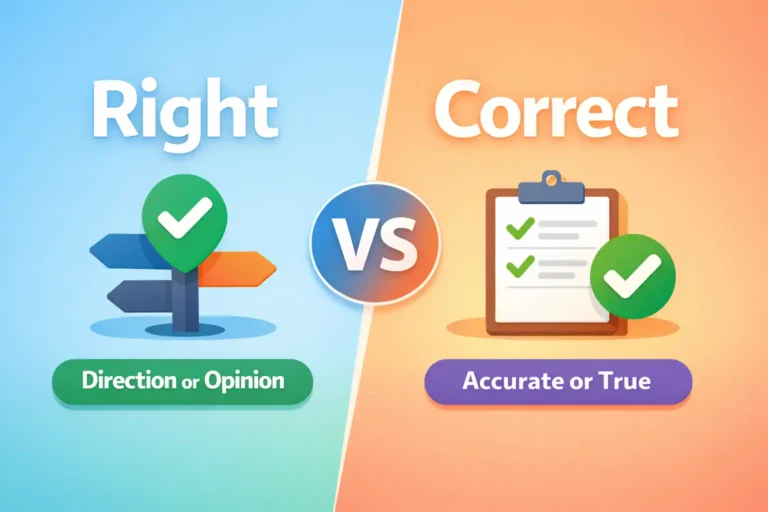
Meaning of Right
- Shows something is true, fair, or morally good
- Often used in daily speech
- Examples:
- You are right about the meeting time.
- She made the right decision.
Meaning of Correct
- Shows something is factually accurate or free from error
- Often used in academic or formal contexts
- Examples:
- That is the correct answer.
- Please correct the spelling.
Easy rule:
Use correct for facts or rules. Use right for opinions, choices, or agreement.
The Origin of Right vs Correct
The difference between right vs correct comes from their history.
The word right comes from the Old English word riht. It meant straight, proper, or just. In early English law and religion, it described fairness and moral truth. Over time, the meaning grew wider. Now people use it for accuracy, agreement, direction, and even politics.
The word correct comes from Latin correctus. It means “to make straight” or “to fix mistakes.” The word entered English through French during the Middle Ages. From the start, it carried the idea of fixing errors and making something accurate.
Because both words once meant “straight” or “true,” their meanings overlapped. This overlap explains why modern writers still confuse them.
Today, the difference is mostly about context. One word often sounds natural in daily speech, while the other fits formal accuracy.
British vs American English Spelling
For right vs correct, spelling stays the same in both British and American English. There is no variation like “colour” vs “color.”
Both regions write the words exactly the same.
Examples:
| Sentence | Usage |
| You are right about the address. | Common conversation |
| That is the correct spelling. | Formal accuracy |
However, the tone of use may differ slightly. American English often uses right in casual agreement. British English sometimes uses correct in more formal responses.
Example:
- US: “Yes, you are right.”
- UK: “That is correct.”
Even so, both versions are widely understood everywhere.
How to Choose the Right Word Fast
Choosing between right vs correct becomes easier when you think about the situation.
Use “right” when:
- You agree with someone
- You talk about moral or personal choices
- You speak in casual conversation
Example:
“You are right about the plan.”
Use “correct” when:
- You check facts
- You grade answers
- You fix mistakes
Example:
“That is the correct formula.”
Audience context also matters.
US writing
- Right is common in speech and everyday writing.
- Correct appears more in education or official contexts.
UK and Commonwealth
- Both words appear often.
- Correct sometimes sounds more formal in replies.
Global or professional writing
- Correct often fits best for clarity and precision.
- Right works better for agreement or opinion.
Common Mistakes with Right vs Correct
Many learners mix these words because both can show truth. Here are common errors.
❌ That is the right spelling.
✅ That is the correct spelling.
Explanation: spelling follows rules, so correct works better.
❌ The teacher said my answer was right grammar.
✅ The teacher said my grammar was correct.
Explanation: grammar accuracy uses correct.
❌ You are correct, I think pizza is tasty.
✅ You are right, I think pizza is tasty.
Explanation: personal opinions usually use right.
Writers often notice that correct sounds more formal, while right sounds more natural in conversation.
Right vs Correct in Real Life Examples
Understanding right vs correct becomes easier with real situations.
Emails
- “You are right about the meeting date.”
- “Please check if the data is correct.”
News writing
- “Experts confirmed the information is correct.”
- “The court ruled the decision was right.”
Social media
- “You were right all along!”
- “That fact is not correct.”
Professional writing
- “Ensure the numbers are correct before submission.”
- “The manager made the right strategic choice.”
These examples show that correct often connects to accuracy, while right connects to agreement or judgment.
Right vs Correct – Word Usage Patterns and Search Trends
Search interest in right vs correct often comes from students, ESL learners, and writers. Many people learn English through conversation first. Later, they face grammar rules in school or work.
Because of this, they wonder why teachers say correct answer, while friends say you are right.
Editors also see this confusion in beginner writing. A student might write, “the right grammar,” when the phrase should be correct grammar.
In professional settings, misuse may cause small misunderstandings. For example, saying “right data” instead of correct data can sound informal or unclear in reports.
This shows why knowing the difference improves clarity in communication.
Right vs Correct Comparison Table
| Feature | Right | Correct |
| Meaning | True, fair, or appropriate | Accurate and free from error |
| Part of Speech | Adjective, noun, adverb | Adjective, verb |
| Context of Use | Opinions, choices, agreement | Facts, grammar, rules |
| Formal vs Informal | Often informal or conversational | More formal and precise |
| Common Mistake | Used for factual accuracy | Used in casual agreement |
| Correct Example | You are right about the idea. | That is the correct answer. |
This table shows that both words connect to truth, but they focus on different types of truth.
FAQs About Right vs Correct
Is right the same as correct?
No. Both words show truth, but correct focuses on factual accuracy, while right can show agreement or moral judgment.
Which one is better in formal writing?
Correct usually works better in formal writing because it clearly shows accuracy.
Can right and correct be interchangeable?
Sometimes. In simple agreement, both may work. However, grammar or factual contexts usually require correct.
Why do people confuse right vs correct?
The meanings overlap. Both words can suggest something is true or not wrong, which causes confusion.
Can grammar tools detect this mistake?
Many grammar tools focus on spelling or structure. They may not always detect subtle word choice differences like right vs correct.
Is there a British vs American difference?
No major spelling difference exists. Both regions use right and correct the same way.
Is “right answer” wrong?
Not always. Teachers often say correct answer, but right answer appears in everyday speech.
Conclusion
The difference between right vs correct may seem small, but it matters in clear communication.
Both words connect to truth, yet they focus on different ideas. Right often relates to agreement, judgment, or personal decisions. Correct, however, focuses on factual accuracy and rules. Because of this, schools, editors, and professionals usually prefer correct when discussing grammar, math, or data.
Many learners mix these words because everyday conversation often uses right in place of correct. While this can sound natural, it may not always fit formal writing or technical contexts.
Overall, the best way to choose between them is to think about the situation. If you talk about facts or rules, use correct. If you agree with someone or describe a choice, right usually works better.
Finally, remember one simple rule:
Facts are correct, but opinions or decisions are right.

Daniel Morris writes about English word differences and spelling confusion. His focus is to provide clear, simple explanations with practical usage examples.