Many people feel unsure when they see semi-annual vs bi-annual. Both words look similar. Both relate to time. Yet they do not always mean the same thing.
This confusion appears in emails, news articles, school writing, and business reports. A company may say it releases a bi-annual report, but readers may not know if that means twice a year or once every two years. That small mistake can change the full meaning of a sentence.
Writers often confuse these words because the prefixes semi and bi sound similar. In daily language, people also use them loosely. As a result, readers may misunderstand schedules, meetings, payments, or events.
This article solves that problem. You will learn the real meaning of semi-annual and bi-annual, how editors use them, and why confusion happens so often. You will also see clear examples from real writing. By the end, choosing the right word will feel simple and natural.
Semi-Annual vs Bi-Annual – Quick Answer
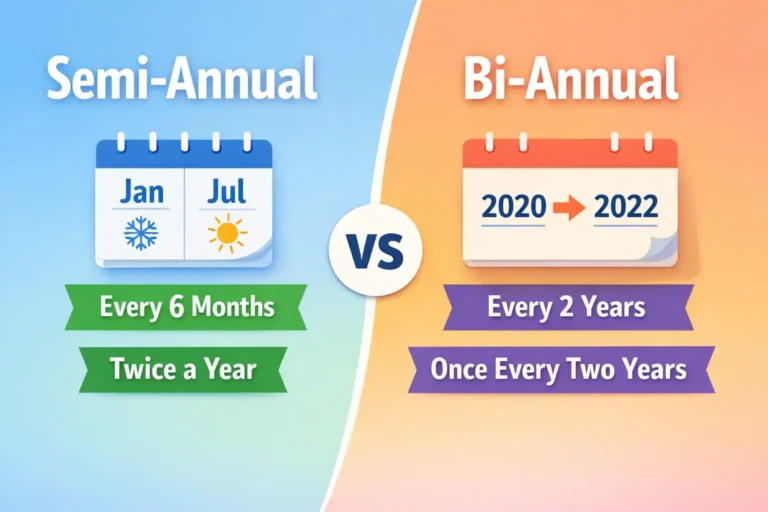
Semi-annual means something happens two times each year.
Bi-annual can mean two times a year or once every two years, which creates confusion.
Examples:
• The company releases semi-annual reports in June and December.
• The city holds a bi-annual festival every two years.
Easy rule:
Use semi-annual for twice a year. Avoid bi-annual when clarity matters.
Meaning of Semi-Annual
Semi-annual describes something that happens two times within one year.
Key points:
• Occurs every six months
• Used in business, finance, and formal writing
• Clear and rarely confusing
Examples:
• The bank sends semi-annual statements.
• The school holds semi-annual parent meetings.
• The company publishes semi-annual financial reports.
Editors often prefer this word because readers understand it quickly.
Meaning of Bi-Annual
Bi-annual is less clear. The word can have two different meanings.
Possible meanings:
• Twice a year
• Once every two years
Examples:
• The magazine releases a bi-annual issue.
• The city hosts a bi-annual art festival.
Because of this double meaning, many writers avoid the word.
A clearer alternative often works better. Writers may use semi-annual or biennial instead.
The Origin of Semi-Annual vs Bi-Annual
Understanding the origin helps explain the confusion.
The prefix semi- comes from Latin. It means half.
So semi-annual literally means half-yearly or every half year.
The prefix bi- also comes from Latin. It means two.
However, the prefix can mean two different things:
• Two times
• Every two units
That dual meaning created confusion in English.
For example:
• Biweekly may mean twice a week or every two weeks.
• Bimonthly may mean twice a month or every two months.
Therefore writers often avoid bi-annual when clarity matters.
Editors usually replace it with clearer words.
British vs American English Spelling
In this case, spelling does not change between British and American English.
Both forms remain the same:
• semi-annual
• bi-annual
However, usage may differ slightly.
Writers in both regions often avoid bi-annual in formal writing because of confusion.
Simple comparison:
| Word | US English | UK English |
| Semi-annual | Same spelling | Same spelling |
| Bi-annual | Same spelling | Same spelling |
Because spelling stays the same, the real issue is meaning clarity, not regional spelling.
How to Choose the Right Word Fast
Choosing the correct word becomes easy once you know the context.
US Writing
Professional writing in the United States often prefers semi-annual.
Reason:
The meaning stays clear.
Example:
• The company holds semi-annual board meetings.
UK and Commonwealth Writing
Writers in the UK also use semi-annual when clarity matters.
However, they sometimes prefer alternatives like:
• twice yearly
• every two years
These phrases remove confusion.
Global or Professional Writing
In international writing, clarity matters even more.
Editors usually avoid bi-annual.
Instead they write:
• semi-annual (twice a year)
• biennial (every two years)
That small change helps global readers understand quickly.
Common Mistakes with Semi-Annual vs Bi-Annual
Many mistakes appear in business and academic writing.
Writers often assume both words mean the same thing.
❌ Incorrect: The company holds a bi-annual meeting every six months.
✅ Correct: The company holds a semi-annual meeting every six months.
Explanation: Semi-annual clearly means twice yearly.
❌ Incorrect: The museum hosts a semi-annual event every two years.
✅ Correct: The museum hosts a biennial event every two years.
Explanation: Biennial means every two years.
❌ Incorrect: The magazine publishes bi-annual issues twice each year.
✅ Correct: The magazine publishes semi-annual issues.
Editors often fix these mistakes because readers may misinterpret the schedule.
Semi-Annual vs Bi-Annual in Real Life Examples
These words appear in many real situations.
Emails
Many companies write:
“Our semi-annual review meeting will take place next week.”
That wording clearly means twice per year.
News
Journalists may report:
“The city council released its semi-annual financial report.”
This avoids reader confusion.
Social Media
Organizations sometimes write:
“Our **bi-annual festival returns this summer.”
Readers may wonder whether the event happens twice yearly or every two years.
Professional Writing
Corporate reports often use precise language.
Example:
“The company reported semi-annual revenue growth.”
Clear wording improves trust and readability.
Semi-Annual vs Bi-Annual – Word Usage Patterns and Search Trends
Search interest in semi-annual vs bi-annual remains steady. Many learners search the phrase because the meanings feel unclear.
Typical users include:
• ESL learners
• Students writing essays
• Journalists and bloggers
• Business writers
Grammar tools sometimes flag the word bi-annual. Editors prefer clearer alternatives.
One real-world scenario shows the risk of confusion.
Imagine a contract that states:
“Payments occur bi-annually.”
One person may expect two payments each year. Another may think the payment comes once every two years.
That misunderstanding can create real problems.
Clear wording avoids that risk.
Comparison Table
| Feature | Semi-Annual | Bi-Annual |
| Meaning | Twice a year | Twice a year or every two years |
| Part of Speech | Adjective | Adjective |
| Context of Use | Business, reports, schedules | General writing |
| Formal Usage | Preferred in formal writing | Often avoided |
| Common Mistake | Confused with biennial | Used when semi-annual is meant |
| Example | The company released a semi-annual report. | The city hosts a bi-annual festival. |
This table helps remove confusion quickly.
FAQs
Is semi-annual the same as bi-annual?
Not always. Semi-annual clearly means twice a year. Bi-annual can mean twice yearly or once every two years.
Which word is correct in formal writing?
Most editors prefer semi-annual because the meaning stays clear.
Can semi-annual and bi-annual be used interchangeably?
Sometimes people use them that way. However, doing so can confuse readers.
Why do people confuse these words?
The prefixes semi and bi both relate to numbers. Also, the prefix bi has two meanings in English.
Can grammar tools detect this mistake?
Some grammar tools warn about bi-annual. They often suggest semi-annual or biennial instead.
Is there a British vs American difference?
No major spelling difference exists. Both forms remain the same in US and UK English.
What word means once every two years?
The correct word is biennial.
Conclusion
Overall, the confusion between semi-annual vs bi-annual comes from the prefix bi. That small prefix carries two meanings, which makes the word unclear in many situations.
Semi-annual solves that problem. It clearly means something happens twice each year. Businesses, editors, and journalists often choose this word because readers understand it instantly.
Bi-annual, however, can mean twice yearly or every two years. This double meaning creates misunderstandings in contracts, schedules, and reports. For that reason, many writers avoid the word when accuracy matters.
A simple solution exists. Use semi-annual when something happens twice a year. Use biennial when it happens every two years.
Finally, remember one easy rule: If clarity matters, choose semi-annual instead of bi-annual.

Daniel Morris writes about English word differences and spelling confusion. His focus is to provide clear, simple explanations with practical usage examples.