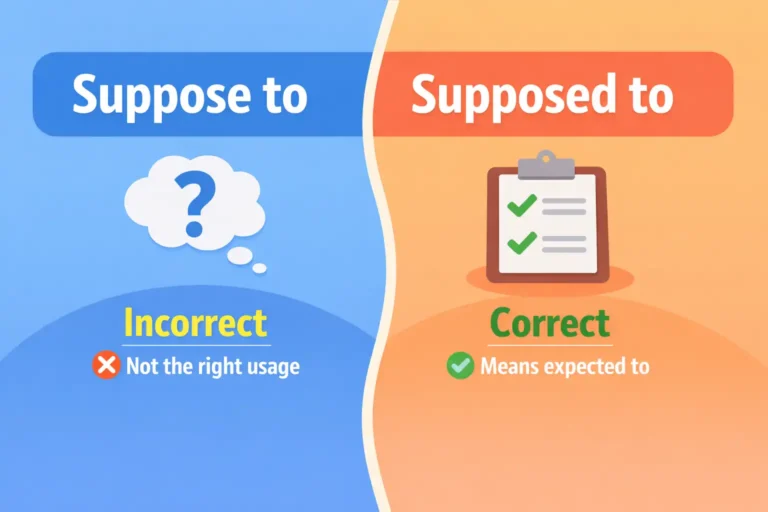
Many English learners search for “suppose to vs supposed to” because both phrases sound almost the same in speech. People hear them in movies, conversations, and social media. So they often type what they hear. As a result, many writers use “suppose to” when they actually mean “supposed to.”
This mistake appears in emails, school essays, and even online posts. The problem happens because spoken English often drops the “d” sound in “supposed.” Therefore, the phrase “supposed to” may sound like “suppose to.”
However, in correct written English, these two forms do not mean the same thing. In fact, one of them is usually wrong in most sentences. Writers, students, and ESL learners often struggle with this difference. The confusion becomes bigger when grammar tools fail to explain it clearly.
This guide explains the difference in very simple English. You will learn the real meaning, the correct usage, common mistakes, and easy rules. By the end, you will know exactly when to use “supposed to” and why “suppose to” is usually incorrect.
Suppose to vs Supposed to – Quick Answer
Meaning of suppose to
- Usually an incorrect form
- Often written by mistake instead of supposed to
Examples:
- ❌ I am suppose to call her.
- ❌ You are suppose to be here.
Meaning of supposed to
- Correct phrase meaning expected, required, or planned
Examples:
- ✅ I am supposed to call her.
- ✅ You are supposed to be here.
Easy rule:
If you mean expected or required, always use “supposed to.”
The Origin of suppose to vs supposed to
The phrase “supposed to” comes from the verb “suppose.” The word entered English through Old French and Latin. It originally meant to assume, believe, or consider something true.
Over time, the past participle “supposed” developed a special meaning. It began to show expectation, duty, or obligation.
For example:
- “You are supposed to finish your work.”
- “The train is supposed to arrive at noon.”
Here the phrase does not mean assume. Instead, it means something is expected or planned.
So where did “suppose to” come from?
The confusion mostly started in spoken English. When people speak fast, the “d” in supposed becomes soft. It sounds like this:
sup-POZE-tu
Because of that sound, many listeners believe the phrase is “suppose to.”
Writers then copy the sound instead of the correct spelling. Editors often see this mistake in student writing, social media comments, and casual messages.
Therefore, the confusion exists mainly because spoken pronunciation hides the final “d.”
British vs American English Spelling
In many English topics, spelling differs between British and American English. However, this phrase does not change across regions.
Both varieties use the same correct form.
| Form | British English | American English | Correct? |
| suppose to | same spelling | same spelling | ❌ Incorrect in most cases |
| supposed to | same spelling | same spelling | ✅ Correct |
Examples:
British style:
- You are supposed to arrive early.
American style:
- You are supposed to arrive early.
Therefore, the difference is not regional spelling. The real issue is simply correct grammar vs a common mistake.
However, informal speech in both regions often drops the “d” sound, which keeps the confusion alive.
How to Choose the Right Word Fast
Choosing the correct phrase is very simple once you know the rule.
US usage
American writers use “supposed to” in both formal and casual writing.
Example:
- The meeting is supposed to start at 10.
UK and Commonwealth usage
British, Australian, and Canadian writers also use “supposed to.”
Example:
- Students are supposed to submit homework online.
Global or professional writing
Professional writing, academic papers, and journalism always use “supposed to.”
Example:
- The law is supposed to protect consumers.
Quick decision rule
If the sentence means expected, required, or planned, use “supposed to.”
Avoid writing “suppose to.”
Common Mistakes with suppose to vs supposed to
Many mistakes happen because writers copy spoken English.
Here are the most common errors.
❌ I am suppose to finish this today.
✅ I supposed to finish this today.
Explanation: The correct form is supposed to.
❌ She was suppose to call me.
✅ She was supposed to call me.
Explanation: Past expectations still require supposed to.
❌ We are suppose to meet tomorrow.
✅ We are supposed to meet tomorrow.
Explanation: The phrase shows a plan or expectation.
❌ They suppose to arrive tonight.
✅ They are supposed to arrive tonight.
Explanation: The phrase also needs the verb are.
Editors often see these mistakes in:
- student essays
- text messages
- social media captions
Grammar checkers sometimes catch the problem. However, simple writing habits solve it faster.
suppose to vs supposed to in Real Life Examples
Understanding the phrase becomes easier when you see real examples.
Emails
- You are supposed to send the report today.
- The team is supposed to review the document.
News writing
- The new bridge is supposed to open next year.
- The president is supposed to meet foreign leaders tomorrow.
Social media
- I was supposed to wake up early today.
- The movie was supposed to be funny.
Professional writing
- Employees are supposed to follow company policy.
- The device is supposed to improve battery life.
Notice that every correct sentence uses “supposed to.”
Even casual posts should follow this rule if you want clear writing.
suppose to vs supposed to – Word Usage Patterns and Search Trends
Search engines show that many users type “suppose to” when they mean “supposed to.”
Students and ESL learners search this phrase frequently. They usually hear it first in spoken English. Then they write it exactly the way it sounds.
Writers also encounter the problem during fast typing. Autocorrect tools sometimes fail to catch it.
Typical users who search this topic include:
- English learners
- school students
- content writers
- bloggers
- job applicants writing emails
A real-life example shows how misuse can cause confusion.
Imagine a workplace message:
Incorrect:
“I suppose to attend the meeting.”
A reader might pause and wonder if the writer means “I think I attend” or “I expect to attend.”
Correct writing removes that confusion:
“I am supposed to attend the meeting.”
Clear grammar helps communication stay smooth.
suppose to vs supposed to – Quick Comparison Table
| Feature | suppose to | supposed to |
| Meaning | Usually a spelling mistake | Expected, required, planned |
| Part of speech | Incorrect phrase | Past participle phrase |
| Context of use | Informal mistake in writing | Correct in all contexts |
| Formal usage | Not acceptable | Fully acceptable |
| Common mistake | Missing the “d” sound | None |
| Correct example | ❌ I suppose to leave now | ✅ I am supposed to leave now |
This table shows that supposed to is the only correct form for most sentences.
FAQs About suppose to vs supposed to
Is suppose to the same as supposed to?
No. Suppose to is usually a spelling mistake. The correct phrase is supposed to.
Which one is correct in formal writing?
Formal writing always uses supposed to.
Can they use interchangeably?
No. Only supposed to is grammatically correct in most sentences.
Why do people confuse them?
People hear the phrase in speech where the “d” sound disappears. So they write what they hear.
Can grammar tools catch this mistake?
Some grammar tools catch it, but not always. Careful proofreading works best.
Is there a British vs American difference?
No. Both British and American English use supposed to.
Does suppose to ever work?
It rarely works. In most cases, writers mean supposed to.
Conclusion
The confusion between suppose to vs supposed to mostly comes from spoken English. When people speak quickly, the “d” sound in “supposed” becomes very soft. As a result, listeners think the phrase is “suppose to.”
However, correct written English almost always uses “supposed to.” This phrase expresses expectation, obligation, or planned action. It appears in everyday conversation, professional writing, journalism, and academic work.
Meanwhile, “suppose to” usually appears only as a mistake. Editors frequently correct this error in student essays, emails, and online posts. The problem is easy to fix once you know the rule.
Overall, remember that clear grammar improves communication. Readers understand your message faster when you use the correct phrase.
In short, always check for the missing “d.” If your sentence shows expectation or duty, the correct form is “supposed to.”
Simple rule to remember:
If the sentence means expected or required, write supposed to, not suppose to.

Daniel Morris writes about English word differences and spelling confusion. His focus is to provide clear, simple explanations with practical usage examples.