Many English learners search for “their self vs themselves” because the two forms look similar. Both seem to refer to a person doing something to their own body or mind. So the confusion feels natural.
However, the truth is simple. One form is correct in standard English, and the other is usually a mistake. Writers often type “their self” when they actually mean “themselves.” This happens in emails, social posts, and even student essays.
The confusion matters because reflexive pronouns follow strict grammar rules. If the wrong form appears in writing, the sentence may look unprofessional or incorrect. Editors often fix this error when reviewing articles, reports, or academic work.
So this guide explains the difference clearly. You will learn the meaning of each form, where mistakes happen, and how to choose the correct word quickly. By the end, you will know when themselves is the right choice and why their self usually does not work in standard English.
Their Self vs Themselves – Quick Answer
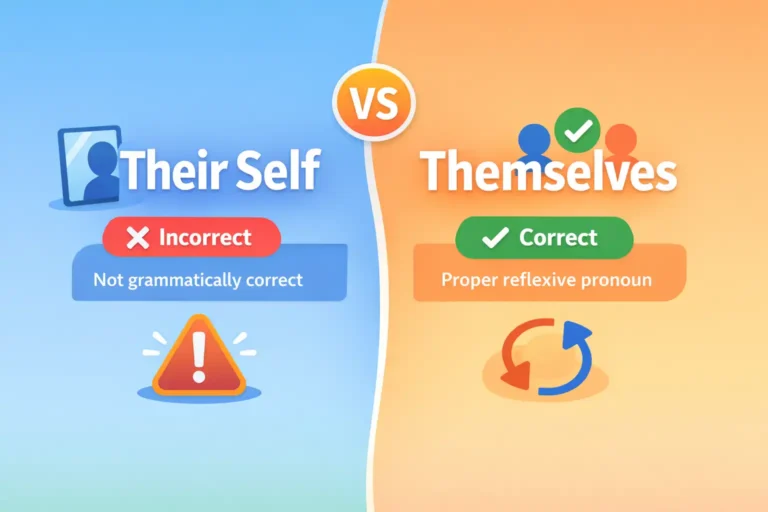
Themselves is the correct reflexive pronoun used with they / them / their.
Their self is usually incorrect in standard English writing.
Meaning of their self
- Not a standard reflexive pronoun
- Often appears as a mistake when writers mean themselves
Examples
- ❌ They prepared their self for the meeting.
- ❌ Each student should check their self.
Meaning of themselves
- Correct reflexive pronoun for they
- Used when people act on their own actions
Examples
- ✅ They prepared themselves for the meeting.
- ✅ Students should check themselves before submitting work.
Easy rule:
If the subject is they, the reflexive form should be themselves.
The Origin of Their Self vs Themselves
Understanding the history helps explain why confusion exists today.
The word themselves comes from Old English and Middle English. It formed by combining them and self. Over time, the plural ending -selves became standard for reflexive pronouns.
Examples include:
- myself
- yourself
- himself
- herself
- ourselves
- themselves
English grammar built a clear pattern. Singular forms end in -self, while plural forms end in -selves.
So themselves became the correct reflexive form for they.
However, modern English sometimes treats they as singular. This change happened because writers often use singular they when gender is unknown or not important.
For example:
- Someone should check themselves before leaving.
Here, they refers to one person. Yet the reflexive form still stays themselves, not their self.
Because of this shift, some writers try to create a singular form like theirself or their self. But standard grammar guides and editors still prefer themselves.
So the confusion mainly comes from the rise of singular they in modern English.
British vs American English Spelling
Many English word differences exist between British and American English. Words like colour / color or organise / organize change spelling depending on the region.
However, their self vs themselves does not follow that pattern.
Both British and American English use themselves as the correct reflexive pronoun.
| Form | British English | American English |
|---|---|---|
| their self | incorrect | incorrect |
| themselves | correct | correct |
Examples in both regions:
British English
- The players prepared themselves for the match.
American English
- The workers protected themselves during the storm.
In contrast, their self appears mostly as a grammar mistake or typing error. It is not a recognized spelling variation.
How to Choose the Right Word Fast
Choosing the correct form becomes easy once you know the reflexive rule.
First, check the subject of the sentence.
If the subject is they, them, or their, the reflexive pronoun should be themselves.
Examples
- They introduced themselves at the meeting.
- The children dressed themselves quickly.
Now consider audience and writing context.
US writing
Professional and academic writing always uses themselves.
UK / Commonwealth writing
Editors follow the same rule. Themselves remains the correct reflexive pronoun.
Global or professional writing
Business communication, journalism, and academic papers also use themselves.
So there is no regional difference. The correct choice stays the same across English varieties.
Quick decision tip
If the sentence needs a reflexive pronoun for they, choose themselves.
Common Mistakes with Their Self vs Themselves
Many writers create errors because reflexive pronouns can feel confusing. These mistakes appear often in casual writing.
Here are common problems.
Using “their self” instead of “themselves”
❌ They should prepare their self before the interview.
✅ They should prepare themselves before the interview.
Reason
Reflexive pronouns must follow the -selves pattern for plural subjects.
Using “their self” after singular they
❌ Each student must ask their self this question.
✅ Each student must ask themselves this question.
Reason
Even when they is singular, the reflexive form still stays themselves.
Separating reflexive pronouns
❌ The players blamed their self for the loss.
✅ The players blamed themselves for the loss.
Reason
Reflexive pronouns are single words.
Editors often see these mistakes in beginner writing, ESL essays, and quick social media posts.
Their Self vs Themselves in Real Life Examples
Understanding real usage makes the rule easier to remember.
Emails
Correct
- Team members should introduce themselves during the meeting.
Incorrect
- Team members should introduce their self during the meeting.
News writing
Correct
- The athletes pushed themselves to finish the race.
Social media
Correct
- People should believe in themselves.
Formal writing
Correct
- Participants must identify themselves before entering the event.
In professional communication, writers almost always use themselves. Editors remove incorrect forms because they weaken clarity.
Their Self vs Themselves – Word Usage Patterns and Search Trends
Online search behavior shows clear patterns.
Students and ESL learners often search for their self vs themselves when learning reflexive pronouns. They want to confirm whether both forms are acceptable.
Writers also search this phrase while editing sentences. Many notice that grammar tools highlight their self as incorrect.
The rise of singular they also increased the confusion. People wonder if a singular reflexive version should exist.
However, modern English continues to use themselves for both plural and singular uses of they.
A real-world example appears in workplace communication.
Imagine a manager writes:
- Employees should introduce their self to the team.
Readers may notice the mistake immediately. So the sentence looks less professional.
The correct version is:
- Employees should introduce themselves to the team.
Small grammar errors like this can affect how writing is perceived.
Quick Comparison Table
| Feature | Their Self | Themselves |
|---|---|---|
| Meaning | Incorrect reflexive form | Correct reflexive pronoun |
| Part of speech | Not standard grammar | Reflexive pronoun |
| Context of use | Often typing error | Used with they / them |
| Formal vs informal | Incorrect in both | Correct in all writing |
| Common mistakes | Writers separate reflexive word | None when used properly |
| Correct example | ❌ They blamed their self | ✅ They blamed themselves |
This table shows that themselves is the correct choice in standard English.
FAQs About Their Self vs Themselves
Is their self the same as themselves?
No. Their self is not a standard reflexive pronoun. Themselves is the correct form used with they.
Which one is correct in formal writing?
Formal writing always uses themselves. Editors treat their self as a grammar mistake.
Can they be used interchangeably?
No. Only themselves is correct in standard English grammar.
Why do people confuse them?
The confusion happens because they can be singular. Some writers think a singular reflexive form like their self should exist.
Can grammar tools catch this mistake?
Yes. Most grammar checkers mark their self as incorrect and suggest themselves.
Is there a British vs American difference?
No. Both British and American English use themselves as the correct reflexive pronoun.
Is “theirself” correct?
Some dialects use theirself, but standard English still prefers themselves.
Conclusion
Overall, the difference between their self vs themselves becomes clear once you understand reflexive pronouns.
English grammar follows a consistent pattern. Singular reflexive pronouns end with -self, while plural ones end with -selves. Because they functions as a plural pronoun, its reflexive form is themselves.
Confusion appears mainly because modern English uses singular they. Some writers assume that a singular reflexive form such as their self should exist. Yet grammar rules have not changed. Standard writing still uses themselves for both plural and singular uses of they.
So the key mistake to avoid is separating the reflexive word. Writing their self breaks the normal pronoun pattern and often signals a grammar error.
Finally, remember one simple rule.
If the subject is they, the reflexive pronoun should almost always be themselves.
Following this rule keeps your writing clear, correct, and professional.

Daniel Morris writes about English word differences and spelling confusion. His focus is to provide clear, simple explanations with practical usage examples.