Many English learners pause when they see thereby vs therefore. Both words appear in formal writing. Both connect ideas. Also, both look almost the same. Because of this, people often think they mean the same thing.
However, the meaning is different. One word shows a result that happens through an action. The other shows a logical conclusion or reason. Writers mix them up in essays, emails, and reports. Editors often see this mistake in academic and professional writing.
This confusion matters because the wrong word can change the meaning of a sentence. A reader may think you mean a cause, while you actually mean a method.
So this guide explains the difference in very simple language. You will learn the meaning of each word, when to use it, common mistakes, and real examples from daily writing. By the end, choosing between thereby vs therefore will feel easy and natural.
Thereby vs Therefore – Quick Answer
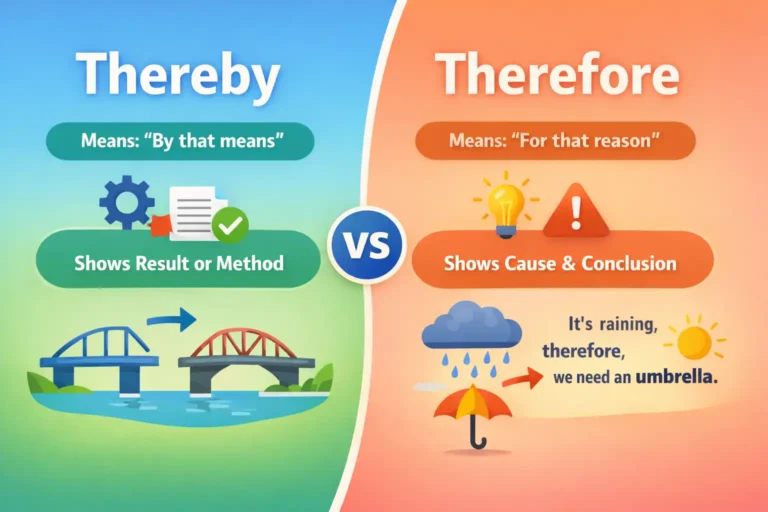
Thereby means by doing that or as a result of that action. It explains how something happens.
Therefore means for that reason or so. It explains why something happens.
Meaning of thereby
- Means by that action
- Shows the method that causes a result
- Often appears in formal writing
Examples
• She reduced costs, thereby increasing profits.
• The company merged departments, thereby improving efficiency.
Meaning of therefore
- Means for that reason
- Shows a logical conclusion
- Common in academic or logical writing
Examples
• The roads are icy. Therefore, drive carefully.
• He studied hard. Therefore, he passed the exam.
Easy rule:
Use thereby when an action creates a result.
Use therefore when a reason leads to a conclusion.
The Origin of Thereby vs Therefore
Both words come from Old English. They combine the word “there” with another part that adds meaning.
Thereby comes from the phrase meaning “by that means.” Writers used it to show that an action directly produced a result. Over time, it became common in legal and formal texts.
Therefore developed from the phrase meaning “for that reason.” It helped writers show logical conclusions. Philosophers, scholars, and scientists often used it when explaining arguments.
The confusion today happens because both words:
- start with “there”
- appear in formal writing
- connect ideas
However, their roles are different. One explains method, while the other explains reason.
British vs American English Spelling
There is no spelling difference between British and American English.
Both forms are written exactly the same:
| Word | American English | British English |
|---|---|---|
| Thereby | Thereby | Thereby |
| Therefore | Therefore | Therefore |
However, the writing style can vary slightly.
In academic British writing, therefore appears often in logical arguments. Meanwhile, thereby appears more in legal or technical writing.
Example:
US style
The policy reduced waste, thereby saving money.
UK style
The policy reduced waste, thereby saving money.
So the spelling remains identical worldwide.
How to Choose the Right Word Fast
Choosing between thereby vs therefore becomes simple if you check the sentence meaning.
First, ask what the sentence shows.
If the sentence explains how an action caused a result, use thereby.
Example
The team automated tasks, thereby saving time.
Now check if the sentence explains a logical conclusion.
If yes, use therefore.
Example
The data is incomplete. Therefore, the report is delayed.
Audience guidance:
US writers
Both words are accepted in formal writing.
UK / Commonwealth writers
Usage remains the same. Formal texts often use therefore more frequently.
Global or professional writing
Use therefore for logic. Use thereby when describing results of an action.
A quick memory tip helps many writers:
Action → thereby
Reason → therefore
Common Mistakes with Thereby vs Therefore
Writers often confuse these words because they both introduce results. Yet the type of result is different.
Here are common errors.
❌ Incorrect
She improved her skills. Thereby, she got the promotion.
✅ Correct
She improved her skills. Therefore, she got the promotion.
Explanation:
The second sentence shows a reason, not a method.
Another example:
❌ Incorrect
The company cut costs. Therefore, increasing profits.
✅ Correct
The company cut costs, thereby increasing profits.
Explanation:
The result happens through the action, so thereby is correct.
Another common mistake appears in punctuation.
❌ Incorrect
The report is late therefore we must wait.
✅ Correct
The report is late. Therefore, we must wait.
Using proper punctuation makes the meaning clear.
Thereby vs Therefore in Real Life Examples
These words appear in many types of writing.
Emails
The team automated the process, thereby reducing manual work.
The client approved the plan. Therefore, we will start next week.
News writing
The government reduced fuel taxes, thereby lowering transport costs.
The storm damaged roads. Therefore, several highways remain closed.
Social media
He practiced daily, thereby improving his skills quickly.
The event sold out early. Therefore, extra tickets are unavailable.
Professional writing
The company expanded online services, thereby reaching more customers.
Sales increased this quarter. Therefore, the outlook remains positive.
These examples show how each word shapes the meaning of a sentence.
Thereby vs Therefore – Word Usage Patterns and Search Trends
Search interest for thereby vs therefore usually comes from students, ESL learners, and professional writers.
Many users search this phrase while writing essays or reports. Grammar tools sometimes flag these words, which also causes curiosity.
Editors often see confusion in academic writing. A student may write:
“The experiment failed, thereby the hypothesis is wrong.”
However, the sentence needs therefore, because it shows a conclusion.
Misuse can confuse readers. In technical documents, a wrong connector may change how a process works or why a decision was made.
Because of this, many style guides encourage writers to use these words carefully.
Comparison Table: Thereby vs Therefore
| Feature | Thereby | Therefore |
|---|---|---|
| Meaning | By that action | For that reason |
| Part of speech | Adverb | Conjunctive adverb |
| Main function | Shows method causing a result | Shows logical conclusion |
| Common context | Formal writing, legal, technical | Academic writing, arguments |
| Formal vs informal | Mostly formal | Formal but also used in essays |
| Common mistake | Used instead of logical conclusion | Used when method is needed |
| Correct example | The company merged teams, thereby improving efficiency. | The company merged teams. Therefore, efficiency improved. |
This table highlights the difference quickly.
FAQs About Thereby vs Therefore
Is thereby the same as therefore?
No. Thereby shows how an action creates a result. Therefore shows a conclusion based on a reason.
Which word is better for formal writing?
Both appear in formal writing. However, therefore appears more often in academic arguments.
Can thereby and therefore be used interchangeably?
No. They have different meanings. Using the wrong word can change the sentence meaning.
Why do people confuse these words?
Both start with “there” and connect ideas. Also, they often appear in formal texts.
Can grammar tools detect the difference?
Some advanced tools can detect misuse. However, they may not always understand the sentence meaning.
Is there a British vs American difference?
No. Both words have the same spelling and meaning in British and American English.
Is thereby used less often today?
Yes. Many modern writers prefer simpler connectors. However, thereby still appears in formal writing.
Conclusion
Understanding thereby vs therefore becomes easy once you focus on their purpose.
Thereby explains how an action leads to a result. The action itself creates the outcome.
Therefore explains a logical conclusion. One fact leads to another idea.
Many writers confuse these words because they both connect results. Yet the type of result is different. One comes from method, while the other comes from reason.
In real writing, the difference matters. Using the wrong word may confuse readers or weaken your message.
Overall, remember one simple rule.
If the sentence shows an action producing a result, choose thereby.
If the sentence shows a logical conclusion, choose therefore.
This small rule helps writers, students, and professionals avoid one of the most common connector mistakes in English.

Daniel Morris writes about English word differences and spelling confusion. His focus is to provide clear, simple explanations with practical usage examples.