Many people get confused when they see tonnes vs ton. Both words look similar, and both talk about weight. So, it feels like they mean the same thing. But that is not always true.
This confusion often happens in school, shipping, construction, and even online shopping. For example, someone may write “5 tons” but mean a different weight than expected. That small mistake can cause real problems, especially in business or global communication.
So, what will you learn here? You will understand the exact meaning of tonnes and ton, how they differ, and when to use each one. You will also see simple examples, common mistakes, and an easy rule to remember.
Now, let’s clear the confusion step by step.
Tonnes vs Ton – Quick Answer
Tonnes and ton both measure weight, but they are not always the same.
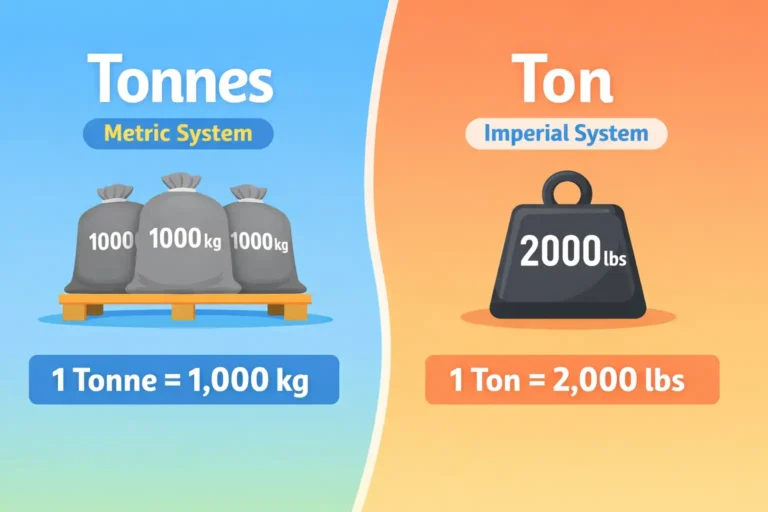
- Tonne = 1,000 kilograms (metric system)
- Ton = can mean different values (usually US or UK system)
Examples:
- The truck carried 2 tonnes of sand
- The ship holds 5 tons of cargo
Easy rule:
Use tonne for metric weight (kg-based), and use ton for US or general use.
Meaning of Tonne
- A tonne is a metric unit
- It equals exactly 1,000 kilograms
- Used worldwide in science and trade
Examples:
- The factory produces 10 tonnes of steel daily
- This machine weighs 1 tonne
Meaning of Ton
- A ton can mean different things
- In the US, 1 ton = 907 kg (short ton)
- In the UK, 1 ton = 1,016 kg (long ton)
Examples:
- The truck carried 1 ton of bricks
- The shipment weighs 3 tons
The Origin of Tonnes vs Ton
The word ton comes from an old French word “tonne,” which meant a large barrel. People used barrels to measure goods like wine. Over time, the word started to mean weight instead of volume.
Later, systems changed. The metric system introduced tonne to create a clear and fixed value of 1,000 kilograms. However, older systems in the US and UK kept using ton with slightly different values.
So now, both words exist. That is why confusion still happens today.
British vs American English Spelling
The difference between tonnes vs ton is not just spelling. It also depends on the measurement system.
- Tonne → used in metric system (global use)
- Ton → used in US and UK systems
However, meanings can vary.
| Type | Word Used | Weight Value |
| Metric system | Tonne | 1,000 kg |
| US system | Ton | 907 kg (short ton) |
| UK system | Ton | 1,016 kg (long ton) |
However, people often use ton casually to mean “a lot” without exact weight.
How to Choose the Right Word Fast
Choosing the right word is easy if you know your audience.
- For US audience: use ton
- For UK audience: use ton (but check context)
- For global or scientific writing: use tonne
If you want clarity, use tonne because it always means 1,000 kg.
So, when accuracy matters, metric is safer.
Common Mistakes with Tonnes vs Ton
Writers often mix these words without thinking. Here are common errors:
❌ Incorrect: The bag weighs 1 ton (metric context)
✅ Correct: The bag weighs 1 tonne
❌ Incorrect: 1 tonne equals 1 ton (always)
✅ Correct: 1 tonne ≠ 1 ton in many cases
These mistakes happen because the words look the same. But the values are not equal.
Tonnes vs Ton in Real Life Examples
You will see these words in many daily situations.
Emails:
- Please confirm if the order is 5 tonnes or 5 tons
News:
- The factory produced 20 tonnes of waste
- The ship carried 50 tons of coal
Social Media:
- I have a ton of homework
(Here, “ton” means “a lot,” not weight)
Professional Writing:
- The project requires 3 tonnes of cement
- The cargo limit is 10 tons
Context is very important here.
Tonnes vs Ton – Word Usage Patterns and Search Trends
People search tonnes vs ton because they want clarity. Students, ESL learners, and writers often face this confusion.
Editors usually see this mistake in international content. For example, a writer may use “ton” in a global report where “tonne” is more accurate.
In real life, this can cause serious issues. Imagine a shipping company mixing up these units. The weight difference can affect cost, safety, and planning.
So, using the correct term is not just about grammar. It also helps avoid real-world problems.
Tonnes vs Ton Comparison Table
| Feature | Tonne | Ton |
| Meaning | Metric unit of weight | Non-metric weight unit |
| Value | 1,000 kg | 907 kg (US) / 1,016 kg (UK) |
| System | Metric system | US / UK system |
| Formal usage | Preferred globally | Used regionally |
| Common mistakes | Confused with ton | Assumed equal to tonne |
| Example | 2 tonnes of steel | 2 tons of coal |
This table makes the difference clear at a glance.
FAQs
Is tonne the same as ton?
No. A tonne equals 1,000 kg, while a ton can vary by region.
Which one is correct in formal writing?
Use tonne for clarity, especially in global or scientific writing.
Can tonne and ton be used interchangeably?
No. They represent different weights in most cases.
Why do people confuse tonnes vs ton?
Because both words look similar and both relate to weight.
Can grammar tools catch this mistake?
Not always. Tools may miss the context of measurement.
Is there a British vs American difference?
Yes. Both use “ton,” but the weight value differs slightly.
Conclusion
The difference between tonnes vs ton may look small, but it matters a lot. Both words describe weight, but they belong to different systems. A tonne always equals 1,000 kilograms. A ton, however, can mean different values depending on location.
So, what should you remember? Use tonne when you want accuracy and global clarity. Use ton when writing for US or UK audiences, but check the context.
Overall, the biggest mistake is assuming both are the same. They are not.
Finally, here is one simple rule:
If you mean 1,000 kg, always write “tonne.”

Ibrahim John is an English language editor with over ten years of experience working with writers, publishers, and international businesses. He specialises in word choice, grammar accuracy, and the differences between British and American English.