Many people search for well or good because these two small words cause big confusion. They look simple. However, they work in very different ways. As a result, students, writers, and even professionals mix them up every day. For example, people often say “I am doing good” when they mean something else. Meanwhile, grammar rules online feel complex and scary. Therefore, learners feel unsure and frustrated.
This article solves that problem step by step. First, it explains what well and good really mean. Next, it shows where mistakes usually happen and why they happen. Moreover, it gives clear examples from real life, such as emails and social media. In contrast to dictionary explanations, this guide uses very simple English. Additionally, each rule stays short and easy to remember.
By the end, you will know when to use well and when to use good. You will also learn one easy rule that works almost every time. Overall, this article helps you write clearly, speak confidently, and avoid common grammar errors.
Usage differences are clarified in the word comparison hub.
Well or Good – Quick Answer
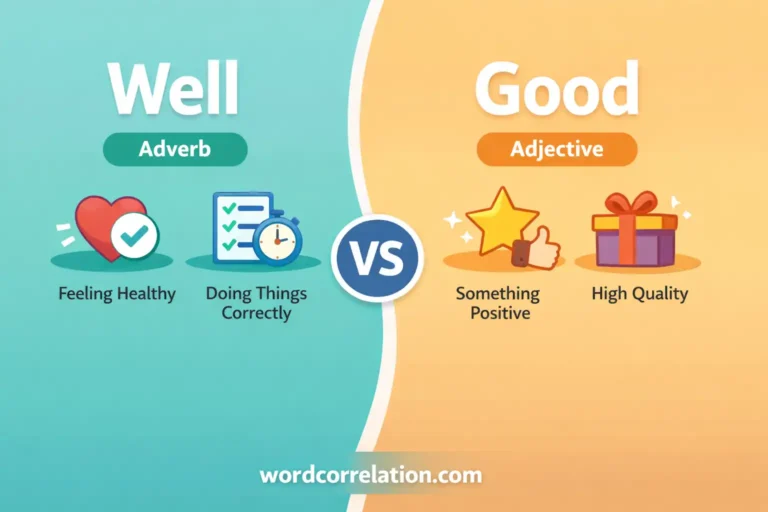
Well describes how an action happens.
Good describes a thing or a person.
- “She writes well.” (How she writes)
- “She is a good writer.” (What she is)
Use well with actions. Use good with nouns.
The Origin of Well or Good
The words well and good come from Old English. However, they had different jobs from the start. Good came from a word meaning valuable or desirable. In contrast, well came from a word meaning in a good way.
Over time, English grammar kept this difference. Good stayed an adjective. Therefore, it describes nouns. Well became an adverb most of the time. As a result, it describes verbs.
The confusion started because both words relate to positive ideas. Moreover, spoken English often ignores strict grammar rules. Because of that, people hear mistakes and repeat them.
This pair belongs under our meaning usage pillar.
British English vs American English Spelling
There is no spelling difference between British and American English for well or good. However, usage habits can differ slightly.
British and American English both follow the same grammar rule. Good modifies nouns. Well modifies verbs. In contrast, informal speech in both regions breaks this rule often.
Examples
- US & UK: “She feels well today.”
- US & UK: “She has a good feeling.”
Quick Comparison
| Region | Rule Change |
| American English | No change |
| British English | No change |
Therefore, spelling and meaning stay the same everywhere.
Which Spelling Should You Use?
Since spelling does not change, the real choice depends on context, not location.
- US users: Follow standard grammar rules. Use good for nouns.
- UK / Commonwealth users: Use the same rule clearly.
- Global or professional writing: Always use correct grammar. Editors expect accuracy.
Meanwhile, casual speech allows more flexibility. However, writing needs clarity. Therefore, choose carefully.
Common Mistakes with Well or Good
Many errors happen because people focus on meaning, not grammar.
❌ Incorrect → ✅ Correct
- ❌ “I am doing good.” → ✅ “I am doing well.”
Reason: “Doing” is an action. - ❌ “She sings good.” → ✅ “She sings well.”
Reason: Singing is a verb. - ❌ “He feels good today.” → ✅ “He feels well today.”
Reason: Health uses well.
However, “feel good” can describe emotions. Context matters.
Well or Good in Everyday Examples
Emails
- “I hope you are doing well.”
- “You did a good job on the project.”
News
- “The team played well.”
- “The company had a good year.”
Social Media
- “Life is good.”
- “That workout went well.”
Formal Writing
- “The method works well in tests.”
- “The study shows good results.”
Each example shows action versus description clearly.
Well or Good – Google Trends & Usage Data
Search data shows strong interest in well or good. Students search it often. ESL learners also struggle with it. Meanwhile, writers check it for editing.
By country, usage stays high in the US, UK, India, and Canada. Professionals search it less. However, mistakes still appear in business emails. Grammar tools catch some errors. However, tools miss context. Therefore, learning the rule matters.
Correct usage appears more in formal writing. In contrast, common mistakes dominate casual posts. As a result, confusion continues online. A similar usage choice appears in anyone or anybody.
Comparison Table: Well vs Good
| Feature | Well | Good |
| Meaning | In a good way | Positive quality |
| Part of speech | Adverb (mostly) | Adjective |
| Context of use | Actions, health | People, things |
| Formal vs informal | Both | Both |
| Common mistakes | Used as adjective | Used for verbs |
| Correct example | “She works well.” | “She is good.” |
This table removes confusion instantly.
Semantic FAQs (People Also Ask)
Is well the same as good?
No. They serve different grammar roles.
Which one is correct in formal writing?
Both are correct when used properly.
Can they be used interchangeably?
Rarely. Only health context overlaps.
Why do people confuse them?
Because speech often ignores grammar.
Can grammar tools catch this mistake?
Sometimes. Context errors slip through.
Is there a British vs American difference?
No. Rules stay the same.
Conclusion
Overall, well or good confusion comes from mixing actions with descriptions. Good describes nouns. Well describes verbs. That rule solves most problems. However, spoken English often hides mistakes. Therefore, writing needs extra care. Contextual correctness also matters in aye or nay.
In short, ask one question before choosing. Are you describing what something is or how something happens? If you describe a thing or person, choose good. If you explain an action or health, choose well. As a result, your sentences sound clear and correct.
Finally, remember this easy rule:
Good = noun. Well = verb.
Follow it, and you will avoid this mistake every time.

Daniel Morris writes about English word differences and spelling confusion. His focus is to provide clear, simple explanations with practical usage examples.