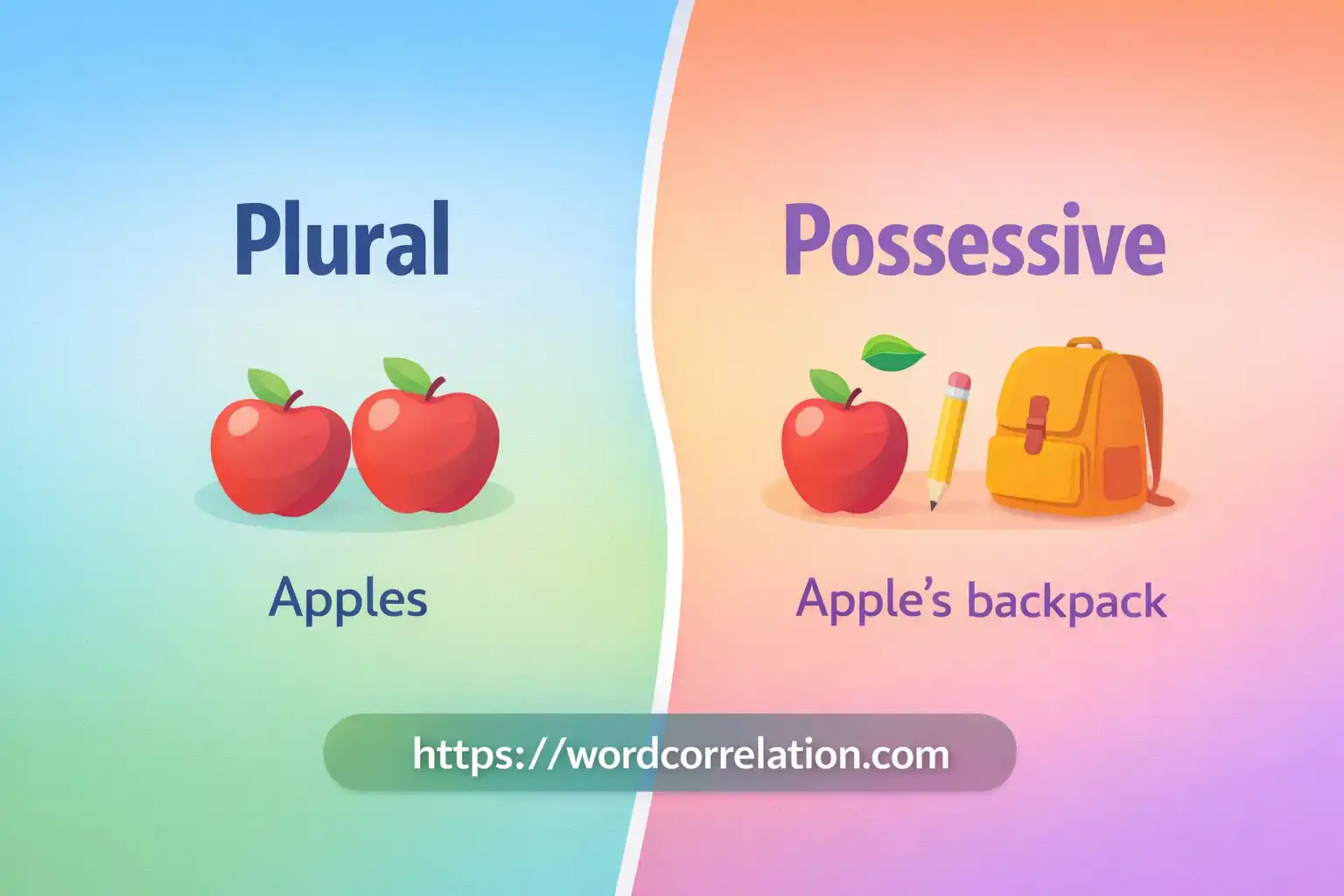
Many people search for plural or possessive because English uses apostrophes in tricky ways. The rules look simple. However, real writing creates doubt. Students pause during exams. Writers hesitate in emails. Moreover, ESL learners feel unsure every day. As a result, small marks create big confusion.
This problem often appears with words ending in s. Writers ask: should I add s, ’s, or s’? Therefore, mistakes happen in essays, posts, and even news headlines. In contrast, spoken English hides these errors. Writing exposes them fast.
This article solves that problem clearly. You will learn what plural and possessive really mean. Additionally, you will see how English history shaped these forms. Examples will guide you step by step. Moreover, tables will remove doubt instantly. By the end, you will choose the correct form with confidence. Finally, one simple rule will stay in your mind forever.
For guidance on word forms and grammar, start at the word comparison hub.
Plural or Possessive – Quick Answer
- Plural shows more than one thing.
Example: cats, books - Possessive shows ownership or relation.
Example: cat’s toy, teachers’ room
Use plural to count.
Use possessive to show who owns something.
The Origin of Plural or Possessive
English comes from Old English and Latin roots. Early English used endings instead of apostrophes. Over time, spelling changed. However, meaning stayed close.
The apostrophe entered English in the 16th century. Writers used it to mark missing letters. Later, it began to show possession. Therefore, ’s became common.
Confusion grew because s already marked plurals. Moreover, spoken English sounds the same in many cases. As a result, writers mix forms easily. This history explains why rules feel unclear today.
This topic is part of our grammar rules pillar for correct noun forms.
British English vs American English Spelling
British and American English follow the same core rules. However, style choices differ slightly.
In American English, clarity comes first. Writers often rephrase to avoid confusion.
In British English, traditional forms appear more often. Writers keep older structures.
Whereas style differs, rules remain the same.
Small Comparison Table
| Aspect | Plural | Possessive |
| Purpose | Count items | Show ownership |
| Apostrophe | No | Yes |
| Spoken sound | Often same | Often same |
| US vs UK | Same | Same |
Which Spelling Should You Use?
Choice depends on meaning. Therefore, ask one question first.
For US readers
Use clear structure. Add s for number. Add ’s for ownership.
For UK / Commonwealth readers
Follow the same rule. However, keep traditional forms with plural nouns.
For global or professional writing
Clarity matters most. Therefore, rewrite the sentence if doubt remains. Clear meaning beats strict form every time.
Common Mistakes with Plural or Possessive
Errors follow clear patterns. Awareness fixes them quickly.
❌ The teachers lounge is closed.
✅ The teachers’ lounge is closed.
❌ Its a plural form.
✅ It’s a plural form. / Its form is plural.
Mistakes happen when writers add apostrophes without checking meaning. Therefore, pause before typing.
Plural or Possessive in Everyday Examples
Emails
The files are ready.
The file’s name appears below.
News
The players arrived early.
The players’ coach spoke later.
Social Media
New phones drop today.
This phone’s camera looks sharp.
Formal or Professional Writing
Reports list errors.
The report’s summary explains them.
Examples show intent clearly. Therefore, practice improves accuracy. A clear example of this rule is boys or boy’s.
Plural or Possessive – Google Trends & Usage Data
Search data shows steady interest in plural or possessive. Students lead these searches. ESL learners follow closely. Writers and professionals also search during editing.
By country, the US, UK, India, and Pakistan rank high. Confusion appears most in academic writing. However, social media errors spread faster. Correct usage improves trust. Therefore, clarity helps both readers and search engines.
Understand the possessive apostrophe usage with simple examples.
Comparison Table: Plural vs Possessive
| Feature | Plural | Possessive |
| Meaning | More than one | Ownership |
| Part of speech | Noun form | Noun modifier |
| Context of use | Counting | Showing relation |
| Formal vs informal | Neutral | Neutral |
| Common mistakes | Adding apostrophe | Missing apostrophe |
| Correct example | Cars line the road. | Car’s door is open. |
This table removes confusion instantly.
Semantic FAQs (People Also Ask)
Is plural the same as possessive?
No. One counts. The other shows ownership.
Which one is correct in formal writing?
Both work when used correctly.
Can they be used interchangeably?
No. Meaning changes completely.
Why do people confuse them?
Apostrophes cause doubt.
Can grammar tools catch this mistake?
Yes. Most tools flag it.
Is there a British vs American difference?
No. Rules stay the same.
Conclusion
Overall, plural or possessive confusion affects many writers. However, the solution stays simple. Plural means more than one. Possessive shows ownership. Therefore, meaning decides form.
You’ll see the same idea in mens or men’s as well.
In short, remove the apostrophe when counting. Add it only to show ownership. Moreover, rephrase sentences when unsure. Clear writing always wins.
Finally, remember this easy rule: If you can replace it with “of,” use possessive. If not, use plural. This single test prevents most errors. Use it every time.

George Orwell is an English novelist, essayist, and journalist whose work remains central to the study of language, meaning, and political expression. Shaped by years of reporting, criticism, and close social observation, Orwell follows a research-based approach to writing that prioritizes clarity, factual accuracy, and intellectual responsibility. His essays and critical works demonstrate sustained attention to word choice, semantics, and the real-world impact of unclear or manipulative language.
Across his body of work, Orwell examines how words influence thought, public understanding, and power structures. He treats language as a precise instrument, favoring plain, direct expression over abstraction, jargon, or euphemism. This method helps readers identify subtle differences in meaning, tone, and intent, especially in political and analytical contexts.
For contemporary readers, Orwell provides a dependable model for critical language analysis. His commitment to linguistic precision and transparent reasoning supports informed reading, builds trust, and helps audiences understand how accurate word usage shapes clear thinking and responsible communication.